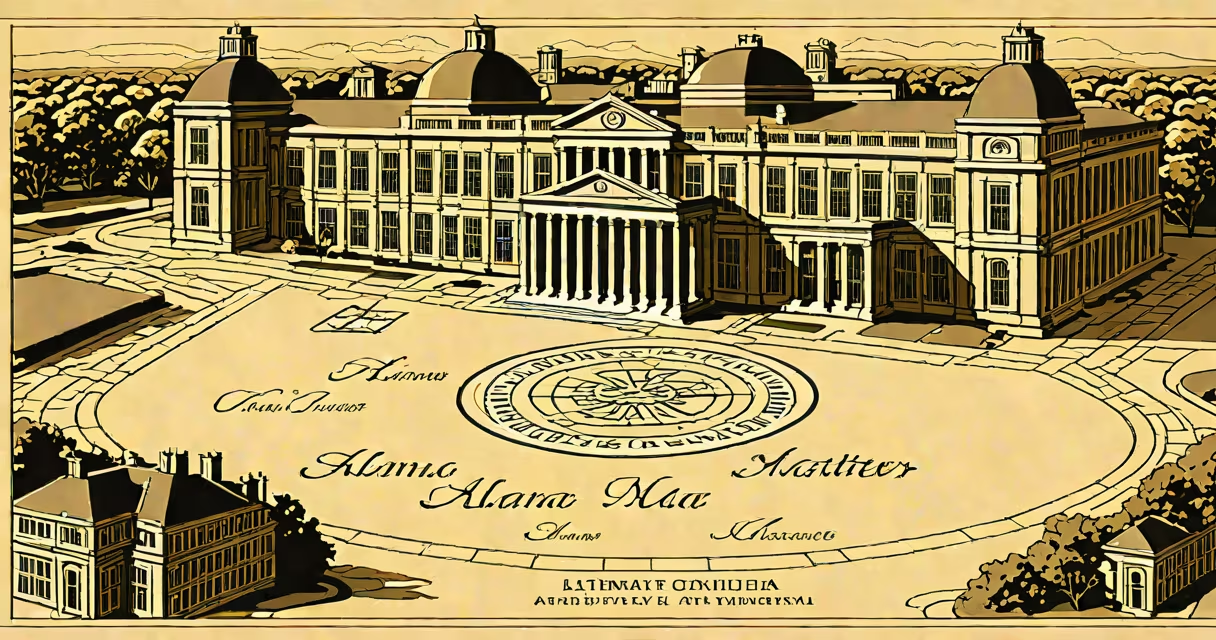
Vis alma mater is a Latin expression meaning "the spirit of your alma mater," referring to the enduring ethos, values, and collective identity of a university or college. It embodies the intangible force that unites students, faculty, and alumni through shared history, mission, and tradition.
The phrase combines two classical elements: *vis*, meaning "force," "power," or "spirit," and *alma mater*, meaning "nourishing mother" - a poetic term for one's educational institution. Together, they signify the living energy of a school's culture, passed down through generations.
While not a formal title or official designation, vis alma mater functions as a symbolic anchor in academic life. It appears in graduation speeches, student publications, and institutional mottos. It is invoked during ceremonies, especially at commencement, to remind graduates of their lasting connection to the institution.
Vis alma mater operates as a cultural structure rather than a physical entity. It is sustained through rituals, language, and collective memory. When a student sings their school's fight song or wears a cap and gown with a specific emblem, they are participating in vis alma mater - not just observing tradition, but embodying it.
At institutions like Harvard, Yale, and the University of California, Berkeley, vis alma mater is reinforced through annual events such as homecoming, alumni reunions, and heritage weeks. These gatherings activate shared narratives - stories of innovation, resilience, or social impact - that define the school's character.
For example, at MIT, the phrase "vis alma mater" is often referenced in student-led initiatives promoting ethical engineering. The idea is not just to graduate with a degree, but to carry forward the institution's commitment to solving global challenges through science and design.
Vis alma mater is not a single thing. It is composed of interlocking parts: institutional history, core values, symbols, and community behavior. These components interact to form a cohesive identity that persists beyond individual tenure.
Key components include:
These elements are rarely written down in a formal document. Instead, they emerge through repeated interaction - a student hearing a professor reference a past Nobel laureate, or seeing a mural of a pioneering scientist in a hallway.
While the concept remains consistent, its expression varies widely based on geography, academic focus, and historical context. A liberal arts college may emphasize intellectual curiosity and debate, while a technical university may show innovation and practical problem-solving.
| Institution Type | Common Expression of vis alma mater | Example |
|---|---|---|
| Private Ivy League | Legacy, excellence, leadership | Yale's "Proud Yale" chant; Harvard's "Old Ironsides" anthem |
| Public Research University | Service, discovery, public impact | UC Berkeley's "Fight for California" fight song; UMich's "The Victors" |
| Historically Black College | Cultural affirmation, resistance, uplift | Spelman College's "Spelman Spirit" tradition; Howard University's "Hail Howard" salute |
| Technical Institute | Engineering rigor, applied ethics | Caltech's "The Caltech Song" references "the mind's fire"; MIT's "Alma Mater" emphasizes "truth and reason" |
Each variant reflects the institution's unique mission. For instance, at Georgia Tech, vis alma mater includes a deep commitment to sustainability, evident in student projects like the Solar Decathlon team and campus-wide recycling programs.
Vis alma mater is most visible during rites of passage: orientation, graduation, and alumni reunions. At these moments, the phrase acts as a bridge between past and future members of the academic community.
During a 2022 commencement at the University of Michigan, the president invoked vis alma mater when addressing graduates: "You are not leaving a place - you are carrying forward a spirit. That spirit is your alma mater." This moment was recorded and shared widely on social media, underscoring how the phrase functions as both emotional and rhetorical tool.
It also shapes internal culture. At Brown University, the honor code - "Students are expected to uphold the highest standards of honesty and integrity" - is not just a rule. It is part of vis alma mater, reinforcing a norm of personal responsibility that students internalize over time.
Vis alma mater is often confused with the official school motto or the name of the alma mater song. While related, these are distinct. The motto is a formal statement of intent (e.g., "Veritas" at Yale). The alma mater song is a musical piece. Vis alma mater is the underlying cultural force that makes both meaningful.
A common error is treating vis alma mater as a static ideal. In reality, it evolves. After the 2020 protests over racial injustice, many universities revised their traditions to reflect inclusive values. At the University of North Carolina, the marching band updated its halftime show to include a tribute to civil rights leaders, aligning vis alma mater with contemporary social goals.
Another misconception is that vis alma mater applies only to elite institutions. It exists at community colleges, trade schools, and online universities too. At Portland Community College, vis alma mater is expressed through student-led mentorship circles and local partnerships with small businesses - reflecting a commitment to accessibility and workforce development.
Vis alma mater is not always positive. Some institutions have a vis alma mater rooted in exclusion or controversy. For example, certain early American universities had traditions tied to eugenics or segregation. Over time, many have confronted these legacies and redefined their spirit accordingly.
Harvard's 2020 report on its ties to slavery acknowledged that the university's early endowment included profits from slave labor. In response, the school launched the "Harvard and Slavery" project, which now informs course curricula and campus discussions. This process illustrates that vis alma mater can be reclaimed - not erased, but transformed.
Consider the University of Washington's 2023 winter commencement. The ceremony began with a traditional drumbeat, followed by the reading of names from the Class of 2023. As each graduate walked across the stage, a short video played showing them in their major, interacting with professors, or volunteering in Seattle neighborhoods.
After the last name was called, the chancellor spoke: "You leave not just with a degree, but with vis alma mater - the quiet confidence that comes from knowing you were shaped by a place that believed in you, even when you doubted yourself."
Later that evening, a group of recent graduates gathered at a café near campus. One said, "I didn't realize how much I'd miss the way the library smelled during finals week." Another replied, "That's vis alma mater - not the building, but the feeling."
This exchange captures the phenomenon: vis alma mater is not a slogan. It is a lived sense of belonging, activated by memory, emotion, and shared experience.
I once taught a seminar at a small liberal arts college in Vermont. During the final class, students brought in objects that represented their connection to the school - a worn copy of Thoreau, a hand-drawn map of the hiking trail behind campus, a photo of a late-night study session in the library. One student handed me a folded piece of paper with the words "vis alma mater" written in pencil.
"This is what we're carrying," she said. "Not just grades. Not just jobs. But the feeling that we belong to something bigger."
That moment stayed with me. It wasn't about performance. It was about continuity - the quiet power of tradition, passed hand to hand, generation to generation.
Vis alma mater is not a ritual, nor a symbol, nor a song. It is the invisible thread that binds individuals to a larger story. It is the reason someone returns to campus decades after graduation, not for a reunion, but because the air still feels familiar.
Understanding vis alma mater means recognizing that education extends beyond curriculum. It lives in the way students speak about their school, in the pride they wear, in the choices they make long after they've left the classroom.