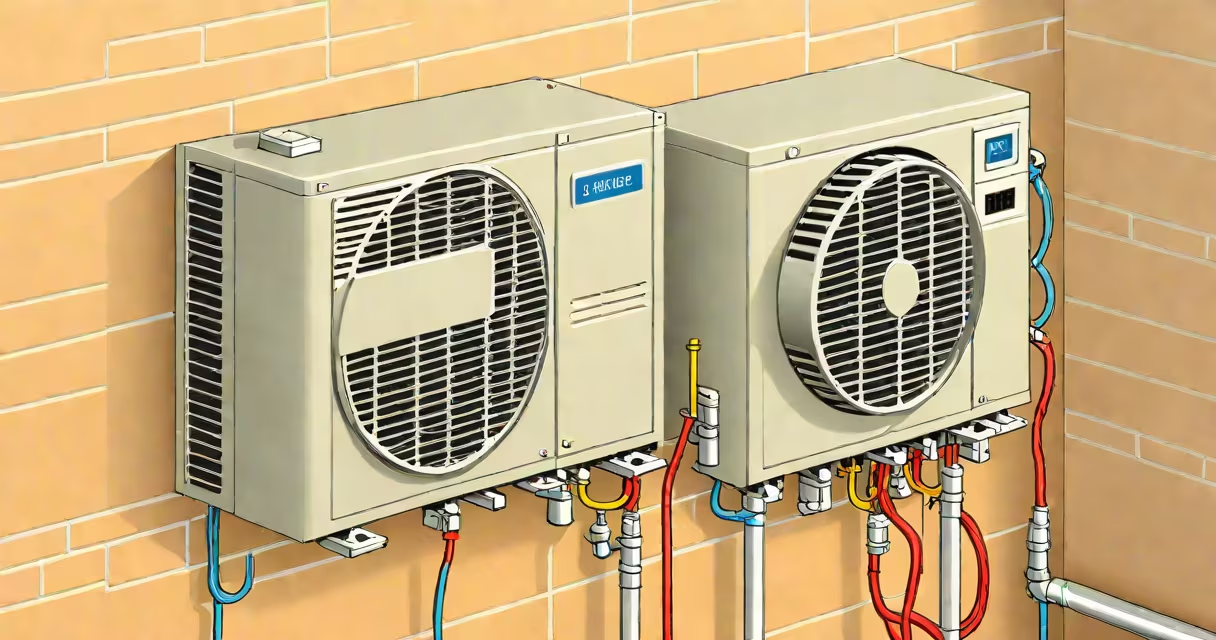
An air conditioner that won't turn on often stems from a power issue, faulty thermostat, or blocked airflow. Start by checking the circuit breaker, verifying thermostat settings, and ensuring the outdoor unit has power. If these fail, inspect the condenser fan motor, capacitor, or refrigerant levels.
Most units stop responding due to interrupted power flow. A tripped breaker or blown fuse cuts electricity to the system. The indoor and outdoor units share a single circuit in many homes. If the outdoor compressor doesn't run, check the disconnect switch near the condenser. It's a wall-mounted box with a toggle switch-often overlooked during troubleshooting.
Thermostat errors account for nearly 30% of non-starting cases, according to the Air Conditioning Contractors of America (ACCA). A dead battery, incorrect mode setting, or misaligned sensor can prevent the unit from signaling the furnace or compressor to activate. Replace batteries, confirm the thermostat is set to "Cool" and "Auto," and ensure the temperature is set below room conditions.
Power loss is the most frequent reason an air conditioner fails to start. Verify the circuit breaker hasn't tripped. Reset it by switching off completely, waiting 30 seconds, then flipping it back on. If the breaker trips again immediately, there's a short in the wiring or a failing component.
The condenser fan motor drives heat dissipation in the outdoor unit. If the fan doesn't spin, the compressor may overheat and shut down. Listen for a humming sound when the system should start. No sound means either no power or a failed motor. Test the fan manually-if it resists movement, the motor is seized. Replace the capacitor if the fan spins slowly or stalls.
Refrigerant leaks cause low pressure, which triggers safety shutoffs. A professional must measure refrigerant levels using a manifold gauge set. Attempting to recharge refrigerant without identifying the leak causes further damage. The EPA prohibits unlicensed individuals from handling refrigerants due to environmental risks.
| Issue | Check Point | Expected Result |
|---|---|---|
| Power supply | Circuit breaker, disconnect switch | Switches ON, no tripping |
| Thermostat | Battery, mode, temperature setting | Set to Cool, Auto, below ambient |
| Outdoor fan | Manual spin, humming noise | Fan turns freely, no grinding |
| Capacitor | Visual bulge, measured capacitance | No bulging, matches rated value |
If the unit still won't start after confirming power, thermostat, and fan function, internal components likely failed. A burned-out compressor windings or damaged control board requires replacement. These repairs cost $600-$1,200 depending on model and labor rates, according to RepairPal.
Refrigerant leaks demand certified technicians. The Environmental Protection Agency (EPA) mandates certification under Section 608 of the Clean Air Act. Technicians must recover refrigerant before repair and properly dispose of it. Attempting DIY recovery risks environmental harm and legal penalties.
I once encountered a 15-year-old central AC unit that wouldn't start despite a working thermostat and intact wiring. After replacing the capacitor, the outdoor fan spun-but the compressor never engaged. A multimeter confirmed no voltage at the compressor terminal. A technician diagnosed a failed contactor relay. Replacing it restored cooling. This case highlights that visual checks aren't enough-electrical continuity matters.
Many assume a non-functioning AC is due to refrigerant loss. But low refrigerant rarely causes a complete failure to start-it usually triggers error codes or intermittent cycling. A unit that won't turn on at all points to power, control, or mechanical issues.
Another misconception: resetting the thermostat always fixes the problem. While it resolves 40% of cases, it fails when the thermostat's communication wire is broken or the indoor control board is dead. Always test the thermostat's output voltage with a multimeter before assuming it's functional.
Some homeowners bypass the disconnect switch to force startup. This is unsafe. The switch isolates power during maintenance. Bypassing it exposes users to live electrical parts. Always restore the switch to "On" after inspection.
Annual servicing reduces breakdowns by 50%, per the National Comfort Institute (NCI). Schedule inspections before summer peak usage. Technicians clean coils, check refrigerant charge, verify electrical connections, and test safety controls.
Replace air filters monthly during high-use months. A clogged filter restricts airflow, causing the evaporator coil to freeze. Ice buildup triggers a high-pressure switch, halting the system. A frozen coil can cause permanent damage if left unchecked.
For units older than 10 years, consider upgrading. Modern models use inverter-driven compressors and smart sensors to reduce energy use by up to 30%. The U.S. Department of Energy reports that replacing a 10-year-old AC with a new ENERGY STAR-rated unit saves $200/year on average.
When troubleshooting, begin with the simplest fix: power and thermostat. If unresolved, proceed through mechanical and electrical diagnostics. Never attempt refrigerant handling without certification. For complex failures, consult a licensed HVAC technician. More on AC systems and 12,000 BTU unit specs can help assess compatibility and performance needs.