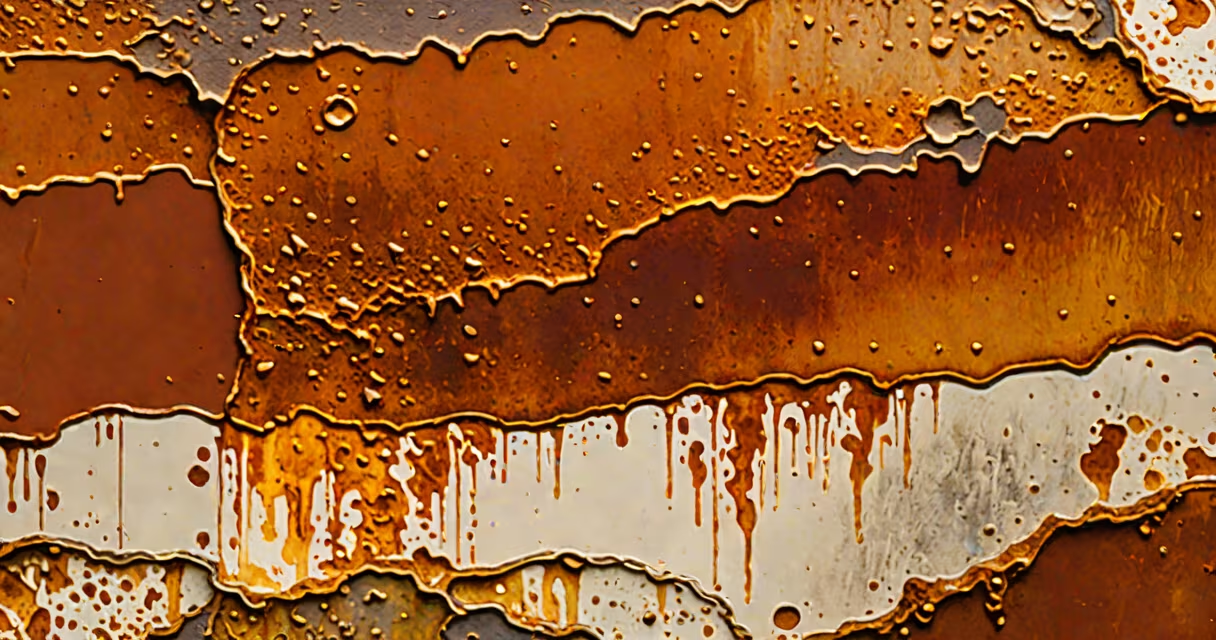
This is rust: a red-orange flaky substance formed when iron or iron-based alloys react with oxygen and moisture through an electrochemical process. The result is hydrated iron(III) oxide, which weakens structural integrity and compromises metal performance.
Rust begins when iron atoms lose electrons to oxygen in the presence of water. This electron transfer creates iron ions that combine with oxygen and water molecules to form iron(III) oxide hydroxide, commonly known as rust. The process accelerates in humid environments and in salty conditions due to increased conductivity.
Unlike protective oxidation layers on aluminum or stainless steel, rust does not form a stable barrier. Instead, it flakes off, exposing fresh metal to further attack. This continuous degradation reduces thickness and strength, leading to failure in critical infrastructure like bridges, pipelines, and vehicles.
Rust forms through a series of electrochemical reactions. When iron contacts water, dissolved oxygen and hydrogen ions create an electrolyte. At anodic sites, iron loses electrons: Fe → Fe²⁺ + 2e⁻. At cathodic sites, oxygen gains electrons: O₂ + 2H₂O + 4e⁻ → 4OH⁻. The resulting Fe²⁺ and OH⁻ ions combine to form Fe(OH)₂, which oxidizes further to Fe(OH)₃ and dehydrates into Fe₂O₃·nH₂O-the compound we recognize as rust.
Temperature and pH influence the rate. Higher temperatures speed up ion mobility and reaction kinetics. Acidic conditions (pH below 6) increase proton availability, accelerating the cathodic reaction. Conversely, alkaline environments slow rust formation but do not stop it entirely.
A practical example: a car left outdoors in winter develops rust on its fenders within months. Salt from road de-icing agents lowers the freezing point of water, allowing liquid electrolyte to persist even at subzero temperatures. This enables ongoing electrochemical activity, leading to visible pitting and flaking.
Rust is not a single material. Different iron oxides form under varying conditions:
| Type | Chemical Formula | Appearance | Formation Conditions |
|---|---|---|---|
| Red rust | Fe₂O₃·nH₂O | Flaky, reddish-brown | Moist air, long exposure |
| Black rust | Fe₃O₄ | Dark gray, lustrous | High heat, low oxygen |
| Green rust | Fe(OH)₂·Fe(OH)₃ | Greenish-gray | Chloride-rich environments, e.g., seawater |
Many assume rust only affects old or neglected metal. In reality, new steel exposed to damp air begins oxidizing within hours. A freshly cut steel plate left in a garage with high humidity shows surface discoloration in 48 hours.
Another misconception: rust is only a surface issue. It penetrates deeply. A 1 mm layer of rust can reduce the cross-sectional area of a steel rod by 15% over five years, weakening load-bearing capacity.
Rust causes billions in annual damage. The U.S. Department of Transportation estimates $20 billion annually in repair and replacement costs for rust-damaged bridges and rail systems. Corrosion accounts for 3% of global GDP annually, according to NACE International's 2023 report.
Industrial equipment fails faster when rust forms inside pipes. In oil refineries, internal rust can clog valves and reduce flow efficiency. A 2021 study by the National Institute of Standards and Technology (NIST) found that 40% of unplanned shutdowns in petrochemical plants were linked to corrosion-related failures.
I once observed a steel support beam in a warehouse develop severe pitting after just two years of exposure to condensation. The rust had eaten through 30% of the wall thickness. Visual inspection missed the internal degradation until a ultrasonic thickness test revealed the extent of loss.
Rust is often mistaken for other forms of metal degradation. Corrosion includes all chemical breakdowns of metals, but rust specifically refers to iron oxide. Aluminum doesn't rust-it forms a passive oxide layer that resists further attack. Zinc protects steel via galvanization, sacrificing itself to prevent iron oxidation.
Some believe painting stops rust permanently. Paint acts as a physical barrier but fails if scratched or cracked. Moisture trapped beneath paint film can initiate undercutting corrosion. A 2019 study by the American Society for Testing and Materials (ASTM) showed that 60% of painted steel structures failed within 10 years due to coating defects.
Another error: assuming dry environments prevent rust. Iron can still oxidize slowly in dry air, though the rate is negligible. However, even trace moisture-such as 30% relative humidity-can trigger measurable rust formation over time.
Controlling moisture and oxygen limits rust. Coatings like epoxy, zinc-rich primers, and powder coatings provide barriers. Galvanization-coating steel with zinc-offers sacrificial protection. When damaged, zinc corrodes first, protecting the underlying iron.
Environmental controls help. Dehumidifiers in storage facilities reduce RH below 50%, slowing reaction rates. Cathodic protection uses external current to reverse the electrochemical process, commonly used in buried pipelines and ship hulls.
For existing rust, mechanical removal (sandblasting) or chemical treatment (phosphoric acid conversion) prepares surfaces for repainting. These methods restore appearance but don't eliminate the risk if maintenance lapses.
Understanding this is rust clarifies why metal preservation matters. It's not just about appearance-it's about safety, cost, and longevity. Preventing rust saves lives and resources.