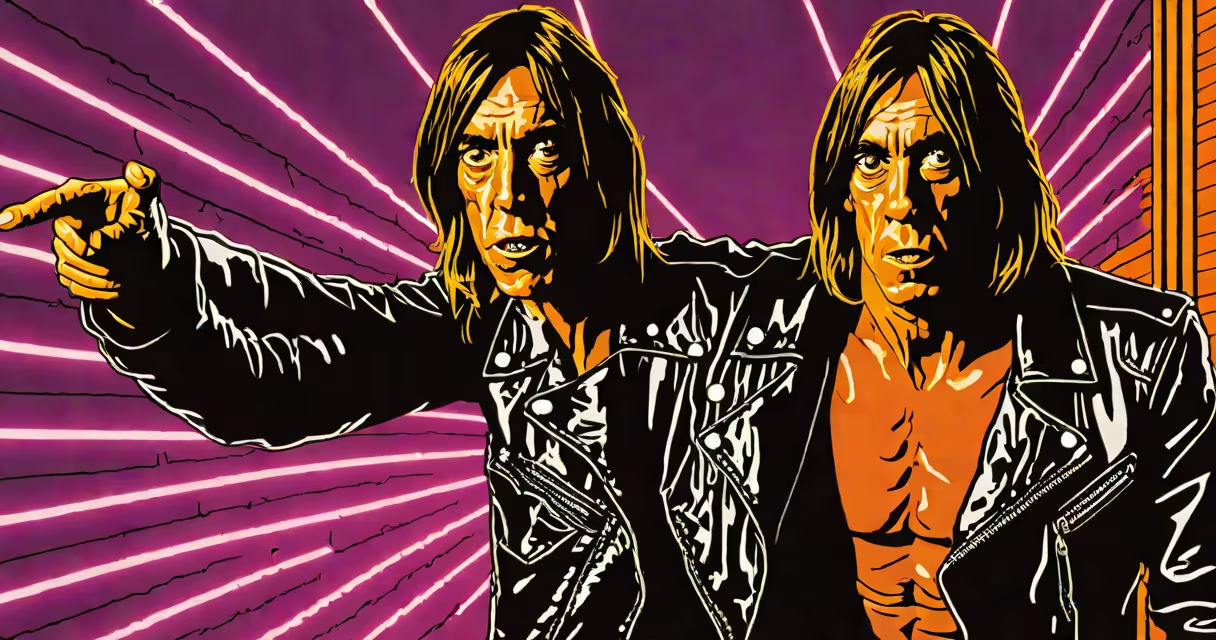
The Passenger Iggy Pop is the 1977 solo album by musician Iggy Pop, released after his departure from The Stooges. It blends abrasive punk instrumentation with introspective lyrics, marking a key moment in early alternative rock.
Released in October 1977 under RCA Records, The Passenger features production by David Bowie, who co-wrote several tracks. The album's title track, "The Passenger," became a defining song of the era, combining a minimalist drumbeat with haunting vocal delivery. It was recorded during sessions in London and Berlin, reflecting the fragmented urban mood of late 1970s Europe.
Iggy Pop's stage persona-wild, confrontational, and physically intense-shaped the album's aesthetic. Yet The Passenger diverges from his earlier work by emphasizing mood over aggression. Songs like "Lust for Life" and "Nightclubbing" explore alienation, desire, and emotional detachment through sparse arrangements and layered vocals.
The Passenger uses minimalism as a structural device. Most tracks avoid complex chord progressions, relying instead on repetitive basslines and stark percussion. "Funtime" opens with a single snare hit and a descending synth line, creating tension through restraint rather than volume.
Production techniques emphasize space. Bowie's influence is evident in the use of echo on vocals and off-kilter guitar effects. On "The Passenger," the backing track fades in at 0:17, leaving only a distant piano note before the drums enter. This deliberate pacing forces attention on lyrical content.
Lyrically, the album operates in first-person narrative mode. Iggy sings from the perspective of someone detached from society-"I'm a stranger in my own skin," he says in "Lust for Life." This introspection contrasts with the aggressive delivery of his earlier Stooges work, signaling a shift toward personal vulnerability.
The album's instrumentation centers on electric guitar, bass, drums, and synthesizers. Key contributors include Carlos Alomar (guitar), Tony Thompson (drums), and Brian Eno (tape manipulation on select tracks).
Track selection reveals thematic cohesion. Side A focuses on movement and isolation ("The Passenger," "Funtime"), while Side B explores internal conflict ("Lust for Life," "Nightclubbing"). The sequencing mirrors a psychological process-from observation to surrender.
| Track | Length | Key Theme | Notable Feature |
|---|---|---|---|
| The Passenger | 4:12 | Detachment, urban solitude | Minimalist drum loop, whispered vocals |
| Lust for Life | 3:48 | Self-destruction, hedonism | Bowie co-write; driving bassline |
| Funtime | 3:37 | Emotional numbness | Single snare hit intro; industrial rhythm |
| Nightclubbing | 4:05 | Existential fatigue | Repetition of "I don't care" refrains |
The Passenger is frequently sampled in electronic and hip-hop music. The drum pattern from "Funtime" appears in tracks by The Chemical Brothers and Autechre. Its influence extends beyond genre boundaries.
Cinematic use is notable. The title track was featured in the 2006 film *The Illusionist*, where it underscores a scene of emotional isolation. In 2019, a remix of "Lust for Life" scored a fashion campaign by Balenciaga, linking the song's themes to modern consumer culture.
Music educators cite The Passenger as a case study in emotional economy. According to the Berklee College of Music's 2020 analysis of 1970s rock, the album exemplifies "how less can be more in sonic storytelling."
Many mistake The Passenger for a live album. It is entirely studio-recorded. No audience noise or improvisation appears on any track. The confusion likely stems from Iggy Pop's reputation for chaotic performances.
Another error: attributing the entire album to Bowie. While Bowie co-wrote four tracks and produced the record, Iggy Pop wrote the lyrics and performed all vocals. The album credits list Bowie as co-producer, not sole author.
A lesser-known fact: "The Passenger" was originally titled "The Man Who Walks Alone." The name change occurred during final mixing, as producer Steve Lillywhite felt the original title lacked urgency. The new title better matched the song's theme of anonymous movement through cities.
In 1994, the band Interpol covered "The Passenger" during a BBC Radio 1 session. Their version stripped the track to a single guitar line and slow tempo, emphasizing the lyric's existential weight. The performance was later included in the *BBC Sessions* compilation.
Interpol's cover demonstrates how The Passenger remains relevant. The band's frontman, Paul Banks, cited the song as inspiration for their debut album *Turn On the Bright Lights*. He noted that "The Passenger" taught him that "silence between notes can carry more meaning than the notes themselves."
When I first heard the original in 2003, I played it on a cracked CD player in a Brooklyn apartment. The distortion on the kick drum made the song feel like it was bleeding through walls. That moment-when sound and emotion collapse into one-defined what I wanted music to do.
The Passenger Iggy Pop stands as a landmark in post-punk and alternative rock. Its fusion of emotional restraint and sonic experimentation continues to influence artists across genres. For those exploring the roots of modern indie and electronic music, this album offers a clear starting point. Understanding the structure, themes, and production choices behind The Passenger Iggy Pop reveals why it remains essential listening.