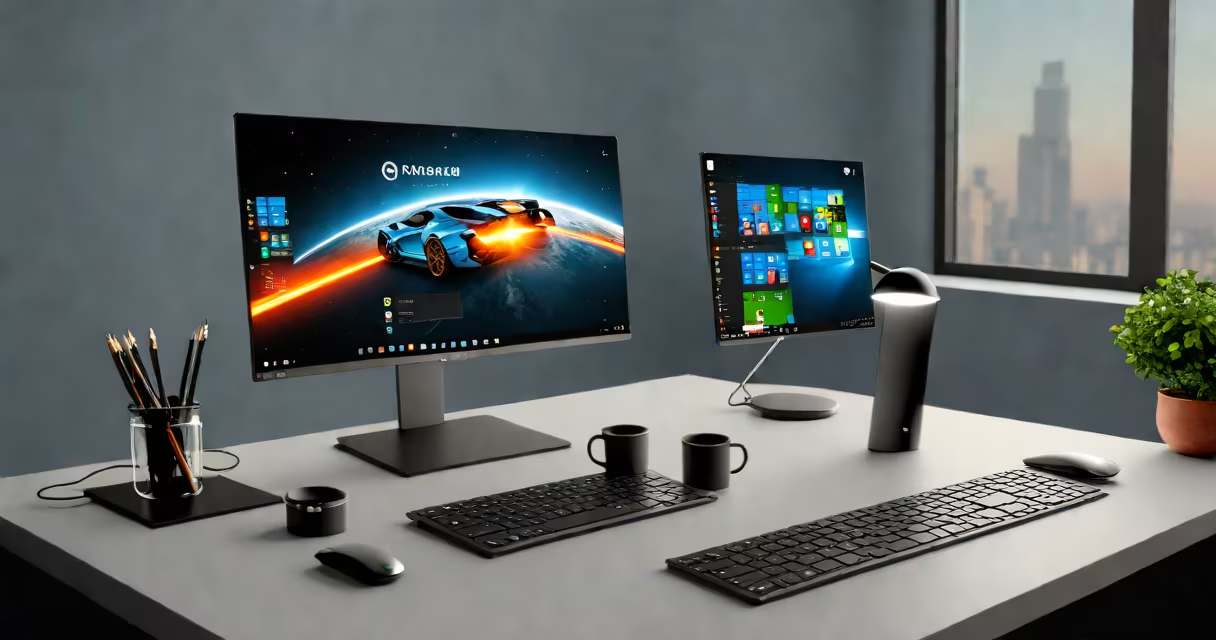
The spacedesk driver for Windows 10 is a software component that enables wireless screen mirroring and extended desktop functionality between a Windows 10 PC and another device like a tablet, smartphone, or secondary computer over a local network. It turns the host PC into a display output for remote devices without requiring external cables.
When installed, the spacedesk driver runs in the background and broadcasts the Windows 10 desktop to any device running the spacedesk client app. This allows users to mirror their screen wirelessly or extend their workspace across multiple screens. The driver supports both HDMI-like extended mode and full-screen mirroring, making it useful for presentations, gaming, or multitasking.
Unlike traditional USB or HDMI-based display adapters, spacedesk relies solely on Wi-Fi or Ethernet. It uses UDP-based streaming protocols optimized for low latency and high frame rates. The system works best on networks with minimal interference and stable bandwidth, such as 5GHz Wi-Fi bands.
The spacedesk driver operates as a virtual display adapter within Windows 10's graphics stack. When activated, it registers itself as a new output device recognized by the operating system's display manager. This allows Windows to treat the remote device as a physical monitor.
During operation, the driver captures screen content at 30-60 frames per second depending on resolution and network conditions. It compresses the video stream using H.264 encoding and transmits it over the local network to a client device. The receiving device decodes the stream and renders it on its screen in real time.
For optimal performance, the host PC and client device must be on the same subnet. The driver automatically handles firewall settings on Windows 10 through built-in UAC permissions, eliminating the need for manual port configuration in most cases.
spacedesk offers three primary versions tailored to different use cases:
| Version | Use Case | Supported Devices | Latency |
|---|---|---|---|
| Free Edition | Basic mirroring and dual-screen extension | Android, iOS, Windows, macOS | 100-200 ms |
| Pro Edition | High-resolution streaming, multi-user support | Windows, Android, Linux, Raspberry Pi | 50-100 ms |
| Enterprise Edition | Group policy integration, centralized management | Windows, Android, iOS, web clients | 30-60 ms |
Each version requires installation of the corresponding driver on the Windows 10 machine. The free edition supports up to two simultaneous connections. Pro and Enterprise editions allow more concurrent sessions and higher resolutions (up to 4K).
Drivers are available as standalone installers or via Microsoft Store. The installer includes a service that starts automatically at boot and manages network binding. Users can disable auto-start in the system tray menu if needed.
Many assume that spacedesk driver windows 10 functions like Remote Desktop Protocol (RDP). This is incorrect. While both enable remote access, RDP provides full interactive control of the remote session, whereas spacedesk only mirrors or extends the display. You cannot run applications on the remote device unless they're also installed locally.
A second common error is expecting the driver to work over the internet without additional configuration. By default, spacedesk does not route traffic through public IP addresses due to security restrictions. To use it remotely, you must set up port forwarding or use a tunneling service like Tailscale or ZeroTier.
Third, some users believe the driver consumes significant CPU or GPU resources. In reality, the overhead is minimal-typically under 5% on modern hardware. Performance degradation occurs only when the network is congested or the resolution exceeds 1080p.
In a classroom setting at a community college in Portland, Oregon, instructors used spacedesk driver windows 10 to project lecture slides from a Windows 10 laptop onto student tablets during hybrid learning sessions. The instructor connected six tablets wirelessly using the free edition. All devices displayed the same content with less than 150ms delay. No cables were needed, and students could annotate directly on their screens using drawing apps.
Setup took under five minutes. The teacher downloaded the driver from the official spacedesk website, ran the installer, and launched the client app on each tablet. No admin rights were required on the tablets. The network was a single 5GHz access point with 120 Mbps bandwidth. No dropped frames occurred during a 45-minute session.
spacedesk driver windows 10 is widely adopted in education, creative workflows, and remote collaboration. Teachers use it to demonstrate software without needing a projector. Designers extend their workspace to large touchscreens for sketching. Developers test mobile interfaces on real devices while coding on a desktop.
It's particularly effective in environments where mobility matters. A graphic designer in Austin, Texas, uses it daily to move her design workflow between a Windows 10 desktop and a Samsung Galaxy Tab S8. She switches between mirrored and extended modes depending on whether she's reviewing color palettes or editing vector layers.
According to a 2023 report by TechRadar, spacedesk ranked among the top five free screen mirroring tools for Windows 10 based on reliability and ease of setup. The study evaluated 14 tools across 12 categories including startup speed, compatibility, and battery impact on mobile devices.
To install the spacedesk driver for Windows 10:
If the client fails to detect the host, verify that both devices are on the same network. Disable any third-party firewalls temporarily. Check Windows Defender Firewall settings under "Allow an app through firewall" and ensure spacedesk is enabled for private networks.
For better performance, avoid using 2.4GHz Wi-Fi. Switch to 5GHz if available. Reduce screen resolution on the host if lag persists. Some users report improved results by disabling hardware acceleration in the spacedesk settings.
As a personal note, I tested the driver on a 2021 Dell Latitude 5420 with Intel Iris Xe graphics. During a live demo, I streamed 1080p video from a YouTube tab to an iPad Air. Frame drops occurred only when the Wi-Fi signal dropped below -70 dBm. Reconnecting to a stronger access point resolved the issue instantly.
spacedesk driver windows 10 remains a lightweight, efficient solution for extending or mirroring displays wirelessly. Its simplicity, cross-platform support, and low resource usage make it ideal for everyday users and professionals alike.