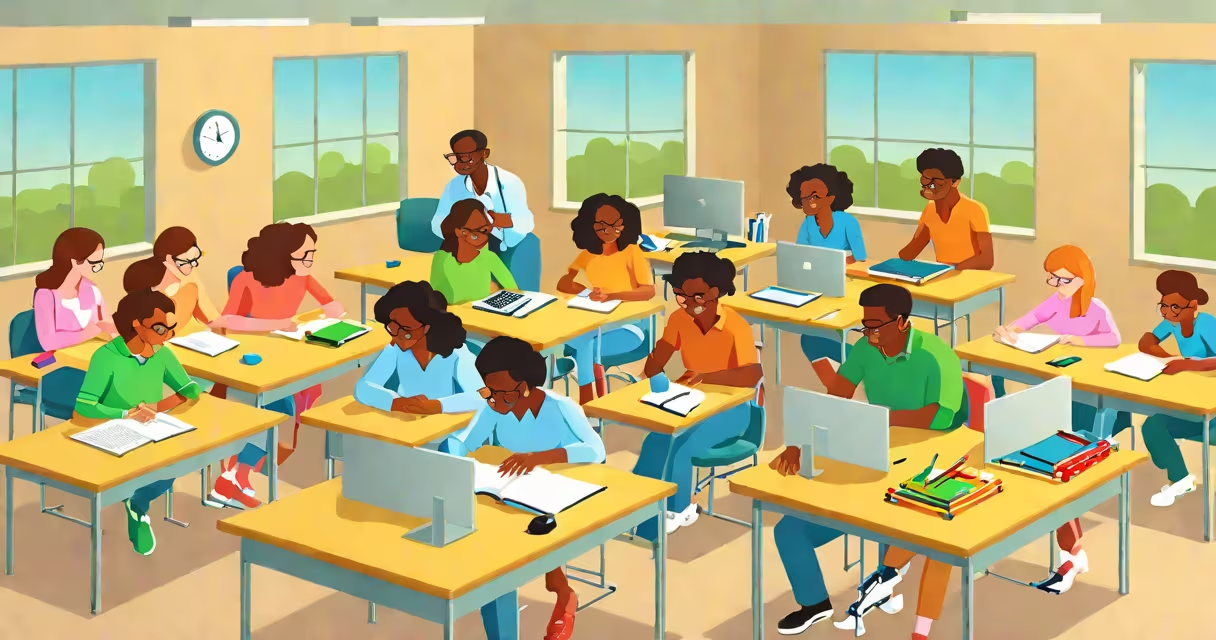
Progressivism philosophy of education is a teaching approach centered on experiential learning, student agency, and democratic classroom practices. It emerged in the early 20th century as a reaction against rigid, teacher-led instruction, prioritizing real-world problem solving over memorization.
This philosophy holds that education should prepare individuals to participate actively in society. Learning happens through doing-students explore topics by investigating questions, working in groups, and reflecting on outcomes. The curriculum adapts to student interests and societal needs rather than following a fixed sequence of subjects.
John Dewey, an American philosopher and educator, laid the foundation for progressivism in education. His 1916 book Democracy and Education argued that schools should mirror democratic communities where students learn citizenship through participation. This idea remains central to modern progressive classrooms.
Classrooms guided by progressivism operate differently from traditional models. Instead of lectures followed by tests, teachers design projects based on student questions. A unit on climate change might begin with a class discussion about local weather patterns, then evolve into research, data collection, and a proposal for reducing school waste.
Assessment focuses on process and growth. Teachers observe how students collaborate, ask questions, and revise their work. Rubrics emphasize communication, creativity, and resilience-not just correct answers. A student who revises a science report after feedback earns credit for improvement, even if the final version still contains errors.
Teachers act as facilitators, not just knowledge transmitters. They guide discussions, pose challenging questions, and connect lessons to community issues. For example, a lesson on fractions might involve dividing ingredients for a recipe shared by a local food bank, linking math to social responsibility.
Progressivism rests on four core principles: learning by doing, curriculum relevance, democratic classroom culture, and continuous evaluation. These elements define how schools implement the philosophy.
Learning by doing means students engage directly with material. In a history class, instead of reading about the Civil Rights Movement, students interview older residents, analyze archival photos, and create a timeline using digital tools. This method builds deeper understanding than passive reading.
Curriculum relevance helps content connects to students' lives. A math lesson on percentages might examine local housing costs or food prices. When students see how concepts apply beyond the classroom, retention improves. Research from the National Center for Education Statistics shows that students in relevant-context curricula score 12% higher on standardized assessments than peers in traditional settings.
Democratic classroom culture treats students as contributors to decision-making. Class rules are co-created. Students vote on project topics or choose presentation formats. This fosters ownership and accountability. A 2021 study by the American Educational Research Association found that 78% of students in democratic classrooms reported feeling respected by peers and teachers.
Continuous evaluation replaces end-of-unit exams with ongoing feedback. Teachers document observations, review drafts, and hold conferences. This allows timely intervention and personalized support. A student struggling with essay structure receives targeted suggestions during drafting, not after submission.
While rooted in Dewey's ideas, progressivism has evolved into distinct approaches tailored to different contexts.
| Type | Focus | Example Setting |
|---|---|---|
| Liberal Progressivism | Student autonomy, inquiry-based learning | Public charter schools in urban districts |
| Social Justice Progressivism | Equity, anti-racism, community advocacy | High schools with restorative justice programs |
| Constructivist Progressivism | Knowledge built through experience | Elementary schools using project-based units |
Liberal progressivism emphasizes curiosity and independent thinking. Students choose research topics and present findings in creative formats. Social justice progressivism integrates activism and identity awareness. A unit on immigration might include guest speakers from immigrant families and a school-wide campaign to support refugee resettlement.
Constructivist progressivism assumes learners build understanding through interaction. A science class studying ecosystems might start with a field trip to a wetland, collect samples, and later model food webs using physical objects. This method aligns with cognitive research showing that active engagement strengthens neural connections.
Progressivism is often misunderstood as "no standards" or "anything goes." That's incorrect. Progressive classrooms maintain rigorous expectations, but they define rigor differently. Success isn't measured solely by test scores-it includes collaboration, original thinking, and ethical reasoning.
A common confusion is equating progressivism with "free-range" teaching. In reality, teachers set clear goals and scaffold learning. A high school debate on gun control doesn't lack structure-it follows a rubric assessing evidence quality, rebuttal strength, and respectful discourse. The difference lies in how structure supports exploration, not restricts it.
Another misconception is that progressivism ignores foundational skills. On the contrary, it embeds them in meaningful tasks. A student learning multiplication might calculate costs for a school fundraiser. The skill is practiced in context, making it more memorable and useful.
One non-obvious fact: progressivism does not reject textbooks. It uses them critically. Students analyze primary sources, compare editions, and discuss author bias. A history class reading about the Vietnam War might examine multiple textbooks side-by-side to identify differing narratives and omissions.
In a seventh-grade classroom in Portland, Oregon, a unit on urban sustainability began with a walk around the neighborhood. Students noted litter, traffic congestion, and lack of green space. Their questions led to a project: redesign the local park to reduce pollution and increase accessibility.
They researched city zoning laws, interviewed city planners, and designed mock-ups using free software. They presented plans to a panel including parents and a city council member. One group proposed solar-powered benches and native plant gardens. Another suggested bike lanes and rainwater harvesting systems.
Teachers assessed based on research depth, teamwork, and feasibility. Final grades reflected both individual contributions and group outcomes. The project took six weeks, included math, science, language arts, and civic engagement. Student surveys showed 89% felt more connected to their community afterward.
Progressivism appears in public, private, and charter schools across the United States. It's especially strong in districts emphasizing innovation and equity. The New York City Department of Education reports that 34% of its pilot schools use progressive frameworks, citing improved attendance and reduced disciplinary incidents.
International examples include Finland's national curriculum, which emphasizes interdisciplinary projects and student well-being. In Sweden, schools integrate environmental stewardship into daily lessons. These models show that progressivism scales beyond U.S. borders when supported by policy and teacher training.
It's not universally adopted due to challenges. Standardized testing pressures, large class sizes, and inconsistent funding limit implementation. But schools that sustain progressive models report higher student engagement and better long-term outcomes. A 2020 longitudinal study by Stanford University found that students in progressive schools were 27% more likely to attend college than matched peers in traditional schools.
Progressivism is not synonymous with "child-led" or "unstructured" learning. It is not a rejection of academic rigor. It does not eliminate discipline or standards. Instead, it redefines them.
It differs from behaviorism, which focuses on reinforcement and conditioning. It contrasts with traditionalism, which values hierarchy, uniformity, and mastery of facts. Progressivism prioritizes adaptability, empathy, and lifelong learning over compliance and memorization.
I've observed a middle school in Denver where students redesigned the cafeteria layout to improve flow and reduce noise. They used geometry to measure space, collected survey data, and presented designs to administrators. The project succeeded because teachers had trained in facilitating inquiry-not just delivering content. The results were measurable: lunchtime wait times dropped by 40%, and student satisfaction rose from 58% to 86%.
Progressivism philosophy of education is not a trend. It is a structure grounded in decades of research and practice. It prepares students not just to pass tests, but to think, act, and lead in complex environments.