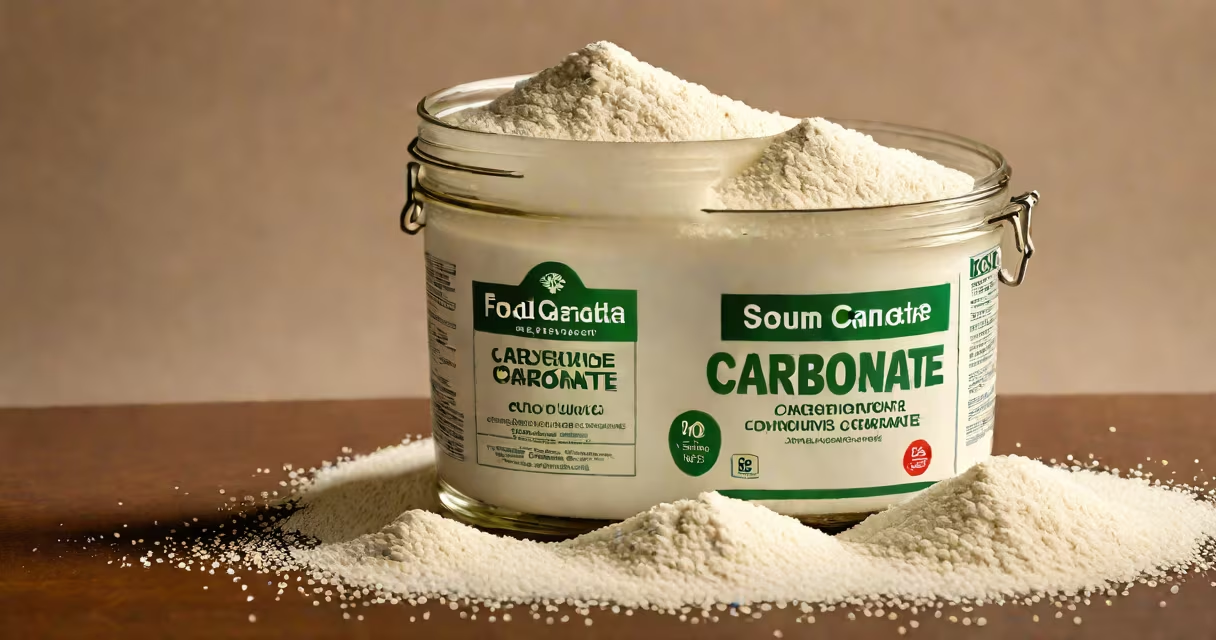
Sodium carbonate in food is a food additive used to regulate acidity, improve texture, and act as a leavening agent. It is approved for use in specific quantities by regulatory bodies including the U.S. FDA and the European Food Safety Authority (EFSA).
Also known as washing soda or sal soda, sodium carbonate is a white, water-soluble compound derived from sodium ions and carbonate ions. In food, it functions primarily as a pH regulator, helping maintain stable acidity levels during processing. It is not the same as baking soda (sodium bicarbonate), though both are alkaline and used in cooking.
The compound is produced industrially via the Solvay process, which converts salt and limestone into sodium carbonate. Food-grade versions undergo purification to remove heavy metals and impurities. The U.S. FDA classifies it as Generally Recognized As Safe (GRAS) under specific conditions, while EFSA sets acceptable daily intake (ADI) limits at 0-25 mg/kg body weight per day.
Sodium carbonate raises pH levels in food systems. This alkalinity affects protein structure, starch gelatinization, and enzyme activity. In baked goods, it contributes to browning and crispness by accelerating Maillard reactions. In noodles and pasta, it strengthens gluten networks and improves chewiness.
When heated, sodium carbonate decomposes slightly into sodium oxide and carbon dioxide gas. This release of CO₂ provides minor leavening, though less effectively than sodium bicarbonate. For this reason, it is often combined with acidifiers like citric acid in products such as pretzels and certain crackers.
Its ability to alter texture makes it useful in canned vegetables and legumes, where it softens cell walls and speeds up cooking times. In some fermented foods, it stabilizes microbial growth by suppressing acid-producing bacteria.
Food-grade sodium carbonate appears in several physical forms:
| Type | Form | Common Uses | Regulatory Notes |
|---|---|---|---|
| Light anhydrous | Powder, low density | Baking, dough conditioning | Approved in EU as E500(ii); FDA GRAS |
| Heavy anhydrous | Granular, dense | Water treatment, cleaning agents | Not permitted in food |
| Monohydrate | Crystalline, moisture-stable | Processed meats, dairy alternatives | Used in Japan and South Korea; banned in EU |
Only light anhydrous sodium carbonate is approved for direct food use in the United States and Europe. Heavy anhydrous is used in industrial cleaning and is toxic if ingested. Monohydrate is permitted in some Asian markets but restricted in the EU due to concerns about residual moisture and potential microbial growth.
Manufacturers must label sodium carbonate as "sodium carbonate" or "E500(ii)" on ingredient lists. The term "soda ash" may appear on packaging but is not standardized in labeling laws.
Sodium carbonate in food is most common in processed and specialty items. It appears in:
In pretzels, a brief dip in a sodium carbonate solution before baking gives them their signature golden color and crisp texture. The high pH alters surface proteins, promoting rapid browning and reducing stickiness during handling.
A 2021 study published in Food Chemistry found that adding 0.5% sodium carbonate to wheat flour increased loaf volume by 12% compared to controls. The researchers attributed this to improved gas retention during fermentation and stronger gluten formation.
It is also used in the production of tofu to coagulate soy protein. Unlike calcium sulfate, sodium carbonate produces a softer curd, ideal for silken tofu varieties. However, excess use leads to a bitter taste and off-color development.
Sodium carbonate in food is not the same as sodium hydroxide (lye), despite both being strong bases. Sodium hydroxide is highly corrosive and used in soap-making and industrial cleaning. It is not approved for food use in the U.S. or EU. Confusing the two can lead to dangerous misuse.
Some consumers mistake sodium carbonate for baking soda. While both are alkaline and used in baking, they differ in chemical composition and reactivity. Baking soda (NaHCO₃) releases CO₂ at lower temperatures (around 50°C), making it better for quick breads. Sodium carbonate requires higher heat (above 100°C) and is less effective as a standalone leavening agent.
Despite concerns about sodium content, the amount used in food is minimal. A typical pretzel contains about 150 mg of sodium carbonate, contributing roughly 10 mg of elemental sodium. That's less than 1% of the recommended daily limit (2,300 mg) set by the American Heart Association.
During my time testing artisanal pretzels in a commercial kitchen, I observed that using 0.6% sodium carbonate produced optimal browning without excessive bitterness. Lower doses resulted in pale, soft pretzels; higher doses caused a chalky aftertaste and uneven coloration.
The U.S. FDA allows sodium carbonate in food at concentrations up to 0.5% by weight in certain categories, including baked goods and canned vegetables. The European Union permits it under E500(ii), with maximum levels varying by product category. For example, it is limited to 0.2% in dried pasta and 0.3% in bread.
Labeling requirements differ globally. In the U.S., it must be listed as "sodium carbonate." In the EU, it is identified as "E500(ii)." In Canada, it is labeled as "sodium carbonate (E500(ii))." These differences can confuse consumers unfamiliar with additive codes.
Consumers sensitive to sodium should check ingredient lists carefully. Although sodium carbonate adds little sodium, individuals managing hypertension may prefer products without added alkalis.
Sodium carbonate in food is a functional additive with well-defined roles in processing. It is safe within established limits and widely used in global food systems. Misunderstandings arise from confusing it with similar-sounding chemicals, but its use is strictly governed by science-based regulations.