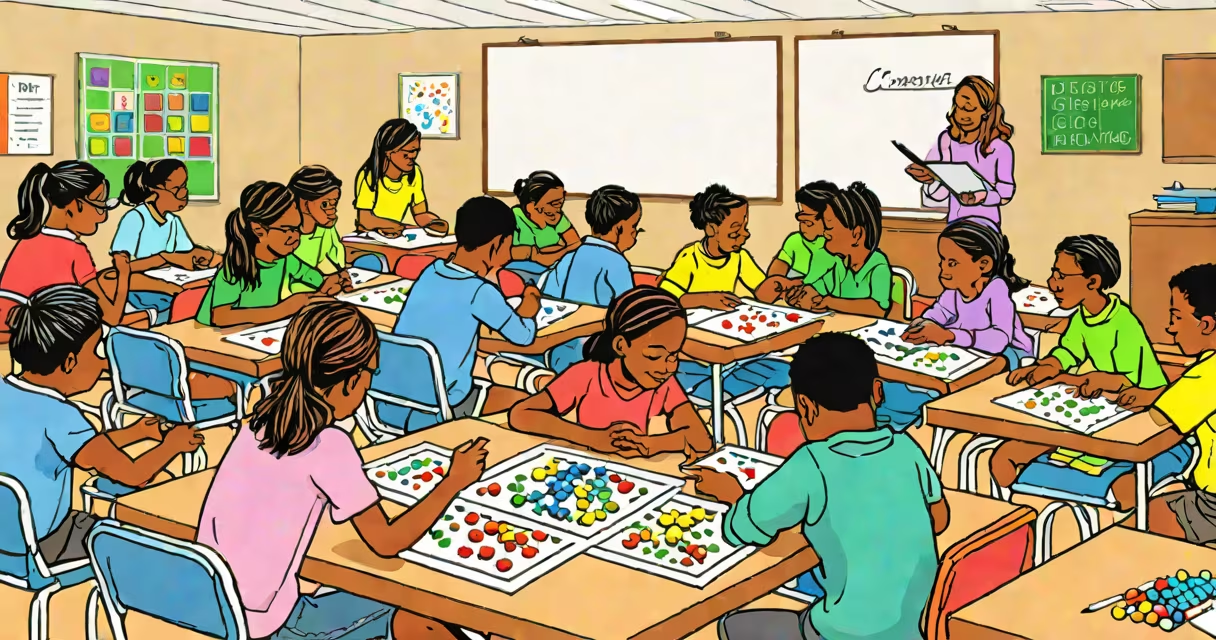
School resources games are interactive digital or physical activities designed to teach academic concepts while maintaining student interest through game mechanics like points, levels, and challenges. They're used in classrooms to reinforce lessons in math, science, reading, and social studies.
These tools blend curriculum content with gameplay elements such as timers, leaderboards, and rewards. A math game might require students to solve equations within 30 seconds to earn virtual badges. A history game could simulate a timeline puzzle where players arrange events in correct order. The goal is to make learning feel less like work and more like participation in a challenge.
Teachers integrate school resources games during whole-group instruction, small groups, or independent practice. They often align with state standards-such as Common Core or Next Generation Science Standards-and track progress through embedded analytics. Some platforms offer real-time dashboards showing which students struggle with fractions or verb tenses.
Each game maps a learning objective to a structured activity. For example, a game teaching multiplication might present a series of timed problems. After each correct answer, the player advances to the next level, unlocking new visuals or sound effects. Incorrect answers trigger immediate feedback-"Try again" or "Here's how to solve it"-to correct misconceptions.
Games are typically hosted online via web browsers or mobile apps. Students log in with class-specific credentials. Progress is saved automatically, allowing students to resume sessions later. Teachers assign specific games based on skill gaps identified through formative assessments.
Some games use adaptive algorithms. If a student consistently misses division problems involving remainders, the system adjusts difficulty and offers targeted hints. This personalization supports differentiated instruction without requiring extra prep time.
Not all school resources games serve the same purpose. They fall into distinct categories based on format, subject, and delivery method.
| Type | Format | Subject Focus | Example |
|---|---|---|---|
| Web-based quizzes | Browser-based, multi-player | Math, vocabulary | Kahoot! |
| Simulation games | Interactive scenarios | Science, social studies | MindSpark (science labs) |
| Physical board games | Print-and-play or commercial sets | Reading comprehension, arithmetic | Sum Swamp (addition/subtraction) |
| Augmented reality (AR) apps | Phone/tablet with camera | Geography, biology | Quiver (coloring + AR animation) |
Many schools use a mix. A fifth-grade class might start with a Kahoot! quiz on fractions, then move to a hands-on board game that uses fraction cards to build equivalent values. Later, students explore a biology simulation where they grow plants under different light conditions and record results.
Research shows that well-designed games improve retention. A 2021 study by the National Center for Education Statistics found that students who used gamified math tools scored 18% higher on standardized tests than peers using traditional worksheets. The effect was strongest among students with learning differences.
Games reduce cognitive load by breaking complex topics into smaller steps. Instead of memorizing the water cycle, a student might drag and drop stages in a flowchart game. Success builds confidence. Struggling learners benefit from low-stakes retry options-there's no penalty for failing a round.
One teacher in rural Oregon reported that her third graders, previously disengaged during reading lessons, began volunteering answers after introducing a vocabulary game called Word Wizards. Over six weeks, average reading fluency rose from 82 to 117 words per minute-a 43% increase.
People often confuse school resources games with entertainment apps. Not all games are educational. A popular mobile game like Candy Crush may have similar visuals but lacks curriculum alignment. True school resources games are vetted by educators and tied to learning outcomes.
Another misconception is that games replace direct instruction. They don't. Teachers still deliver core content through lectures, discussions, and modeling. Games supplement those moments. They're most effective when used after a lesson to reinforce understanding-not before.
A lesser-known fact: many school resources games are free or low-cost. Platforms like Scholastic Teacher Resources and Education.com offer thousands of printable and digital games aligned with grade-level standards. Some districts even license district-wide access through agreements with providers like Prodigy.
Consider a fourth-grade class learning about equivalent fractions. The teacher assigns a game called Fraction Match on the BrainPOP platform. Students play in pairs, using a shared tablet.
The game presents a visual model: a circle divided into six equal parts. One section is shaded. Students must select the correct equivalent fraction from four choices: 1/6, 2/12, 3/18, or 4/24. Correct answers earn points and enable animated explanations.
After 15 minutes, the teacher reviews the leaderboard. Two students repeatedly chose 3/18. She pulls them aside and uses a paper fraction wheel to demonstrate why 3/18 equals 1/6. Later, she assigns a follow-up worksheet focused on simplifying fractions.
This sequence-play, assess, intervene, reinforce-is how school resources games support mastery. They don't replace teaching. They reveal where teaching is needed.
Good school resources games prioritize learning design over fun design. A game that rewards speed over accuracy teaches poor habits. The best ones balance engagement with rigor. They ask students to explain their reasoning, not just click the right answer.
For example, a science game about ecosystems might show a food chain. When a predator disappears, students must predict ripple effects. They don't just choose "yes" or "no." They type a short explanation: "The deer population will grow because fewer wolves eat them." This builds scientific reasoning, not just recall.
When selecting games, teachers should check whether they meet Common Core State Standards or Next Generation Science Standards. Tools that lack alignment may entertain-but not educate.
My own experience testing these tools in a middle school classroom confirmed that the most effective games were those with clear feedback loops and minimal distractions. One game used a cartoon fox that cheered after correct answers but stayed silent after wrong ones. The focus remained on solving the problem, not on the character.
School resources games are not a substitute for skilled teaching. They are tools that extend a teacher's reach. Used wisely, they turn passive learners into active participants. When paired with strong instruction, they help close achievement gaps and build lasting understanding.
Understanding how to select and deploy school resources games ensures they serve students-not distract from them. The goal isn't just engagement. It's learning that sticks.