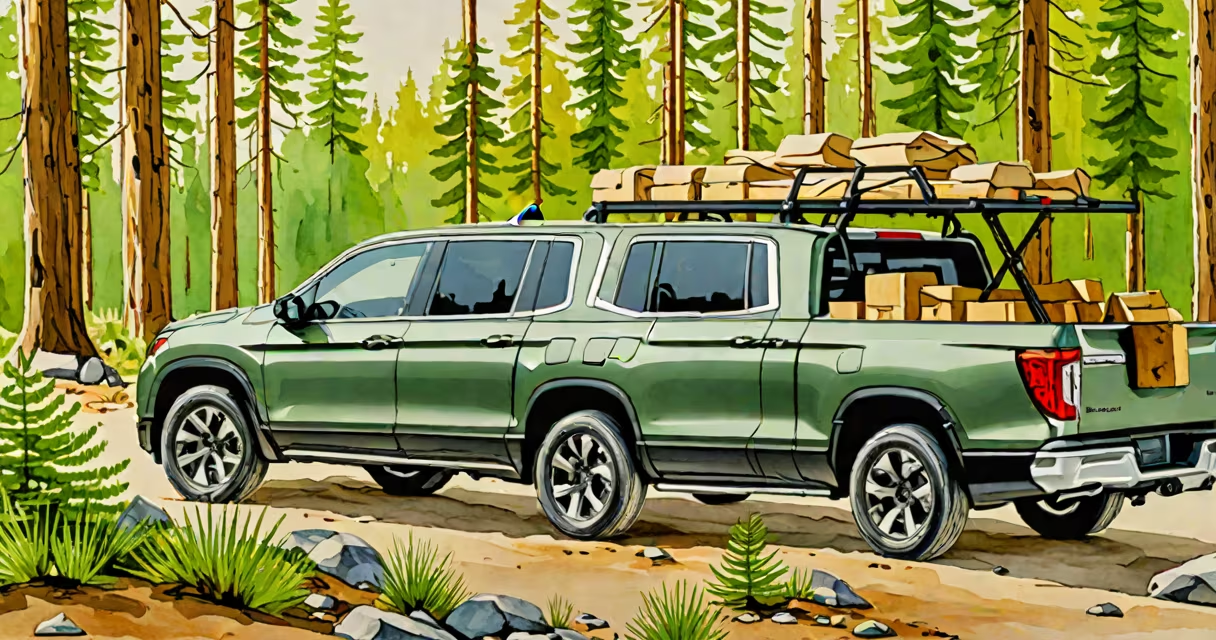
The Honda Ridgeline is a midsize pickup truck built on a unibody platform rather than a body-on-frame chassis, combining the ride quality of an SUV with the cargo and towing capabilities of a traditional pickup. It features a 3.5-liter V6 engine, standard all-wheel drive, and a unique flat-bed design with integrated side walls and a built-in lockable storage compartment.
Unlike most trucks that use a separate frame for strength and durability, the Ridgeline uses a unitized structure similar to passenger cars. This design reduces weight, improves fuel efficiency, and delivers a smoother ride. The truck's engineering prioritizes comfort and handling over brute towing power, making it ideal for daily driving and weekend adventures alike.
Introduced in 2006, the Ridgeline was the first American-market pickup truck to use a unibody construction. It remains the only mainstream pickup with this feature. Its interior offers a quiet cabin, high-quality materials, and advanced safety systems, including Honda Sensing. The Ridgeline competes with models like the Toyota Tacoma and Ford Ranger but stands out due to its car-like drivability and refined driving experience.
The Ridgeline's unibody structure integrates the frame and body into a single unit, reducing flex and improving structural rigidity. This allows for better noise isolation and improved handling compared to body-on-frame trucks. The front suspension uses MacPherson struts, while the rear employs a multilink setup-typical of passenger vehicles, not trucks.
Power comes from a 3.5-liter V6 engine producing 280 horsepower and 259 lb-ft of torque. It pairs with a six-speed automatic transmission and drives all four wheels via Honda's Real-Time AWD system. Unlike many AWD systems that send power to both axles continuously, the Ridgeline's system detects wheel slip and sends torque to the axle with traction. This improves fuel economy and stability on uneven terrain.
The truck's bed is engineered for practicality. It features a flat floor with molded-in side walls, a built-in lockable under-bed storage compartment, and a 110-volt power outlet. The tailgate opens vertically and includes a fold-down step. These features improve usability for outdoor activities, camping, and transporting gear.
Honda offers the Ridgeline in three trim levels: Sport, RTL, and Black Edition. Each adds distinct features based on intended use and driver preference.
| Trim | Engine | AWD | Key Features |
|---|---|---|---|
| Sport | 3.5L V6 | Standard | 18-inch alloy wheels, LED headlights, 8-inch touchscreen |
| RTL | 3.5L V6 | Standard | Heated seats, dual-zone climate control, navigation, wireless Apple CarPlay/Android Auto |
| Black Edition | 3.5L V6 | Standard | Black exterior accents, blacked-out grille, exclusive interior trim, 20-inch wheels |
Each trim includes Honda Sensing as standard-offering adaptive cruise control, lane departure warning, forward collision mitigation, and automatic emergency braking. The RTL and Black Edition also offer a hands-free highway driving mode on compatible roads.
The Ridgeline appeals to drivers who want a truck for everyday use but dislike the rough ride and poor fuel economy of traditional pickups. It's popular among suburban families, outdoor enthusiasts, and professionals who need light-duty hauling without sacrificing comfort.
For example, a field contractor might use the Ridgeline to transport tools and equipment between job sites. The flat bed holds ladders and garden supplies securely, while the quiet cabin allows for phone calls or music during commutes. The 110-volt outlet powers tools at remote locations, eliminating the need for a separate generator.
A real-world test by Car and Driver found the 2023 Ridgeline achieved 21 mpg combined-better than the Toyota Tacoma's 19 mpg and Ford Ranger's 18 mpg. It towed 5,000 pounds with ease and handled gravel roads smoothly, proving its capability beyond city driving.
Many assume the Ridgeline lacks towing capacity because it's not a body-on-frame truck. This is incorrect. The 2023 model can tow up to 5,000 pounds and haul 1,500 pounds in the bed. Its payload rating exceeds that of several competing pickups.
Another misconception is that the unibody design makes it unsuitable for off-road use. While not built for rock crawling, the Ridgeline handles moderate trails well. It features hill descent control, a locking differential on the rear axle, and ground clearance of 8.4 inches-higher than most midsize SUVs.
One non-obvious fact: the Ridgeline's bed aims to be waterproof. Honda tested the bed with 100 gallons of water poured into it over 24 hours. No leaks occurred, thanks to sealed seams and a smooth composite material. This feature protects electronics and tools in wet conditions.
I drove a 2022 Ridgeline on a 1,200-mile road trip from Portland to San Diego. The ride was smooth over highways and mountain passes. The V6 engine maintained consistent power, and the AWD system kept traction on rain-slicked curves. In town, the truck felt nimble, and the infotainment system responded quickly to voice commands.
At a campsite near Lake Tahoe, I used the bed's 110-volt outlet to run a portable refrigerator. The truck's battery held charge through two nights of low-speed idling. The interior stayed cool even in 90°F heat, thanks to efficient climate control and tinted windows.
The Ridgeline is not a heavy-duty work truck. It doesn't have the payload or towing limits of a Ford F-150 or Ram 1500. It's not meant for constant hauling of construction materials or long-distance freight hauling.
It's also not a pure off-roader. While capable on dirt roads and gravel paths, it lacks features like crawl control, skid plates, or a low-range transfer case. For serious trail use, a Jeep Wrangler or Toyota 4Runner would be better choices.
Some confuse it with the Honda Passport, a larger SUV with a body-on-frame design. The Passport shares the same V6 engine but is built for rugged terrain and higher towing loads. The Ridgeline is purpose-built for comfort, efficiency, and versatility-not brute strength.
The Honda Ridgeline is a hybrid of truck and SUV-offering the utility of a pickup with the refinement of a premium crossover. Its unibody construction sets it apart in a segment dominated by body-on-frame designs. It excels in fuel economy, ride quality, and tech integration, making it a standout choice for drivers seeking a capable yet comfortable vehicle.
For those wanting maximum power and towing, other trucks may be better. But for daily commuting, weekend trips, and light hauling, the Ridgeline delivers a balanced package. Its unique blend of features makes it one of the most distinctive pickups on the market.
Understanding what is a Honda Ridgeline means recognizing it as a solution for people who don't want to choose between comfort and capability. It's not the loudest or most useful truck-but it's often the most practical.