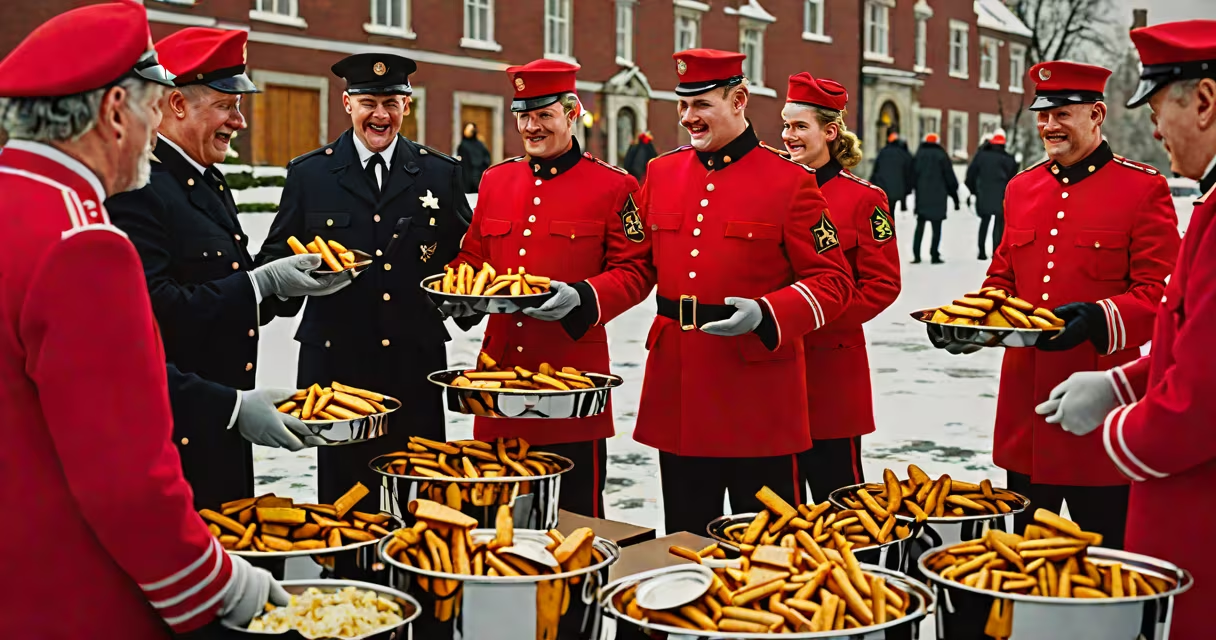
The Salvation Army is a Christian denomination and international charitable organization that combines religious evangelism with direct social service. Founded in 1865 in London by William and Catherine Booth, it operates in over 130 countries, providing emergency shelter, food assistance, addiction recovery, and disaster response.
Its core mission centers on "saving souls and serving the poor." The group uses military-style ranks and uniforms to emphasize discipline and unity, though it is not a military organization. Members are known for their red uniforms, brass instruments, and street-corner hymn singing during holidays.
Despite common confusion with secular charities, the Salvation Army maintains a distinct theological identity rooted in Wesleyan Methodism. It believes in personal conversion through faith in Jesus Christ and sees social work as an extension of Christian love. This dual focus-spiritual and material-defines its global impact.
Each local corps (local church unit) functions as both a worship center and a service hub. They hold regular Sunday services, offer counseling, run thrift stores, and operate homeless shelters. Volunteers and paid staff manage operations based on a centralized command structure led by the General, who resides in London.
Funding comes entirely from donations, not government grants. Over 90% of contributions go directly to programs. The organization reports $1.2 billion in annual revenue globally, with nearly half spent on direct aid like food, housing, and crisis care.
For example, during Hurricane Harvey in 2017, the U.S. branch deployed 1,200 personnel and served 1.8 million meals across Texas. Their mobile feeding units and temporary shelters were operational within 48 hours of the storm's landfall.
The Salvation Army organizes itself using a hierarchical system modeled on military ranks. Officers (ministers) wear uniforms with insignia indicating rank: Lieutenant, Captain, Major, Colonel, and General. Each level has increasing responsibility for regional oversight and doctrinal leadership.
| Rank | Role | Example Responsibility |
|---|---|---|
| Lieutenant | Local corps leader | Oversees weekly worship and community outreach |
| Captain | Regional supervisor | Manages multiple corps and coordinates disaster response |
| Major | Divisional commander | Leads operations across a state or country |
| Colonel | National director | Directs national strategy and budget allocation |
Unlike many churches, the Salvation Army does not accept tithes or collections during services. Instead, it relies on public donations, often solicited through street appeals and holiday bell ringing at shopping centers.
Many assume the Salvation Army is solely a charity focused on helping the poor. While it provides critical aid, its primary identity is religious. The organization views poverty alleviation as part of its divine mandate to reflect Christ's compassion.
A frequent error is equating it with secular nonprofits like the Red Cross or United Way. The Salvation Army differs in three key ways: it is explicitly Christian in doctrine, it uses a military organizational model, and it requires members to commit to a lifestyle of service and obedience.
Another misconception is that all Salvation Army workers are clergy. In reality, about 60% of staff are lay volunteers or paid non-officer employees. Only officers are formally trained ministers.
I once attended a Christmas Eve service in Detroit where a volunteer with no formal religious training led a choir. He wasn't an officer, but he had volunteered for six years. That moment showed me how deeply the organization values participation over credentials.
The Salvation Army operates in urban centers and remote regions alike. In Japan, it runs rehabilitation centers for drug users and supports elderly populations through home care. In South Africa, it manages youth centers and distributes school supplies to rural schools.
Its presence in conflict zones is notable. During the Syrian civil war, it delivered over 100,000 hygiene kits and distributed food to displaced families in refugee camps near the Turkish border. These efforts are coordinated through the International Emergency Services division.
One non-obvious fact: the Salvation Army was among the first organizations to establish permanent shelters for the homeless in the U.S. The first such facility opened in New York City in 1887. Today, it operates over 1,500 shelters across North America alone.
People often confuse the Salvation Army with other Christian-based groups like the Catholic Church's Caritas or Protestant ministries such as World Vision. All provide aid, but the Salvation Army stands out due to its unique blend of structured hierarchy, visible uniforms, and integration of worship with service.
For example, while World Vision focuses on long-term development projects in low-income nations, the Salvation Army emphasizes immediate relief and spiritual support. Its field teams respond to emergencies faster-often within hours-not days.
Unlike many faith-based groups, the Salvation Army does not maintain a formal priesthood. Leadership roles are filled by elected officers who serve fixed terms and are subject to review by higher command.
Understanding the Salvation Army meaning requires recognizing both its religious foundation and its practical role in society. It is not a charity that happens to have a faith component-it is a faith movement that institutionalizes service as worship.