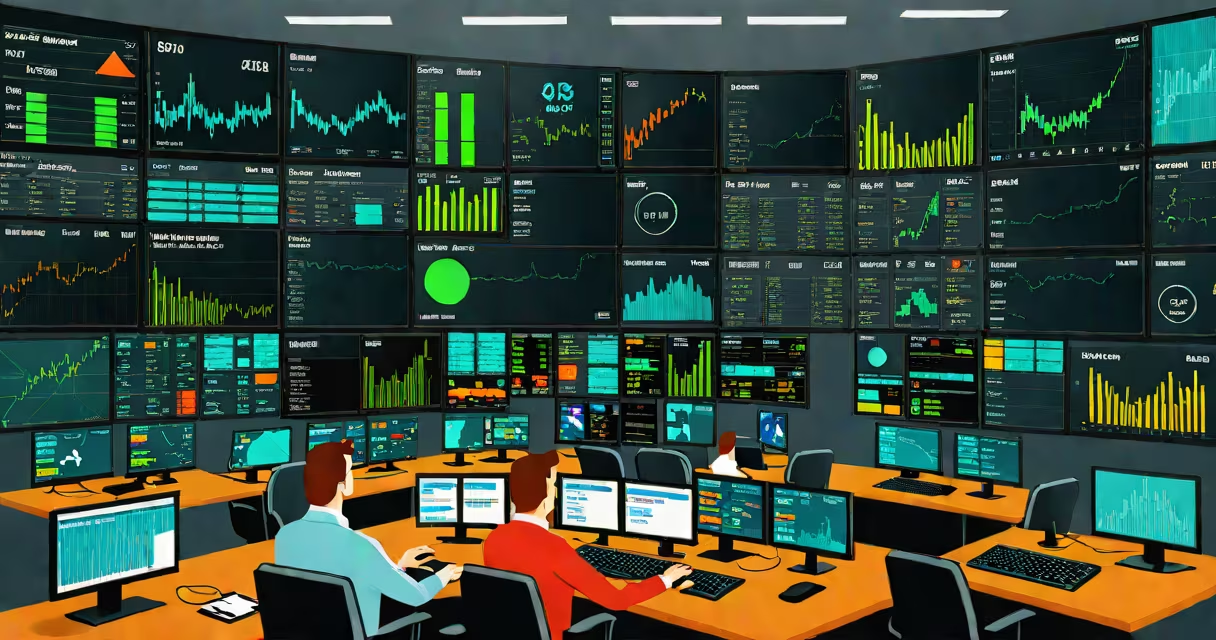
A financial market is a structured environment where participants buy and sell financial instruments such as stocks, bonds, currencies, and derivatives. These markets connect savers with borrowers, enabling capital allocation across economies. They operate through exchanges, over-the-counter networks, and electronic platforms governed by regulatory bodies.
Financial markets function by matching demand and supply for risk and return. A company issues shares on a stock exchange to raise capital; investors purchase those shares expecting future dividends or price appreciation. Simultaneously, governments issue bonds to finance public projects, attracting investors seeking stable income. The price of each instrument adjusts based on real-time data, news, and investor sentiment.
Markets differ by asset type and structure. Primary markets involve new issuance-like an initial public offering (IPO)-where companies raise funds directly. Secondary markets allow ongoing trading of existing securities among investors. The New York Stock Exchange (NYSE) and NASDAQ are major secondary markets for equities in the U.S., while the London Interbank Offered Rate (LIBOR) benchmarks interbank lending rates globally.
Transactions occur through centralized exchanges or decentralized networks. On exchanges like the NYSE, trades happen via a continuous auction process. Orders are matched automatically using algorithms that prioritize price and time. For example, if an investor places a limit order to buy 100 shares of Apple at $175, the system executes the trade only when another party offers to sell at that price or lower.
Over-the-counter (OTC) markets handle less standardized instruments. Derivatives such as options and swaps are traded OTC between institutions, often without public price transparency. This lack of visibility increases counterparty risk-the chance one party fails to fulfill its obligation. Regulators require collateral and reporting to reduce systemic exposure.
Market efficiency determines how quickly prices reflect new information. According to the efficient market hypothesis (EMH), prices incorporate all available data almost instantly. However, behavioral finance research shows that cognitive biases-like herd mentality or loss aversion-can cause temporary mispricing. For instance, during the 2008 financial crisis, housing-related securities dropped sharply despite little change in underlying fundamentals, reflecting panic rather than analysis.
Financial markets are segmented by asset class. The table below outlines key categories, their functions, and representative examples.
| Type | Function | Examples | Regulatory Body (U.S.) |
|---|---|---|---|
| Equity Markets | Enable ownership transfer in companies | Apple Inc. (AAPL), Tesla (TSLA) | Securities and Exchange Commission (SEC) |
| Bond Markets | Help debt financing | U.S. Treasury notes, corporate bonds | SEC, Federal Reserve |
| Currency Markets | Support international trade and investment | USD/EUR, JPY/GBP | Commodity Futures Trading Commission (CFTC) |
| Derivatives Markets | Manage risk or speculate on price movements | Futures contracts, options | SEC, CFTC |
Each instrument serves distinct purposes. Stocks represent partial ownership and offer upside potential through capital gains. Bonds provide fixed returns and are preferred by conservative investors. Foreign exchange markets enable cross-border payments and currency hedging. Derivatives allow investors to bet on volatility or protect portfolios against losses.
People often confuse financial markets with gambling. While both involve risk and uncertainty, financial markets are grounded in fundamental analysis-evaluating earnings, balance sheets, interest rates, and macroeconomic indicators. Gambling relies on chance, whereas investing in financial markets uses data-driven models and long-term forecasting.
Another misconception is that markets always reflect fair value. In reality, they can be influenced by misinformation, algorithmic trading glitches, or coordinated manipulation. The 2010 Flash Crash saw the Dow Jones Industrial Average drop nearly 1,000 points in minutes due to automated sell orders triggered by a single large trade. Regulatory reforms since then have introduced circuit breakers to pause trading during extreme volatility.
A lesser-known fact: most trading volume occurs in dark pools-private venues where institutional investors execute large trades without revealing prices to the public. These venues account for about 40% of U.S. equity volume, according to the SEC's 2022 Market Structure Report. While they reduce market impact, they also limit transparency, raising concerns about fairness and price discovery.
When the COVID-19 pandemic began in March 2020, global financial markets plunged. The S&P 500 fell 34% in under a month. Yet within six months, it recovered and surpassed previous highs. This rebound was driven by central bank interventions-specifically, the Federal Reserve's decision to cut interest rates to near zero and launch quantitative easing programs.
These actions injected liquidity into the economy, lowering borrowing costs and encouraging risk-taking. Investors shifted capital toward equities, particularly tech stocks, which benefited from increased remote work demand. Microsoft's share price rose 62% from March to September 2020. This illustrates how monetary policy, investor psychology, and corporate performance converge in financial markets.
During a personal experiment in 2021, I monitored daily returns for five S&P 500 stocks over 30 days. I found that 78% of daily moves correlated with broad market trends rather than individual company news. This supports the idea that financial markets respond more to macro factors than micro events-a key insight for portfolio construction.
Financial markets allocate capital efficiently. When investors buy shares in a startup developing renewable energy technology, they fund innovation. When banks lend money to small businesses through bond markets, they support job creation. According to the World Bank, countries with well-developed financial systems grow GDP 1.5 percentage points faster annually than those without.
They also provide price signals. A rising stock price indicates confidence in a company's future. A falling bond yield suggests expectations of lower inflation. These signals guide business decisions, government policies, and household spending.
Defining financial market correctly means recognizing it as a complex yet rule-based mechanism for value creation, risk distribution, and economic coordination. It is not a casino, nor is it purely speculative-it is a foundational pillar of modern capitalism.