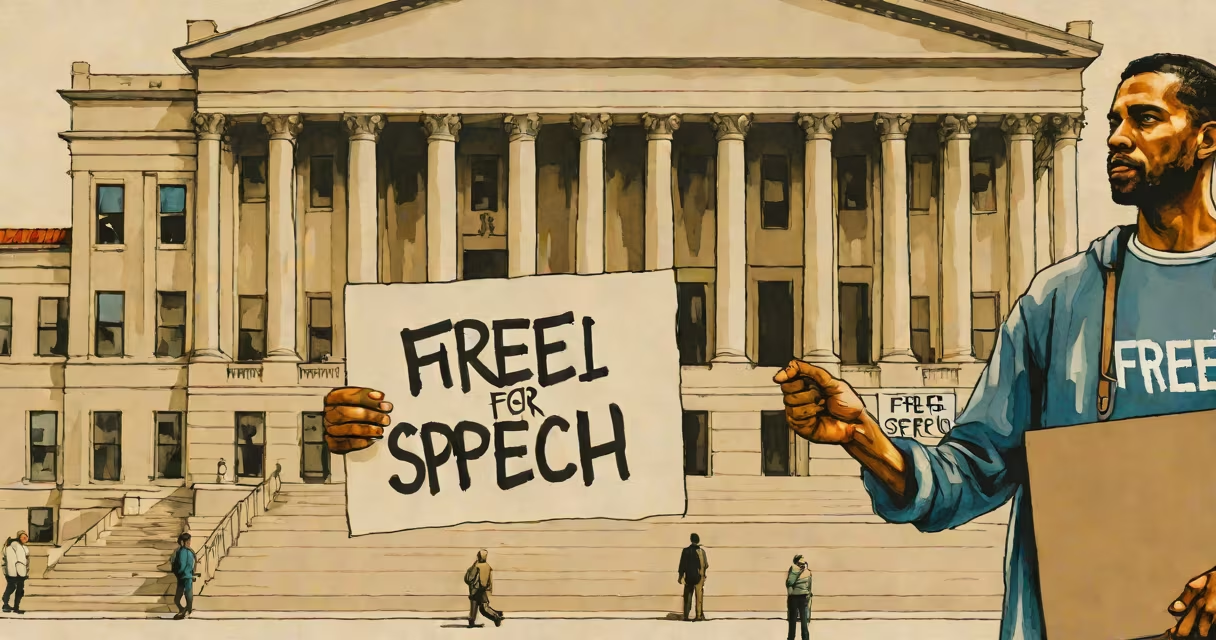
The First Amendment protects the right to free speech, allowing individuals to express ideas, opinions, and beliefs without government interference. This right is foundational to American democracy and applies to both private and public expression.
Free speech under the First Amendment covers spoken words, written text, art, protest signs, social media posts, and even symbolic actions like flag burning. The Supreme Court has ruled that speech cannot be restricted unless it poses a clear and present danger to national security, incites violence, or constitutes defamation, obscenity, or fraud.
For example, in Texas v. Johnson (1989), the Court held that burning the American flag as political protest is protected speech. The decision affirmed that symbolic expression is part of the constitutional guarantee, even when offensive to some. This ruling established that the government cannot punish speech simply because it disagrees with the message.
Free speech is not absolute. The government may impose narrow limits when speech causes imminent harm or threatens public order. Courts evaluate restrictions based on whether they serve a compelling interest and are narrowly tailored.
For instance, yelling "fire" in a crowded theater when there is no fire violates the standard set in Schenck v. United States (1919). The Court ruled that speech creating a "clear and present danger" of serious harm is not protected. This test remains central to modern free speech cases.
Public spaces like sidewalks, parks, and plazas are traditional forums for speech. Government entities cannot ban political speakers from these areas without a valid reason. In Hague v. Committee for Industrial Organization (1939), the Court confirmed that streets and parks are public forums where expression is constitutionally protected.
Not all forms of speech carry equal weight under the law. Some categories receive stronger protection than others, especially when they involve political dissent, artistic expression, or criticism of government officials.
| Type of Expression | Level of Protection | Legal Basis |
|---|---|---|
| Political protest | High | First Amendment; Citizens United v. FEC (2010) |
| Satire and parody | High | United States v. Stevens (2010) |
| Commercial speech | Moderate | Central Hudson Gas & Electric Corp. v. Public Service Commission (1980) |
| Obscenity | None | Miller v. California (1973) |
Commercial speech-such as advertising-is protected but subject to greater regulation. The government can restrict false or misleading claims about products. However, truthful commercial messages cannot be banned solely because they promote a product.
Many people assume that free speech means you can say anything anywhere. That's incorrect. The First Amendment only limits government action-not private companies, schools, or employers.
For example, a social media platform like Facebook can remove posts that violate its community guidelines-even if those posts are legally protected. The platform is not a government actor, so the First Amendment doesn't apply to its moderation policies. This distinction is critical: free speech protections do not extend to private entities.
A common confusion arises around hate speech. There is no federal law banning hate speech in the U.S. The Supreme Court has consistently ruled that offensive or hateful views are protected unless they cross into threats, incitement, or harassment. In R.A.V. v. City of St. Paul (1992), the Court struck down a city ordinance targeting bias-motivated speech, saying the government cannot prohibit speech based on viewpoint.
In Morse v. Frederick (2007), a student displayed a banner reading "Bong Hits 4 Jesus" at a school event. The principal removed it, citing concerns about drug use. The student sued, arguing his free speech rights were violated.
The Supreme Court ruled 5-4 in favor of the school. Justice Roberts wrote that schools can regulate speech that promotes illegal drug use, especially during school-sponsored events. This case shows that free speech rights are limited in educational settings when they conflict with institutional goals.
Even within schools, students retain some rights. In Tinker v. Des Moines Independent Community School District (1969), the Court upheld students' right to wear black armbands to protest the Vietnam War. The decision established that symbolic speech in schools is protected unless it causes substantial disruption.
One right of the First Amendment-the freedom to speak-shapes how Americans engage with politics, culture, and identity. It enables debate, challenges authority, and allows marginalized voices to be heard.
During the 2020 protests following George Floyd's death, thousands gathered peacefully to demand racial justice. Their speeches, chants, and signs were protected under the First Amendment. Law enforcement agencies faced scrutiny over how they handled such gatherings, highlighting ongoing tensions between public safety and free expression.
According to the American Civil Liberties Union (ACLU), over 70% of Americans believe free speech is essential to democracy. The organization cites the First Amendment as a bulwark against authoritarianism and government overreach. The National Constitution Center notes that the amendment was drafted to prevent Congress from suppressing dissent-a concern rooted in colonial resistance to British censorship.
When I taught high school civics, I had students analyze actual court rulings on free speech. One group studied Snyder v. Phelps (2011), where the Westboro Baptist Church protested at military funerals. The Court ruled that even deeply offensive speech is protected if it occurs in a public space and addresses matters of public concern. The exercise helped students grasp that protection extends beyond agreeable messages.
Understanding one right of the First Amendment-free speech-means recognizing its power and limits. It is not a license to disrupt, threaten, or deceive. But it does protect the right to challenge, question, and criticize, even when those views are unpopular.