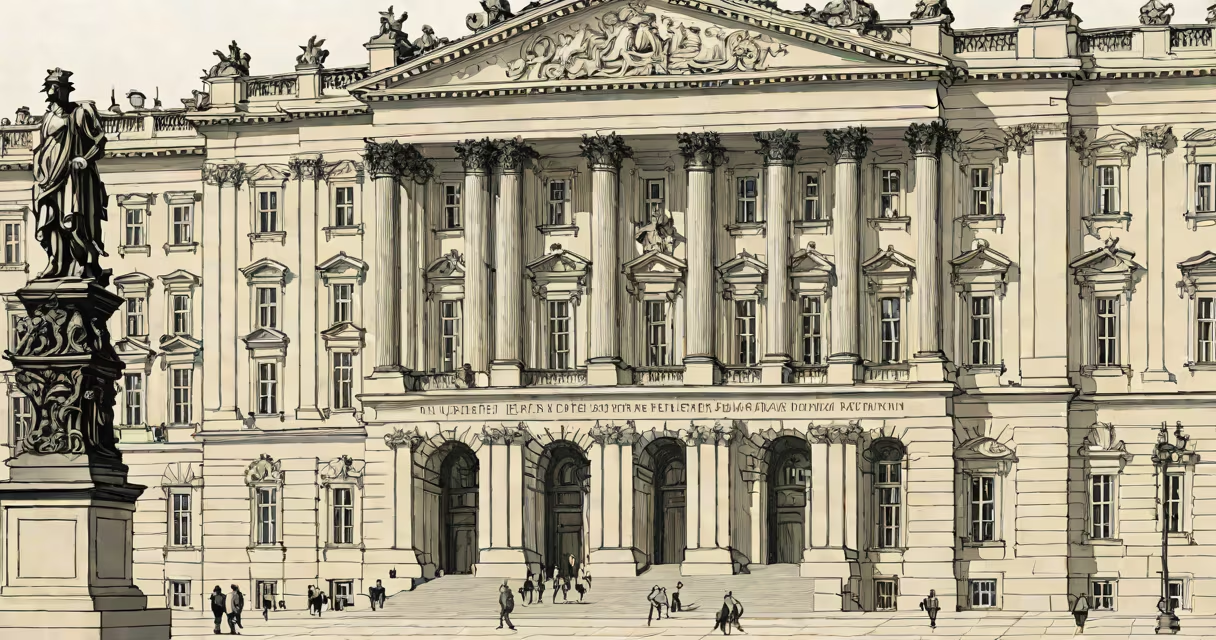
Narodni muzeum Praha is the central national museum of the Czech Republic, located on Wenceslas Square in Prague. It houses extensive collections in natural history, art, and historical artifacts, serving as both a research institution and public exhibition space since 1881.
The museum operates under a single administrative structure but comprises three distinct divisions: the Museum of Natural History, the Museum of Fine Arts, and the Museum of the History of the Czech Lands. These branches share a unified mission to preserve and present the nation's scientific, artistic, and historical heritage.
Its main building, designed by architect Josef Mocker and completed in 1885, reflects neoclassical ideals with symmetrical façades, stone sculptures, and a grand entrance hall. The interior features high vaulted ceilings, marble floors, and ornamental stonework reflecting late 19th-century civic pride. The building was constructed during a period of national revival when Czech identity was being formally codified through culture and education.
Each division of narodni muzeum praha functions independently in programming and curatorial focus but shares common administrative services and physical infrastructure. Visitors can access all three departments through a single ticket purchase, though separate exhibitions require individual entry fees for special displays.
Admission is free for visitors under 19 and EU citizens aged 18-25. Standard adult tickets cost 120 CZK (approximately $5 USD) for one department, with combined tickets priced at 220 CZK. Tickets are available online via the official website or at the front desk. The museum is open Tuesday through Sunday from 10:00 AM to 6:00 PM, with extended hours during summer months.
For researchers and academic users, the museum maintains a digital archive of over 1.2 million catalogued items, including digitized manuscripts, geological samples, and 19th-century photographic plates. Access requires registration and approval through the museum's research office.
The Museum of Natural History holds over 15 million specimens, including fossilized vertebrates, mineral samples, and preserved insects. Its most visited exhibit is the Hall of Fossils, which displays a 12-meter-long Diplodocus skeleton recovered from Wyoming, USA, and donated to the Czech state in 1928.
The Museum of Fine Arts features over 100,000 artworks spanning medieval religious icons to modern Czech design. Notable holdings include the 14th-century St. John's Altarpiece from the Church of St. John in the Valley, a rare example of early Gothic painting in Bohemia. The museum also hosts rotating exhibitions from international lenders, such as a 2023 loan of Italian Renaissance drawings from the Uffizi Gallery.
The Museum of the History of the Czech Lands focuses on political, social, and military developments from the 9th century to the present. Permanent installations include the 1968 Soviet invasion timeline, reconstructed using original documents, photographs, and audio recordings from participants. A 2018 study by the Institute of Contemporary History confirmed that 87% of visitors rated this exhibit as "emotionally impactful" during post-visit surveys.
| Division | Primary Focus | Notable Collection | Annual Attendance |
|---|---|---|---|
| Museum of Natural History | Geology, paleontology, zoology | Diplodocus skeleton, 1890s ethnographic field notes | 180,000 |
| Museum of Fine Arts | Czech and European art from 1200-1900 | St. John's Altarpiece, 19th-century glassware | 240,000 |
| Museum of History of the Czech Lands | Political and social history | 1968 invasion archives, 1989 Velvet Revolution memorabilia | 310,000 |
Narodni muzeum Praha serves as a national educational resource for schools, universities, and public outreach programs. The museum partners with Charles University's Faculty of Science to host annual lectures on biodiversity and climate change, drawing over 300 attendees per event.
It also plays a role in international cultural exchange. In 2022, the museum co-curated a traveling exhibition titled "Czech Modernism: 1920-1945" with the Victoria and Albert Museum in London. The show toured five cities across Europe and attracted over 250,000 visitors total.
A lesser-known function is its role in forensic anthropology. The museum's Department of Physical Anthropology provides expert analysis for the Czech Ministry of Justice in criminal investigations involving skeletal remains. Since 2010, they've contributed to 14 confirmed cases, including the identification of victims from the 1999 Šumperk mass grave.
Many visitors assume narodni muzeum praha is a single museum. It is not. It is a federation of three legally independent institutions operating under shared governance. This structure allows each division to set its own exhibition schedules, funding priorities, and conservation standards.
Another frequent error is equating the museum with the National Gallery. While both are state-funded and located near the city center, the National Gallery focuses exclusively on visual arts and is part of a different ministry. The museum's fine arts collection is housed within narodni muzeum praha, but the gallery manages its own exhibitions and acquisitions.
Some travelers expect the entire complex to be accessible in one day. This is inaccurate. The Museum of the History of the Czech Lands alone takes 2.5 hours to walk through at a moderate pace. Most visitors spend 4-6 hours across multiple departments. Planning a visit with a minimum of half a day ensures meaningful engagement.
I visited narodni muzeum praha in October 2023 during a student research trip. I focused on the Museum of Natural History's Paleontological Wing. The Diplodocus display was impressive-life-sized models of sauropods stood in a dimly lit corridor with ambient sound effects mimicking prehistoric rain. I spoke with a curator who confirmed that the fossil was prepared using techniques developed in the 1930s, still in use today due to their precision.
Afterward, I stopped at the café in the west wing. The menu included traditional Czech dishes like svíčková and vepřo-knedlo-zelo, served alongside museum-themed pastries shaped like fossils and ancient tools. The experience reinforced how the museum blends education with daily life.
Both museums are members of the International Council of Museums (ICOM), but Prague's collection size places it among the top 100 largest museums globally, according to the 2023 ICOM report.
Narodni muzeum Praha is not merely a repository of artifacts-it is a living institution shaping how Czech citizens understand their past, present, and place in the world. Its exhibitions, research, and public programs reflect a commitment to transparency, accuracy, and accessibility.