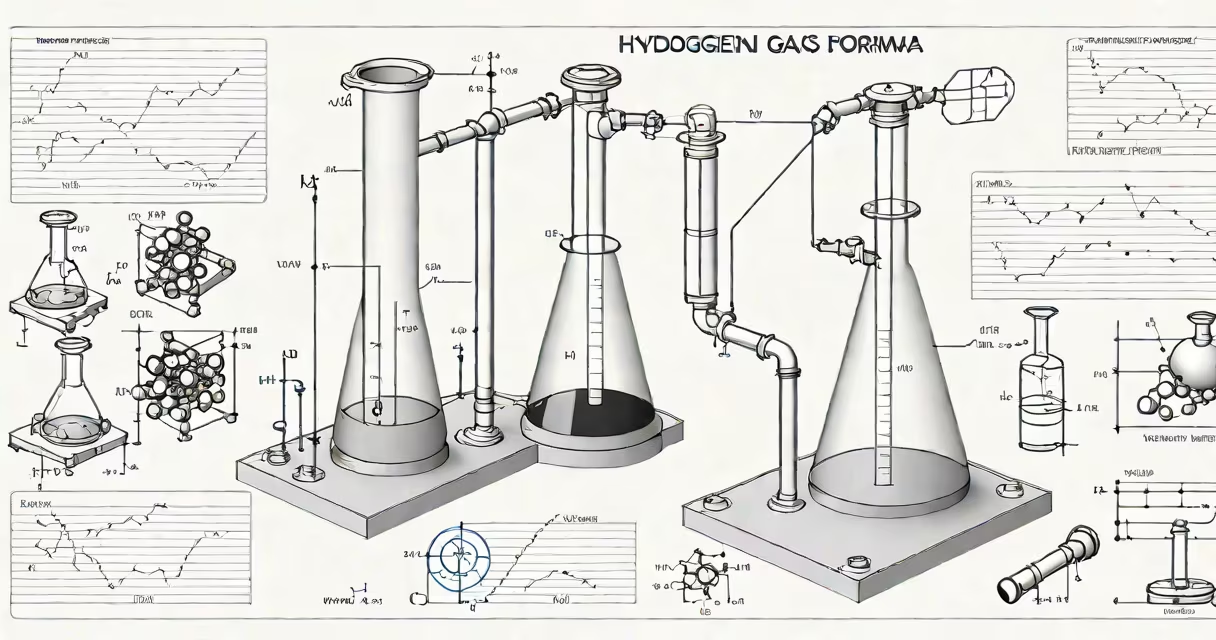
The hydrogen gas formula is H₂, indicating a molecule composed of two hydrogen atoms covalently bonded. This diatomic form is the most stable and common state of elemental hydrogen under standard conditions.
Hydrogen exists as H₂ because each hydrogen atom has one electron and needs one more to fill its outer shell. By sharing electrons, both atoms achieve a stable configuration similar to helium. The bond between them is a single covalent bond, forming a nonpolar molecule with equal electron distribution.
At room temperature and atmospheric pressure, hydrogen gas is colorless, odorless, and highly flammable. It makes up about 75% of the mass of the universe, primarily in stars and interstellar space. On Earth, it's extracted from water via electrolysis or from natural gas through steam methane reforming.
When hydrogen atoms meet under suitable conditions-such as high temperature or electrical energy-they pair up to form H₂. This process releases energy, making H₂ formation thermodynamically favorable. The bond dissociation energy for H₂ is 436 kJ/mol, meaning significant energy is required to split it back into individual atoms.
In combustion, H₂ reacts with oxygen (O₂) to produce water vapor: 2H₂ + O₂ → 2H₂O. This reaction releases 286 kJ of energy per mole of H₂ burned, making it a clean-burning fuel with no carbon emissions. The same reaction occurs in fuel cells, where electricity is generated directly from the chemical reaction.
Hydrogen gas does not exist freely in Earth's atmosphere. It's too light and reactive. Most atmospheric hydrogen comes from the breakdown of organic compounds or water vapor, but it quickly escapes into space due to low molecular weight. Industrial-scale H₂ is produced on-site using methods like steam reforming, which uses methane and steam at high temperatures.
While H₂ is the dominant form, hydrogen can exist in other states depending on energy input:
| Form | Description | Stability | Use Case |
|---|---|---|---|
| H₂ (diatomic) | Two hydrogen atoms bonded together. Stable at room temperature. | High | Fuel cells, rocket propellant, ammonia synthesis |
| H• (atomic hydrogen) | Single hydrogen atom. Highly reactive and short-lived. | Very low | Used in plasma research and welding |
| H⁺ (proton) | Ionized hydrogen. Found in acids and plasmas. | Depends on environment | Electrochemistry, nuclear fusion |
Atomic hydrogen (H•) forms only under extreme conditions-like in electric arcs or solar atmospheres-and rapidly combines with another H• or H₂ to return to stability. Protons (H⁺) are central to acid-base chemistry and appear in aqueous solutions, such as in hydrochloric acid (HCl).
Many assume "hydrogen" and "hydrogen gas" are interchangeable. But hydrogen is an element; hydrogen gas is a specific physical state. The term "hydrogen" can refer to atomic hydrogen, ions, or even isotopes like deuterium (²H) or tritium (³H), which have different formulas and behaviors.
A frequent error is writing H₂ as "H2" in scientific contexts. While "H2" appears in casual text, proper notation uses subscript formatting: H₂. This distinction matters in equations, databases, and academic publishing.
Another confusion arises around "green hydrogen." This refers to H₂ produced via electrolysis powered by renewable energy, not a different chemical formula. Green hydrogen still has the formula H₂-it's the production method that differs. According to the International Energy Agency, green hydrogen accounted for less than 1% of global hydrogen output in 2023, but growth is accelerating.
Hydrogen gas is used in the Haber-Bosch process to make ammonia fertilizer. For every ton of ammonia produced, about 1,200 kg of H₂ is consumed. The process runs at 400-500°C and 150-300 atm pressure, requiring precise control of H₂ flow rates.
In industry, H₂ is essential for refining crude oil. A typical petroleum refinery consumes 10,000-20,000 cubic meters of H₂ daily to remove sulfur and nitrogen impurities. The reaction is called hydrodesulfurization: H₂ + R-SH → RH + H₂S.
I once observed a small-scale hydrogen generator during a lab demonstration. Using a 12V battery and a platinum electrode setup, water was split into H₂ and O₂ gases. The H₂ collected in a test tube displaced water and ignited with a pop sound when exposed to flame-a classic test for purity. The reaction confirmed the formula: 2H₂O → 2H₂ + O₂.
Most sources fail to clarify that H₂ is not a compound. It's a homonuclear diatomic molecule, meaning both atoms are the same element. Compounds require two or more different elements. Water (H₂O) is a compound; H₂ is not.
Also, while H₂ is often called "clean energy," it's not inherently clean. Its environmental impact depends entirely on how it's produced. Gray hydrogen from fossil fuels emits CO₂. Blue hydrogen captures and stores those emissions. Only green hydrogen avoids emissions entirely.
According to the U.S. Department of Energy, hydrogen's energy density by mass is 142 MJ/kg-more than three times that of gasoline (46 MJ/kg). But its energy density by volume is low unless compressed or liquefied. Liquid H₂ at -253°C stores 8.5 MJ/L, compared to 32 MJ/L for liquid gasoline.