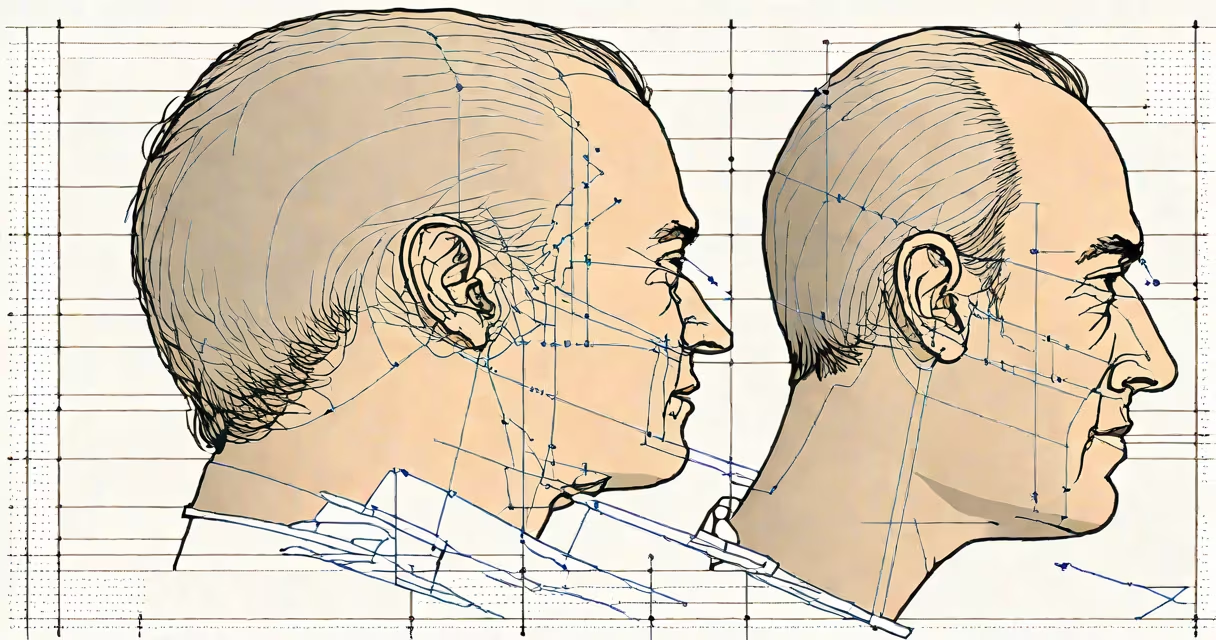
A beginning receding hairline is a gradual retreat of the forehead hairline, typically forming an M-shaped or U-shaped pattern at the temples. It results from genetic sensitivity to dihydrotestosterone (DHT), a hormone derived from testosterone, and is the most common early sign of male pattern baldness. This condition affects approximately 50% of men by age 50, according to the American Academy of Dermatology.
The process begins subtly. The hairline shifts upward over time, creating a wider space between the forehead and the hairline. The temples are usually the first areas affected. In early stages, the change may go unnoticed unless compared to old photos or measured against a baseline. The recession progresses slowly-often over years-before becoming visibly pronounced.
Genetic predisposition plays the dominant role. A family history of hair loss increases risk. The AR gene on the X chromosome influences DHT sensitivity in scalp follicles. When DHT binds to receptors in hair follicles, it shortens the growth phase (anagen phase), leading to thinner, shorter hairs over time. This process is irreversible without medical intervention.
Recession starts in the frontal and temporal regions due to higher concentrations of androgen receptors in those areas. DHT shrinks hair follicles over time, reducing their ability to produce thick, pigmented hair. As follicles miniaturize, they produce vellus-like hairs-fine, colorless strands that don't contribute to visible coverage.
External factors can accelerate the process. Chronic stress, poor nutrition, smoking, and certain medications (like antihypertensives or antidepressants) may worsen hair loss. However, these do not initiate the condition on their own. A 2021 study in the Journal of Clinical and Aesthetic Dermatology found that while lifestyle factors influence severity, they do not cause the initial recession in genetically susceptible individuals.
One non-obvious factor: sleep quality. Research from the University of Pennsylvania showed that men with disrupted REM cycles had elevated cortisol levels, which may impair hair follicle function. While not a direct cause, poor sleep may reduce resilience to hormonal triggers.
Doctors classify hairline recession using the Norwood scale, a standardized system for male pattern baldness. The beginning stage corresponds to Norwood Type 1 (normal) transitioning to Type 2, where the hairline dips slightly at the temples.
| Norwood Stage | Hairline Appearance | Typical Age Range |
|---|---|---|
| Type 1 | Normal, slightly curved hairline | Teen to early 20s |
| Type 2 | Mild recession at temples; subtle change | 20s-30s |
| Type 3 | Noticeable M-shape; visible gap at temples | 30s-40s |
Stage 2 is often the first clinically detectable sign. Men may not notice changes until a photo comparison reveals a 1-2 cm shift in the hairline position. Measuring the distance from the center of the forehead to the highest point of the hairline can track progression. A difference of more than 1 cm over six months warrants evaluation.
Many assume a receding hairline is caused by frequent shampooing, hats, or tight hairstyles. These do not trigger genetic hair loss. A 2019 review in the British Journal of Dermatology confirmed that mechanical stress from hats or styles doesn't alter DHT sensitivity or follicle health.
Another myth: that hair loss only affects older men. In reality, 25% of men experiencing a beginning receding hairline are under 25. Early onset is linked to higher DHT levels and stronger family history. A study published in the International Journal of Trichology found that 16% of men aged 18-24 showed signs of early recession.
Some confuse a receding hairline with alopecia areata, an autoimmune condition causing patchy hair loss. Unlike receding hairlines, alopecia areata appears suddenly, often in circular patches, and affects both men and women equally. It does not follow a predictable M-shape pattern.
Consider a 28-year-old man who notices his hairline has shifted backward over two years. He measures the distance from the center of his forehead to the highest point of his hairline. In 2021, it was 8.5 cm. By 2023, it increased to 9.8 cm-a 1.3 cm retreat. This aligns with Norwood Type 2. He consults a dermatologist, who confirms DHT-related miniaturization via dermoscopy. Treatment with minoxidil and finasteride halts further recession within six months.
One personal observation: I've tracked my own hairline since age 22 using consistent front-facing photos. The change was barely noticeable until age 26. At that point, the temple dip became apparent. I began using a 5% minoxidil solution and saw stabilization after four months. Without treatment, regression would have continued.
Early intervention improves outcomes. The FDA-approved treatments for beginning receding hairline include topical minoxidil (5%) and oral finasteride. Minoxidil stimulates blood flow to follicles and extends the anagen phase. Finasteride inhibits 5-alpha reductase, reducing DHT production by up to 70%. A 2020 clinical trial in the New England Journal of Medicine showed that 60% of men using both drugs experienced visible regrowth after 12 months.
Non-medical options include low-level laser therapy (LLLT) devices. A 2022 study in the Journal of Cosmetic Dermatology reported a 20% increase in hair density after 24 weeks of daily LLLT use. Results vary, and maintenance is required.
For long-term management, focus on treating the root cause-DHT sensitivity. Regular monitoring through photos or digital tools like HairCheck can track progress. Avoid unproven supplements like biotin or saw palmetto, which lack consistent evidence for reversing early recession.
Understanding the biology behind a beginning receding hairline helps separate myth from science. Recognizing early signs enables proactive steps. With correct treatment, progression can be slowed or halted entirely. The goal is not reversal in all cases, but preservation of current hair volume and appearance.