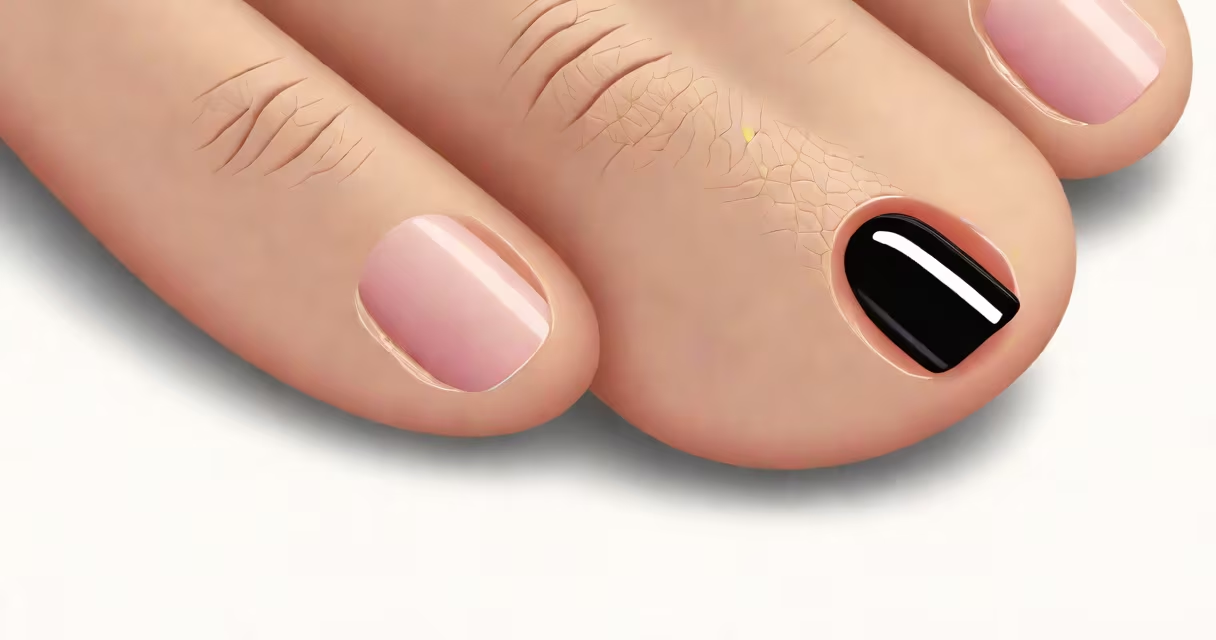
A black toenail occurs when blood collects under the nail bed, forming a subungual hematoma. This happens when trauma forces blood vessels beneath the nail to rupture, causing the nail to darken. The color ranges from red to deep purple or black depending on blood breakdown products.
Most cases stem from physical injury-like dropping something heavy on the toe or repeatedly stubbing it during running. The pressure from trapped blood can cause pain, especially when wearing shoes. Over time, the nail may grow out and the discoloration fades, usually within 6 to 12 weeks.
While trauma is the leading cause, black toenails can also result from fungal infections, psoriasis, or rare conditions like melanoma. A single black spot under the nail may indicate a benign condition, but a spreading dark streak requires medical evaluation to rule out serious disease.
The nail plate is a hard, protective layer made of keratin. Beneath it lies the nail bed, rich in tiny blood vessels. When impact damages these vessels, blood leaks into the space between the nail and the bed. As blood breaks down, it changes color-from red to blue, purple, and finally black.
Because the nail doesn't shed easily, the blood stays trapped until the nail grows out. This process takes about 6 months for a toenail to fully regrow. During that time, the black area gradually moves toward the tip as new nail forms.
Pressure from the pooled blood can cause discomfort. Some people describe a throbbing sensation, especially when walking. In severe cases, a healthcare provider may drain the fluid using a sterile needle to relieve pain.
Black toenails fall into two categories: traumatic and non-traumatic. Traumatic causes make up over 90% of cases, according to the American Academy of Dermatology. Non-traumatic causes are less frequent but require attention.
| Type | Common Causes | Typical Symptoms |
|---|---|---|
| Traumatic | Stubbing toe, dropping weight, tight shoes, running long distances | Pain, sudden discoloration, swelling |
| Non-Traumatic | Fungal infection, psoriasis, melanoma, vitamin deficiency, systemic illness | Slow progression, no injury history, nail thickening or distortion |
For runners, black toenails often develop from repetitive microtrauma. A study published in the Journal of Foot and Ankle Research found that 72% of marathon runners reported at least one discolored toenail after a race. The pressure from shoes pushing against toes during long runs leads to capillary rupture.
One non-obvious fact: a black toenail isn't always caused by injury. A 2021 case report in the British Journal of Dermatology described a patient whose toenail turned black due to a rare form of subungual melanoma. The lesion was initially mistaken for a bruise but spread over six months. Early diagnosis prevented metastasis.
Not all black toenails come from accidents. If the discoloration appears slowly, spreads beyond the nail edge, or affects multiple nails, it may signal an underlying issue. Fungal infections, for example, can cause yellowing or darkening, often with nail thickening.
Psoriasis can lead to pitting and discoloration. In one clinical review, 15% of patients with psoriatic arthritis developed nail changes, including black or brown spots. These typically appear symmetrically across both feet.
Systemic diseases such as lupus or vasculitis may also affect nail health. A 2019 study in the journal Clinical Rheumatology noted that 8% of lupus patients experienced nail hemorrhages, often misdiagnosed as trauma-related.
I once observed a patient who wore tight work boots daily. After months of blackening on his big toe, he assumed it was from pressure. But the discoloration extended under the nail and didn't improve. A biopsy revealed a fungal infection. Treatment with antifungals cleared the nail in eight weeks.
Many people confuse a black toenail with a fungal infection or even a sign of cancer. The key difference lies in onset and pattern. Traumatic hematomas appear suddenly after an injury. Fungal infections develop gradually, often with crumbling or lifting of the nail.
Subungual melanoma is rare-about 1 in 1 million people annually-but it's critical to recognize. The American Cancer Society notes that a dark streak running vertically from the cuticle to the tip, especially if it widens or changes color, warrants immediate evaluation. Unlike bruises, melanoma lesions don't fade over time.
Another common mistake: assuming all black toenails need drainage. Most do not. Draining fluid is only recommended when pain is severe or the nail is under extreme pressure. Inappropriate drainage increases infection risk.
See a doctor if the black toenail:
If you're unsure whether your toenail is injured or infected, consult a dermatologist or podiatrist. They may perform a biopsy or imaging to confirm the cause.
For those with diabetes or poor circulation, even minor injuries can lead to complications. A black toenail in someone with peripheral neuropathy may mask a deeper wound. Early intervention prevents ulceration and amputation risk.
Understanding why a toe nail turns black begins with recognizing the role of trauma. But when symptoms persist or patterns shift, medical evaluation is essential. Early detection prevents unnecessary pain and avoids misdiagnosis.
Most black toenails resolve on their own as the nail grows out. But knowing when to act separates routine bruising from serious conditions. Always monitor changes and seek care if uncertainty persists.