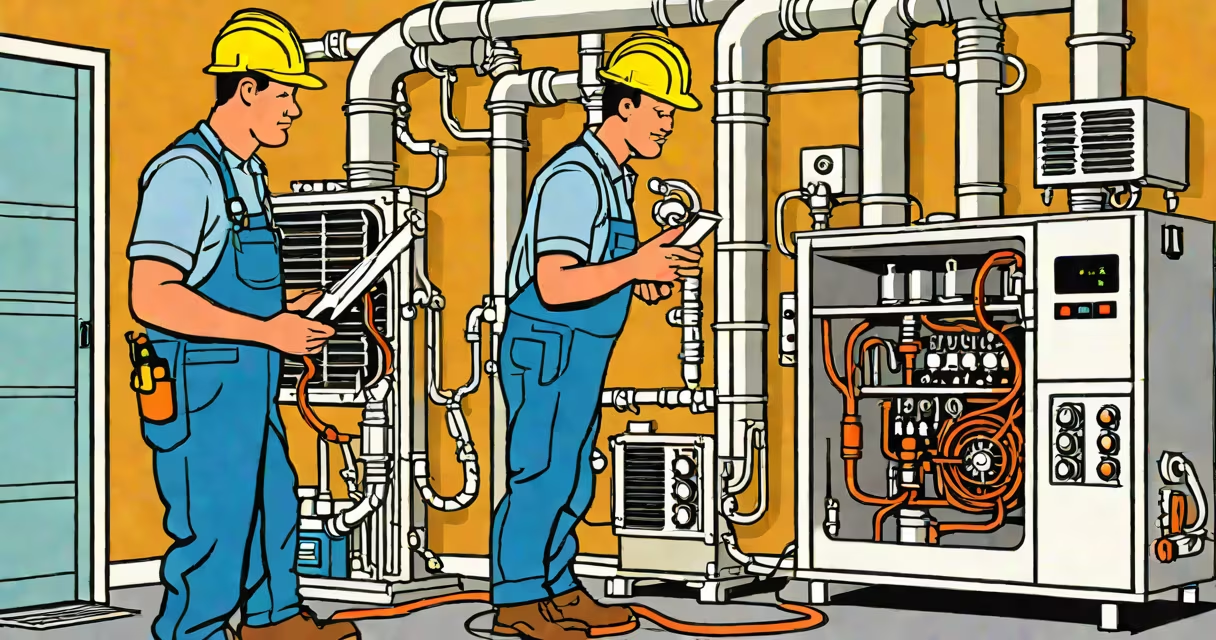
An hvac technician definition refers to a trained professional responsible for installing, maintaining, and repairing heating, ventilation, and air conditioning systems in homes, commercial buildings, and industrial facilities. These technicians ensure climate control systems operate efficiently and safely, following manufacturer guidelines and local codes.
HVAC stands for heating, ventilation, and air conditioning. Technicians work with complex mechanical, electrical, and refrigeration systems. They diagnose malfunctions using gauges, multimeters, and digital diagnostics tools. Their work prevents system failures during extreme weather and ensures indoor air quality meets health standards.
The U.S. Bureau of Labor Statistics reports that HVAC technicians earned a median annual wage of $52,110 in 2023, with employment projected to grow 6% through 2032-faster than average for all occupations. This growth stems from rising demand for energy-efficient systems and aging infrastructure needing replacement.
Technicians begin with a site assessment. They check system performance, airflow, refrigerant levels, and electrical connections. A malfunctioning thermostat or clogged filter can reduce efficiency by up to 30%, according to the U.S. Department of Energy.
When diagnosing issues, they follow a systematic process: verify power supply, test sensors, measure pressure and temperature differentials, then identify root causes. For example, low refrigerant pressure may indicate a leak, not a faulty compressor. Misdiagnosis leads to unnecessary part replacements and customer dissatisfaction.
After repairs, technicians perform a system check. They confirm proper airflow, correct temperature output, and safe combustion (for gas systems). They document findings and provide written service reports. Some technicians also handle system upgrades, such as replacing old thermostats with programmable models that reduce energy use by 10-15% annually.
Technicians specialize based on system type and application. Residential systems typically use forced-air furnaces and split-system AC units. Commercial systems often involve large chillers, variable refrigerant flow (VRF) systems, and rooftop units.
| System Type | Common Applications | Specialized Skills |
|---|---|---|
| Residential Furnace & AC | Single-family homes, apartments | Gas safety checks, duct sealing, thermostat programming |
| Commercial Chillers | Office buildings, hospitals | Refrigerant handling under EPA regulations, load calculations |
| VRF Systems | High-end offices, hotels | Variable speed compressors, zone control logic |
| Geothermal Heat Pumps | New construction, eco-friendly homes | Ground loop installation, thermal conductivity testing |
Some technicians earn certifications like NATE (North American Technician Excellence) or EPA Section 608 certification for refrigerant handling. These credentials improve job prospects and eligibility for higher-paying roles.
Technicians are essential in new construction, retrofits, emergency repairs, and routine maintenance. During winter storms, HVAC failures cause indoor temperatures to drop below 60°F in unheated homes, increasing health risks for elderly residents. Technicians restore heat quickly to prevent hypothermia and property damage.
In commercial settings, HVAC systems account for 40% of building energy use, according to the U.S. Environmental Protection Agency. Proper maintenance reduces energy waste and lowers utility bills. A study by the National Renewable Energy Laboratory found that poorly maintained systems consume 20% more energy than optimally serviced ones.
For example, a technician working at a hospital in Chicago identified a failing chiller unit during a summer heatwave. The system was operating at 75% capacity due to fouled heat exchangers. After cleaning and recalibrating, the system returned to full output within four hours, preventing potential patient discomfort and equipment strain.
Many assume HVAC technicians only fix broken AC units. In reality, their work includes preventive maintenance, system design input, and energy audits. A technician may recommend replacing a 15-year-old furnace with a high-efficiency model (SEER rating 16+) to cut cooling costs by 30% over five years.
Another misconception is that all HVAC work requires advanced degrees. Most technicians complete vocational training or associate degrees in HVAC technology. Programs like those offered by Lincoln Tech or Penn Build cover thermodynamics, electrical theory, and refrigeration cycles. Completion takes 6-12 months, depending on program intensity.
A key distinction: HVAC technicians differ from HVAC engineers. Engineers design systems using software like Carrier HAP or Trane Trace. Technicians implement designs and troubleshoot installed systems. One technician I observed on a job site in Denver had to adjust airflow balancing in a multi-zone office building. He used a manometer and dampers to correct imbalances that caused uneven temperatures between floors-a task beyond the scope of most homeowners.
Entry-level positions require a high school diploma and completion of a technical program. Apprenticeships combine paid on-the-job training with classroom instruction. The International Brotherhood of Electrical Workers (IBEW) and National Association of HVACR Contractors offer structured programs lasting 2-4 years.
Certification is mandatory for handling refrigerants. The EPA Section 608 exam covers environmental protection laws and safe recovery procedures. Technicians must pass this to legally work with refrigerants. Failure to comply results in fines up to $10,000 per violation.
Advanced certifications include NATE's Core and Specialty exams. Passing the NATE Core exam demonstrates proficiency in system fundamentals. Specialty exams focus on specific areas like gas heating, air conditioning, or hydronics. Certified technicians earn 15-20% more than non-certified peers, according to a 2022 survey by the Air Conditioning Contractors of America (ACCA).
A homeowner in Phoenix reported that their central AC unit ran continuously but failed to cool the house. The technician arrived and measured the indoor temperature at 82°F while outdoor conditions were 105°F. The system had a 10°F temperature drop across the evaporator coil-well below the expected 18-22°F.
Using a manifold gauge set, the technician found low suction pressure and high superheat readings. These indicated insufficient refrigerant charge. After checking for leaks with a UV dye and electronic sniffer, he located a small crack in a copper line near the indoor unit. He repaired the joint with a flare nut and replaced the filter-drier.
After evacuating the system to 500 microns vacuum, he charged the system with 3.2 pounds of R-410A refrigerant. Final test showed a 20°F temperature drop and stable pressures. The homeowner reported comfort restored within 30 minutes. The repair cost $420, including parts and labor-less than half the price of a new unit.
Understanding the hvac technician definition clarifies the scope of this critical trade. These professionals maintain indoor environments that affect health, productivity, and energy use. Their work supports daily life across urban and rural communities.