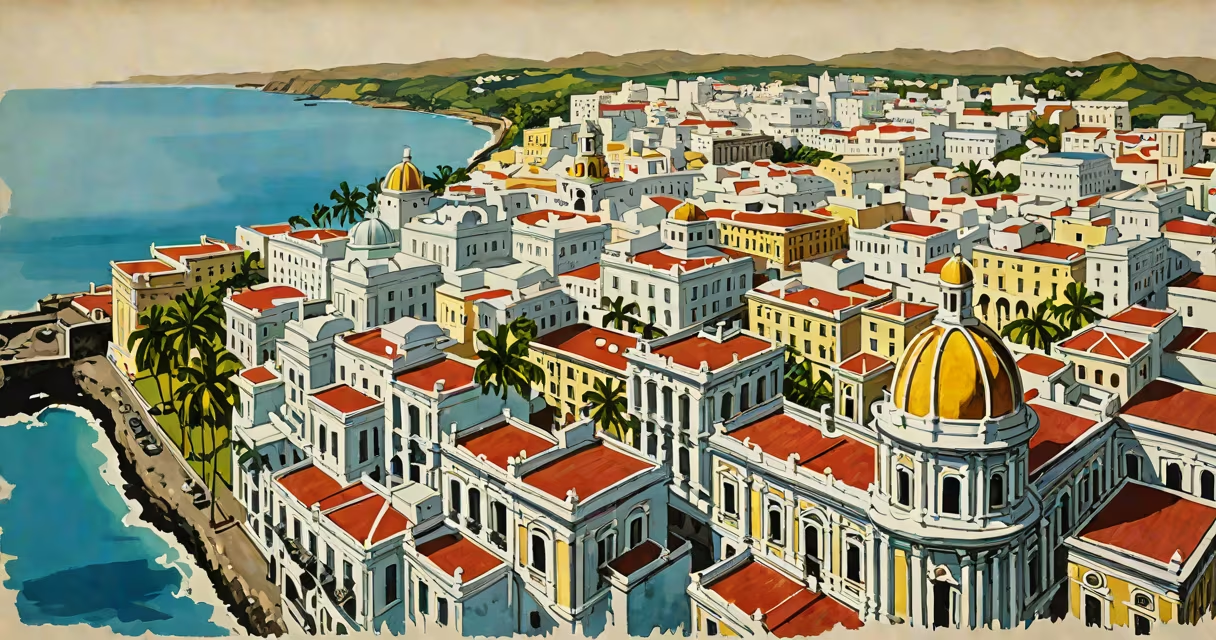
The history of Puerto Rico traces over five centuries of Indigenous presence, European conquest, colonial rule, and American territorial status, shaped by waves of migration, cultural fusion, and political struggle. From Taíno villages to Spanish forts, U.S. military bases to modern-day debates over statehood, Puerto Rico's past reflects complex layers of power, resistance, and identity.
Indigenous Taíno people inhabited Puerto Rico for at least 1,000 years before Christopher Columbus arrived in 1493. They called the island Borikén, meaning "Land of the Valiant Lord." The Taíno lived in small communities, practiced agriculture, fished, and created complex ceremonial objects. Their society was organized around caciques-chiefs who ruled districts.
Columbus claimed the island for Spain, renaming it San Juan Bautista. Within decades, Spanish colonization led to the near-total collapse of the Taíno population due to warfare, forced labor, and introduced diseases. By 1530, few Taíno remained. Survivors intermarried with Spaniards and African slaves brought later, forming the foundation of Puerto Rico's mixed-race population.
Archaeological evidence from sites like Caguana in Utuado reveals Taíno ball courts, petroglyphs, and stone carvings. These artifacts confirm a sophisticated society predating European contact. The persistence of Taíno spiritual symbols in modern Puerto Rican folklore shows enduring cultural influence.
Spain established San Juan as a strategic port in 1521. The city became a military stronghold to defend the Caribbean against rival European powers. Fort San Felipe del Morro and Fort San Cristóbal were built to guard the harbor. These structures still stand today and are part of a UNESCO World Heritage Site.
Colonial governance operated under the Spanish Crown's strict hierarchy. Peninsulares (Spaniards born in Spain) held top positions. Criollos (Spaniards born in the colonies) had limited authority. Africans and Afro-Puerto Ricans were enslaved until abolition in 1873. The economy relied on sugar, tobacco, and coffee plantations using forced labor.
In 1867, Spain granted Puerto Rico limited autonomy through a charter known as the "Grito de Lares," a failed independence uprising. Though suppressed, it marked the first organized effort to challenge Spanish rule. The island remained a colony until 1898, when Spain lost control during the Spanish-American War.
The United States invaded Puerto Rico in July 1898 during the Spanish-American War. The Treaty of Paris ended the war that December, ceding Puerto Rico, Guam, and the Philippines to the U.S. for $20 million. Puerto Ricans did not vote on the transfer. The island became a U.S. territory under the Foraker Act of 1900.
Under U.S. rule, Puerto Ricans gained limited citizenship in 1917 via the Jones Act. This granted them U.S. nationality but not full voting rights. Residents could elect a governor and legislature, but Congress retained ultimate authority. The U.S. military took control of key infrastructure, including ports and communication networks.
A major shift occurred in 1952 when Puerto Rico became a commonwealth with internal self-government. The U.S. Congress approved a constitution, and Puerto Rico adopted its own flag and official language (Spanish). However, the island remains a U.S. territory. Puerto Ricans cannot vote in presidential elections and have no voting representation in Congress.
Political status remains a central issue. Since 1997, Puerto Rico has held six referendums on its relationship with the U.S. In 2012, 61% of voters chose statehood. In 2017, 97% supported statehood-but voter turnout was low, and critics questioned legitimacy. The 2020 referendum showed 52% favor statehood, 32% favored independence, and 16% wanted free association.
Despite economic hardship and natural disasters, Puerto Rican culture thrives. Music genres like salsa, reggaeton, and bomba originated on the island. The 2017 hurricane season devastated infrastructure, killing nearly 3,000 people according to a 2021 independent study. Recovery efforts were slow, highlighting systemic neglect.
I visited San Juan in 2019 and walked through the old city's cobblestone streets. A mural of the Taíno goddess Atabey adorned a wall near the cathedral. Locals spoke of pride in their hybrid identity-neither fully American nor fully Latin American, but something distinct. That duality defines the modern history of Puerto Rico.
| Year | Event | Significance |
|---|---|---|
| 1493 | Columbus lands on Puerto Rico | Beginning of Spanish colonization |
| 1521 | San Juan founded | Establishment of colonial capital |
| 1898 | U.S. invades; Treaty of Paris | End of Spanish rule; start of U.S. territorial status |
| 1917 | Jones Act grants U.S. citizenship | Legal structure for limited self-rule |
| 1952 | Commonwealth status adopted | Internal autonomy under U.S. oversight |
| 2017 | Hurricane Maria strikes | Death toll estimated at 2,975; widespread infrastructure failure |
Many assume Puerto Rico is a country. It is not. It is a U.S. territory with limited self-governance. The term "commonwealth" is misleading-it describes a political status, not sovereignty. Puerto Rico cannot sign international treaties or declare war.
Another error is equating Puerto Rican identity with American identity. While citizens hold U.S. passports, they do not enjoy equal rights. They pay federal taxes but lack voting representation. The Supreme Court affirmed this in the 1904 case Downes v. Bidwell, ruling that constitutional rights do not automatically apply in U.S. territories.
Some believe Puerto Rico's economy is solely dependent on U.S. aid. In reality, it has a diversified economy-tourism, pharmaceuticals, and manufacturing contribute. The island hosts over 100 multinational companies under the IRS's Section 936 tax incentives, which expired in 2006 but left lasting industrial roots.
Understanding the history of Puerto Rico clarifies current challenges: debt crises, migration patterns, and debates over political status. The island's GDP per capita is about 60% of the U.S. average. Over 1 million residents live in the U.S. mainland, forming a large diaspora.
Historical context explains why many Puerto Ricans resist assimilation. The 1930s Puerto Rican Nationalist Party movement, led by Pedro Albizu Campos, sought independence through armed resistance. The U.S. government labeled them terrorists. This legacy fuels skepticism toward federal intervention.
The history of Puerto Rico is not a single narrative. It is layered-Taíno, Spanish, African, American, and global influences intertwined. It is not just about dates and wars. It is about survival, adaptation, and the ongoing search for belonging in a world that often denies full recognition.