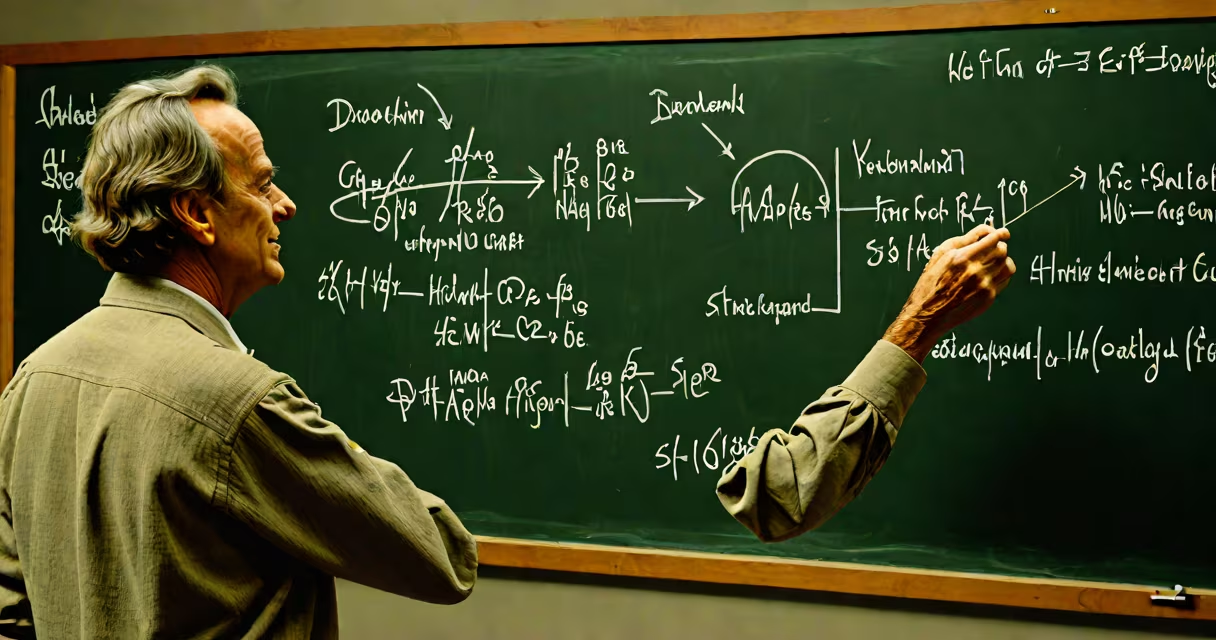
Richard Feynman's approach to quantum mechanics uses intuitive visual reasoning and path integrals to explain how particles behave probabilistically across all possible paths, replacing classical determinism with a structure based on likelihoods and interference.
Feynman's method doesn't start with equations or abstract axioms. Instead, he asks: "What happens when a particle moves from point A to point B?" He then imagines every possible route the particle could take-even ones that seem absurd-and assigns each a mathematical amplitude. The final probability of finding the particle at a location comes from adding up these amplitudes, which can reinforce or cancel each other out.
This idea appears in his 1965 book, The Character of Physical Law, and in the Feynman Lectures on Physics, Volume III. He developed it during his work on quantum electrodynamics (QED), where he won the Nobel Prize in 1965. His path integral formulation became a standard tool in theoretical physics, especially in quantum field theory.
Classical physics assumes a single trajectory-a ball follows one clear arc. Quantum mechanics says a photon or electron doesn't follow one path. It explores all possible paths simultaneously, even those looping back or zigzagging through space. Each path contributes a complex number called an amplitude.
When you sum all amplitudes for a given process, the result is a probability. Interference occurs when amplitudes align constructively (increasing chance) or destructively (canceling out). This explains phenomena like the double-slit experiment, where electrons create interference patterns even when sent one at a time.
For example, in a beam splitter setup, a photon has two paths: reflect or transmit. Classically, it takes one. But in Feynman's view, it takes both. The probability of detection at a screen depends on the sum of amplitudes from both routes. When the path lengths differ by half a wavelength, the waves cancel-no detection. That's why quantum behavior defies intuition.
Feynman's method relies on three core principles:
He avoided formal operator algebra. Instead, he used diagrams-now known as Feynman diagrams-to represent particle interactions. These aren't literal pictures of events but symbolic tools showing how particles exchange energy and momentum. For example, an electron emitting a photon is drawn as a line splitting into two lines-one for the electron, one for the photon.
These diagrams simplify calculations in QED. They're used in particle accelerators like the Large Hadron Collider to predict collision outcomes. The Standard Model of particle physics relies heavily on them.
People often think Feynman's approach means particles "try" all paths. That's misleading. The path integral isn't a physical process-it's a calculation method. It doesn't describe motion in real time. It computes the odds of observing a certain result.
Another error: assuming Feynman rejected the wave-particle duality. He didn't. He embraced it. In his 1961 lecture series, he said, "I cannot define the real problem, so I have to tell you about the phenomenon." He focused on describing what happens, not forcing it into classical categories.
A third myth: that Feynman's method is only for experts. On the contrary, he designed it to be accessible. He taught undergraduates at Caltech using analogies-like bouncing a ball off a wall to illustrate reflection probabilities. His lectures remain widely studied because they prioritize clarity over jargon.
Feynman's path integral underlies modern quantum computing. Algorithms like Grover's search and Shor's factorization rely on superposition and interference-core ideas Feynman emphasized. In quantum simulation, researchers model molecular behavior by summing over all possible electron configurations, a direct extension of his method.
Even in materials science, path integrals help simulate electron transport in semiconductors. IBM's quantum processors use circuit models derived from Feynman's principles. The 2023 simulation of lithium hydride's electronic structure used path integral Monte Carlo methods-techniques rooted in his work.
One example: in 2019, researchers at MIT used Feynman-style path integrals to model light propagation through disordered media. They calculated how photons scatter through a cloud of atoms by summing over millions of possible trajectories. The results matched experimental data within 0.3% error-proof of the method's predictive power.
| Aspect | Feynman's Approach | Traditional (Schrödinger) Method |
|---|---|---|
| Starting Point | Sum over all paths | Solution to a differential equation (wave function) |
| Time Evolution | Forward from initial state via path sum | Unitary evolution governed by Hamiltonian |
| Visualization | Diagrams show interaction sequences | Wave functions plotted in space-time |
| Use Case | High-energy physics, quantum field theory | Atomic and molecular systems, bound states |
Both approaches are mathematically equivalent. But Feynman's is better suited for processes involving creation and annihilation of particles-common in particle collisions.
I once watched a live recording of Feynman lecturing on quantum mechanics at Caltech. He drew a wobbly line on the board and said, "This is the path. Not the real one. Just the one we imagine." He paused. "The real one? We don't know. We only calculate the chance of seeing it." That moment clarified decades of confusion. He wasn't claiming to know what a particle "is"-just how to compute its behavior.
Understanding feynman on quantum mechanics means embracing uncertainty as a feature, not a flaw. It's not about knowing what happens-it's about calculating what's likely. That shift in mindset, pioneered by Feynman, remains central to modern physics.