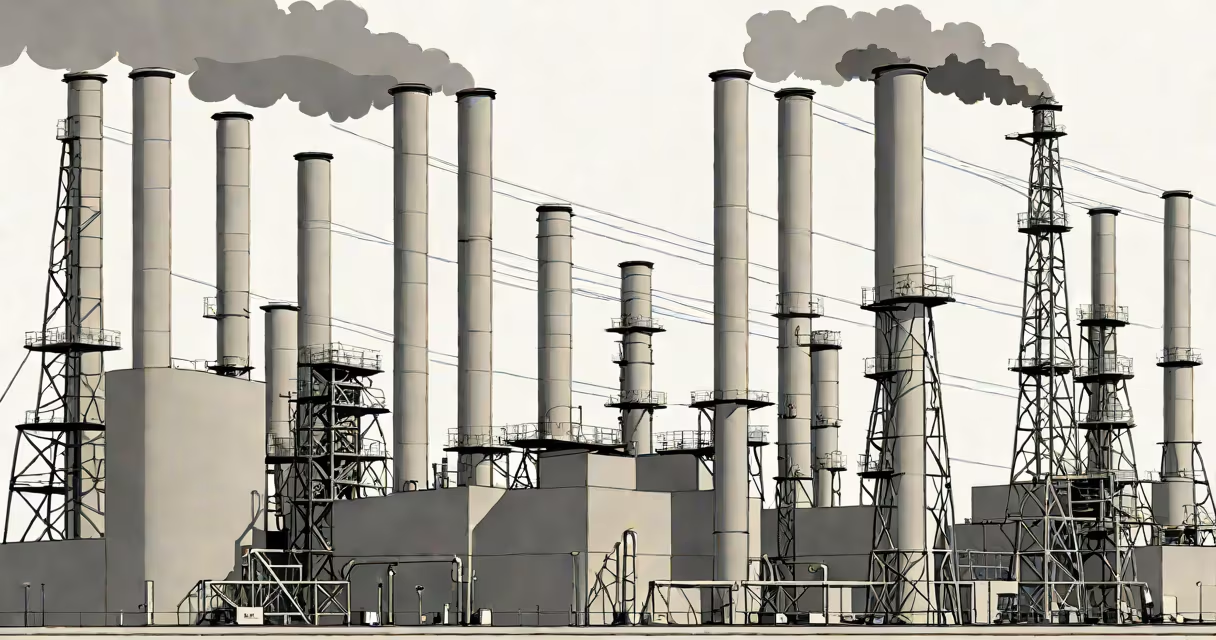
Hard to abate describes industrial processes that generate high levels of greenhouse gas emissions which cannot be easily eliminated using existing clean technologies. These sectors remain major contributors to global warming despite decarbonization efforts.
Hard to abate emissions stem from industries requiring extreme heat, chemical reactions, or continuous operations that rely on fossil fuels. Steelmaking, cement production, and heavy chemical manufacturing fall into this category. Unlike power generation or transportation, where electrification works well, these sectors lack low-carbon alternatives at scale.
The International Energy Agency (IEA) estimates that hard to abate sectors account for about 30% of global energy-related CO₂ emissions. The U.S. Department of Energy identifies over 100 industrial processes as hard to abate due to technical and economic constraints. Without targeted interventions, these emissions will undermine net-zero commitments by 2050.
These processes involve physical transformations that release CO₂ as a byproduct, not just from burning fuel. For example, producing cement requires heating limestone to over 1,450°C, releasing CO₂ even when powered by renewable electricity. The reaction itself creates carbon dioxide-there's no way around it with current chemistry.
Other hard to abate sectors include aluminum smelting, ammonia production, and paper manufacturing. In each, the core chemical process generates CO₂ regardless of energy source. Even switching to green hydrogen or electric furnaces doesn't eliminate the emissions-they only reduce them if the input materials are also low-carbon.
Unlike transport or buildings, where switching to electric vehicles or heat pumps removes most emissions, hard to abate sectors face fundamental material and thermodynamic limits. Their emissions are not just "hard" to reduce-they are inherently tied to the output.
Hard to abate is not a single category. It includes multiple industrial segments with distinct challenges:
| Sector | Primary Emissions Source | Current Mitigation Pathway |
|---|---|---|
| Cement Production | Calcination of limestone (chemical reaction) | Carbon capture and storage (CCS), alternative binders |
| Steel Manufacturing | Coal-based blast furnaces | Direct reduced iron (DRI) with green hydrogen, CCS |
| Chemical Fertilizers | Ammonia synthesis via Haber-Bosch process | Green hydrogen feedstock, process optimization |
| Petrochemicals | Cracking and reforming processes | Electrolysis-based hydrogen, CCS |
Each sector faces different technical and economic hurdles. Cement plants, for example, emit roughly 0.8 tons of CO₂ per ton of cement produced-more than any other industrial process. There is no known method to make cement without calcination, making it one of the hardest to abate.
Some companies are testing low-carbon cement made with fly ash or slag. But scaling these alternatives remains limited. A 2023 IEA report found that less than 1% of global cement capacity uses alternative materials at scale.
Net-zero pledges by 2050 depend on eliminating nearly all emissions. But if hard to abate sectors aren't addressed, they will continue to emit large volumes of CO₂ even as other sectors decarbonize.
According to the Intergovernmental Panel on Climate Change (IPCC), achieving 1.5°C of warming requires cutting global emissions by 45% by 2030 and reaching net zero by 2050. Hard to abate sectors represent a critical gap in this timeline. Without intervention, they could consume up to 60% of remaining carbon budgets by 2050.
A key insight often missed: hard to abate is not a synonym for "impossible to decarbonize." It means "difficult with current tools." Some progress is happening. For example, Sweden's HYBRIT project aims to produce steel using green hydrogen instead of coal. The pilot plant began operations in 2021 and has already demonstrated a 90% reduction in emissions per ton of steel.
Many assume that all industrial emissions can be replaced with renewables. That's false. Solar panels and wind turbines don't run blast furnaces or kilns. Electrifying these processes doesn't solve the problem if the inputs are still fossil-based.
Another misconception is that carbon capture and storage (CCS) can fix everything. While CCS is essential for hard to abate sectors, it's not ready at scale. As of 2023, only 40 commercial CCS facilities exist worldwide, capturing less than 0.1% of global CO₂ emissions. Most are in oil and gas, not industry.
There's also confusion between "hard to abate" and "hard to breathe." The latter is a medical term referring to respiratory distress. Hard to breathe involves symptoms like shortness of breath and chest tightness. It's unrelated to emissions. Confusing the two leads to misinformation in public discourse.
The Port of Rotterdam, Europe's largest port, hosts over 100 industrial facilities emitting hard to abate gases. In 2022, the port launched a strategy to cut emissions by 50% by 2030 and reach net zero by 2050.
They focused on three pillars: green hydrogen for refining and chemicals, carbon capture at steel and cement plants, and offshore wind to power industrial zones. By 2025, they plan to have 1 GW of green hydrogen capacity operational.
One facility, a cement plant operated by HeidelbergCement, installed a pilot-scale carbon capture unit in 2023. It captures 100,000 tons of CO₂ annually-about 15% of the plant's total emissions. The captured CO₂ is stored underground in depleted North Sea gas fields.
This project shows that hard to abate emissions can be reduced-but only with massive infrastructure investment, policy support, and cross-sector coordination. No single company can do it alone.
In 2022, I visited a steel mill in Ohio that was evaluating direct reduced iron (DRI) technology using green hydrogen. The plant manager showed me the feasibility study: replacing 30% of their coal usage with hydrogen could cut emissions by 40%. But the cost was $120 million for the conversion-and no government funding was available.
He said, "We're not refusing to act. We're waiting for the price of green hydrogen to drop below $2 per kg. Right now, it's $4 to $6. Until then, we're stuck." That moment revealed the core challenge: hard to abate isn't just technological-it's economic.
Hard to abate refers to industrial processes that produce unavoidable greenhouse gas emissions due to chemical or thermal constraints. These sectors-cement, steel, chemicals-cannot be fully decarbonized with current technologies. They require new materials, advanced energy systems, and large-scale carbon capture.
Global climate targets depend on addressing hard to abate emissions. Without action, they will dominate future emissions profiles. Solutions exist but require coordinated investment, policy incentives, and innovation. The path forward demands more than clean energy-it demands engineering breakthroughs and long-term planning.
Understanding hard to abate is essential for anyone involved in climate policy, corporate sustainability, or energy transition strategy. It's not a side issue-it's central to meeting net-zero goals.