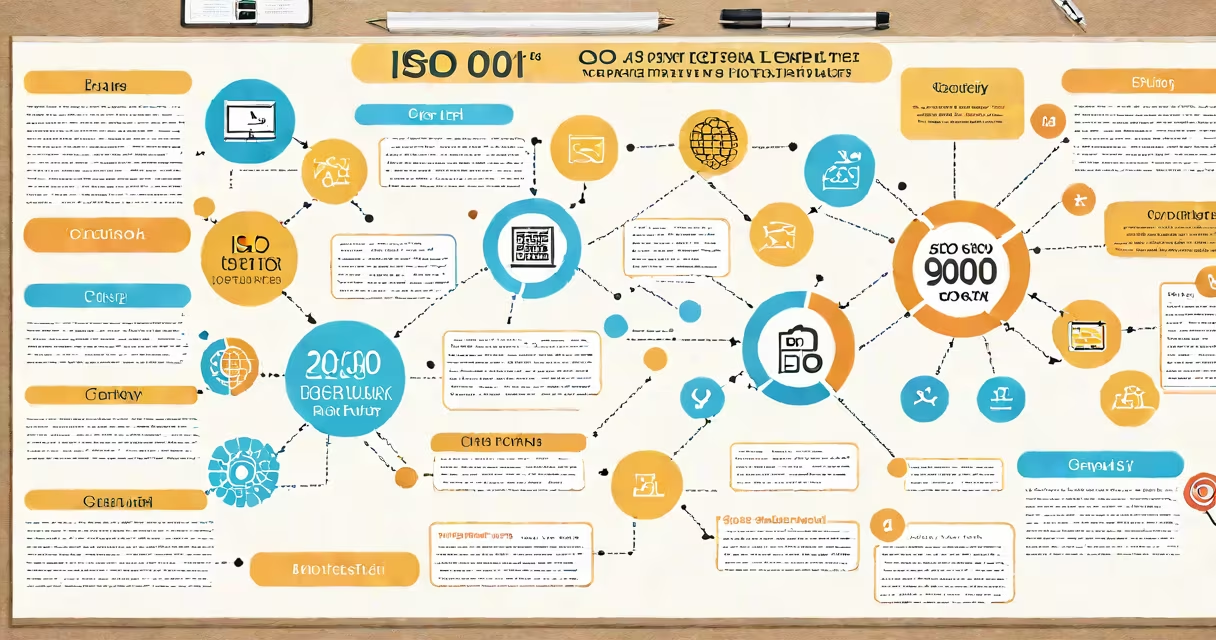
ISO 9001 templates are structured document frameworks designed to help organizations implement and maintain a compliant quality management system (QMS) according to ISO 9001:2015 standards. These templates provide standardized formats for key QMS components such as quality policies, procedures, work instructions, and records, reducing development time and improving consistency.
These templates are not mandatory under ISO 9001, but they serve as practical tools to meet the standard's requirement for documented information. The standard requires organizations to create and maintain documents that support the effectiveness of their QMS, including processes, responsibilities, and performance monitoring. Without templates, teams risk inconsistent formatting, missing elements, or redundant effort during documentation creation.
For example, a manufacturing company implementing ISO 9001 must define how it handles nonconforming products. A well-designed template includes fields for incident description, root cause analysis, corrective action steps, verification of effectiveness, and responsible personnel. Using a template helps every nonconformance report follows the same structure, enabling auditors to quickly assess compliance and internal teams to track resolution timelines.
ISO 9001 templates function as reusable blueprints for creating required documentation. They are typically developed using word processors or document management software and include predefined sections, placeholders, and guidance notes. When an organization adopts a template, staff fill in context-specific details while preserving the correct format and terminology.
Each template aligns with specific clauses in ISO 9001:2015. For instance, Clause 7.5 on documented information mandates that organizations control the creation, approval, distribution, and retention of documents. A template for a work instruction must include version numbers, revision dates, approval signatures, and controlled access fields to satisfy this requirement.
Templates also support audit readiness. During a certification audit, auditors verify that documented information exists and is applied consistently. A template helps every procedure document contains the same core elements-objective, scope, responsibilities, workflow steps, and references to related documents-making it easier for auditors to validate compliance.
Organizations use several categories of ISO 9001 templates depending on the purpose and level of detail needed. The most common types include:
| Type | Use Case | Example Content | Compliance Requirement |
|---|---|---|---|
| Quality Policy Template | Top-level statement of organizational commitment to quality | Leadership declaration, customer focus, continual improvement goals | Clause 5.1 - Leadership |
| Process Procedure Template | Step-by-step guidance for executing a business process | Input/output, roles, decision points, review frequency | Clause 6.2 - Quality Objectives |
| Work Instruction Template | Specific task execution guidance for operators | Tool list, safety precautions, sequence of operations | Clause 7.1 - Resources |
| Record Template | Proof of activity completion or outcome verification | Date, signature, reference number, result field | Clause 7.5.3 - Control of documented information |
Some templates are generic and suitable for multiple industries. Others are industry-specific-such as templates tailored for medical device manufacturers under ISO 13485 alignment or automotive suppliers following IATF 16949. A construction firm might use a template for site inspection reports that includes weather conditions, equipment logs, and safety checklists, all aligned with ISO 9001's risk-based thinking approach.
A critical but often overlooked point: templates do not replace judgment. A template for a nonconformance report may prompt users to enter "corrective action taken," but the actual effectiveness of that action must still be evaluated through follow-up audits or performance metrics. Overreliance on templates without understanding context leads to mechanical compliance, not real quality improvement.
Many organizations assume that using a template guarantees ISO 9001 certification. This is incorrect. Certification depends on demonstrated application, not just document presence. An auditor can reject a QMS even if all templates are filled out correctly if the processes aren't actually being followed.
Another misconception is that templates must be identical across organizations. ISO 9001 allows flexibility in format and content as long as the intent is met. A small service provider might use a single-page template for all procedures, while a multinational corporation uses multi-section templates with embedded workflows and digital approvals. Both approaches are valid if they meet the standard's requirements.
One non-obvious distinction: templates for records differ from those for procedures. A procedure template defines how something should be done. A record template captures evidence that it was done. The latter focuses on traceability, not process design. For example, a template for a calibration log must include serial numbers, date of last calibration, and next due date-not step-by-step instructions on how to calibrate a tool.
A local HVAC repair shop aiming for ISO 9001 certification adopted a template for customer service complaint handling. The template included:
After six months of use, the team reviewed 14 complaints. Six were traced to recurring issues with thermostat wiring. The team updated their training manual and added a new step in the installation checklist. This led to a 40% reduction in repeat calls within three months. The template didn't fix the problem-it revealed it and enabled action.
I personally observed this process during a consultancy engagement. The shop owner initially resisted using templates, calling them "bureaucracy." After seeing how the template reduced miscommunication and improved response times, he requested a version for warranty claims. The shift from resistance to adoption happened because the template solved a real problem, not because it looked official.
Reputable sources include the International Organization for Standardization (ISO) itself, national standards bodies like ANSI in the U.S., and accredited certification bodies. The ISO website offers a free overview of ISO 9001:2015, though it does not provide downloadable templates. Instead, it directs users to accredited providers.
According to ISO's official guidance, organizations should ensure that any template used supports the principles of risk-based thinking and continual improvement. The standard emphasizes that documented information must be "fit for purpose" and "adequate." A template that omits risk assessment fields or lacks version control fails this test.
Third-party providers such as ASQ, BSI, and NIST offer customizable templates. Some are free; others require purchase. Always verify that templates reflect current versions of ISO 9001:2015 and include guidance on how to adapt them to your organization's size, complexity, and sector.
Using ISO 9001 templates is not about copying forms-it's about applying structure to improve clarity, accountability, and consistency. When implemented with understanding, these tools become foundational to sustainable quality performance.