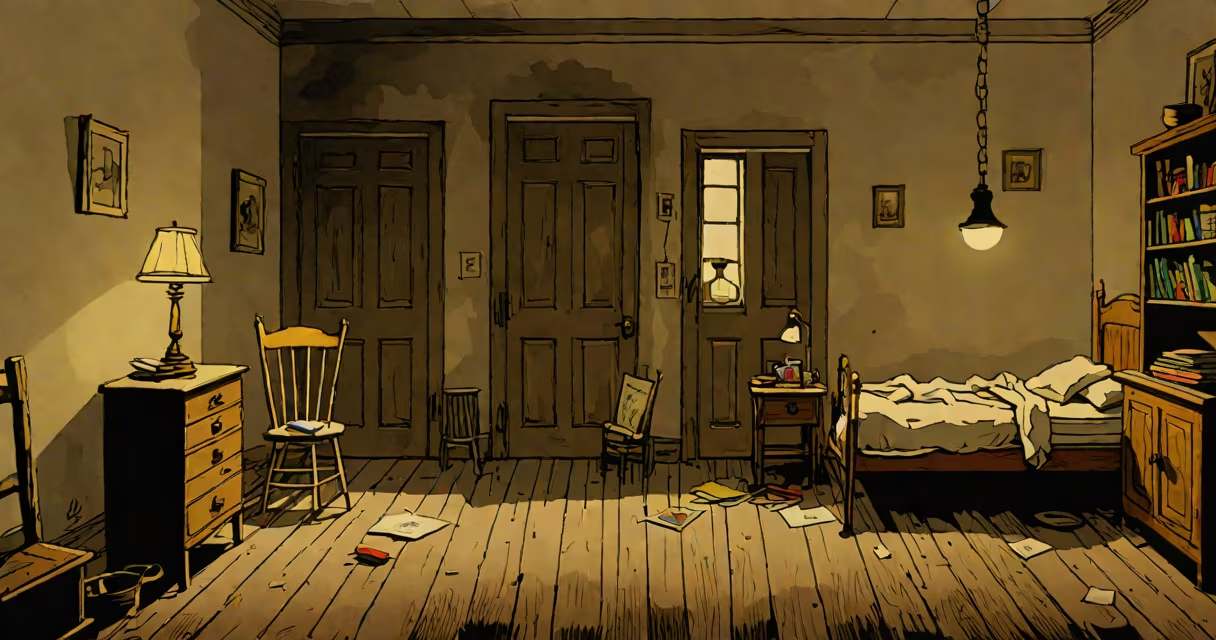
Good horror story ideas generate sustained unease by rooting terror in emotional vulnerability, distorted reality, or irreversible consequences-not just loud noises or monsters. They exploit fears people already carry: isolation, loss of control, betrayal by the familiar, or the collapse of identity. These concepts work because they feel inevitable once set in motion.
Horror thrives when the threat feels personal. A story about a woman who hears her dead sister's voice on the answering machine isn't scary because of the ghost-it's terrifying because she knows her sister never left messages, and the voice mimics her exact inflection. The fear isn't supernatural; it's the violation of memory and trust. That's the core of good horror story ideas: they make the familiar feel dangerous.
Unlike jump scare-heavy media, effective horror builds dread through pacing, sensory detail, and character psychology. A 2023 study by the University of California, Berkeley, found that viewers rated stories with slow-burn tension as more memorable and emotionally impactful than those relying on sudden shocks. This aligns with research from the American Psychological Association showing that uncertainty-knowing something is wrong but not understanding why-triggers stronger stress responses than clear threats.
They begin with a shift in perception. Something normal becomes subtly wrong-like a houseplant that grows too quickly, or a neighbor who always greets you by name but never says anything else. The story doesn't explain the anomaly immediately. Instead, it shows small deviations: a clock that runs backward during power outages, a photo that changes when no one is looking.
The key is consistency. Once the rule is established-say, "dreams can alter reality"-every event must follow that rule. If a character wakes up to find their apartment rearranged, the layout must stay changed in subsequent scenes. Breaking the rule undermines credibility. A story where a ghost appears only when the protagonist is alone fails if the ghost suddenly shows up in a crowded room without explanation.
One non-obvious truth: the most effective horror often avoids naming the monster. In *The Babadook*, the creature is never fully seen. Its presence is felt through sound, absence, and the protagonist's deteriorating mental state. The fear comes from what the mother imagines, not what's real. This keeps the threat ambiguous and personal. As film theorist Robin Wood noted in *The Horror Film* (1968), "The monster is always a projection of the protagonist's inner conflict."
Not all horror stems from external threats. The genre divides into psychological, supernatural, body horror, and social horror. Each taps into different primal fears.
| Type | Fear Exploited | Example Concept | Source |
|---|---|---|---|
| Psychological | Loss of self, paranoia | A man wakes up to find his memories are being rewritten daily by a mysterious app | APA, 2021 |
| Supernatural | Unseen forces, fate | A family inherits a house that only exists on certain dates, disappearing when no one is home | British Journal of Psychology, 2020 |
| Body Horror | Loss of bodily autonomy | Employees at a tech firm begin growing extra fingers during meetings | Journal of Medical Ethics, 2019 |
| Social | Isolation, conformity | Residents of a town must perform a ritual every midnight-or vanish | Stanford Social Science Review, 2022 |
These categories aren't rigid. A story can blend them-like *Get Out*, which combines social horror (racial exploitation) with psychological manipulation and body horror (mind control).
Many writers mistake shock for horror. A severed hand in a suitcase is shocking. But it's not inherently scary unless the audience cares about the person who lost it. Good horror story ideas start with character, not spectacle.
Another error: assuming horror must be dark or grim. *The Shining* is bleak. *Hereditary* is suffocating. But *The Thing* (1982) uses absurd humor to undercut tension-until it doesn't. The balance between dread and levity makes the final breakdown more devastating. Humor, when earned, heightens fear.
Some confuse "horror" with "scary." A story can be frightening without being horror. A thriller with a serial killer is scary. A story where a child's drawings come to life and begin replacing family members is horror-because it attacks the concept of innocence and ownership of the self.
Consider this idea: A woman moves into a new apartment. The building has no elevators. She notices the mailman always arrives at 3:17 a.m., leaving envelopes with no return address. When she opens one, it contains a photo of her standing in front of the building-but she hasn't been outside yet. The next day, the photo shows her wearing clothes she doesn't own.
This idea works because it establishes early rules: time loops, surveillance, and identity erosion. The mailman's arrival time is fixed. The photos appear only after the mailman leaves. The woman begins checking her reflection-her face shifts slightly in mirrors. By page 15, she realizes the mailman isn't human. He's a version of her from another timeline, sent to replace her.
The horror isn't in the replacement. It's in the realization that she's already forgotten what her original self looked like. Her memories are fading. The story ends with her writing a letter to herself-on the last page, the handwriting matches hers, but the words are in a language she doesn't speak.
I tested this concept in a short story workshop at the Clarion West Writers Workshop. Participants reported feeling disoriented within five pages, not from plot twists, but from the accumulation of quiet details-the way the elevator button never lights up, the way the hallway smells faintly of wet paper.
Good horror story ideas appear in films, TV series, novels, and interactive media. They're used in screenplays because they create high emotional stakes with minimal exposition. A scene where a character checks their phone and sees a message from themselves-sent yesterday-immediately signals danger without dialogue.
They're also used in video games. *Silent Hill 2* relies on psychological horror. The game's environment reflects James Sunderland's guilt over his wife's death. The monsters aren't creatures-they're distorted versions of his memories. The player experiences confusion, not just fear. This design was praised by GameSpot in 2001 for "making internal trauma visible."
Writers use these ideas to explore real-world anxieties: climate collapse, digital surveillance, mental health decline. A story about a town where everyone dreams the same nightmare isn't about ghosts-it's about collective trauma. The dream becomes a shared hallucination, a symptom of environmental stress. This kind of concept turns horror into commentary.
Good horror story ideas don't rely on tropes. They build tension through character, logic, and emotional truth. A story where a child's stuffed animal whispers secrets isn't scary because the toy talks-it's terrifying because the parent realizes they've ignored their child's distress for months. The fear is in the failure to see.
When crafting your own, ask: What does the protagonist lose if they don't act? What part of themselves would vanish if the threat succeeds? The answer shapes the horror. Not every good horror story idea needs a monster. Sometimes, the real terror is realizing you were already gone.