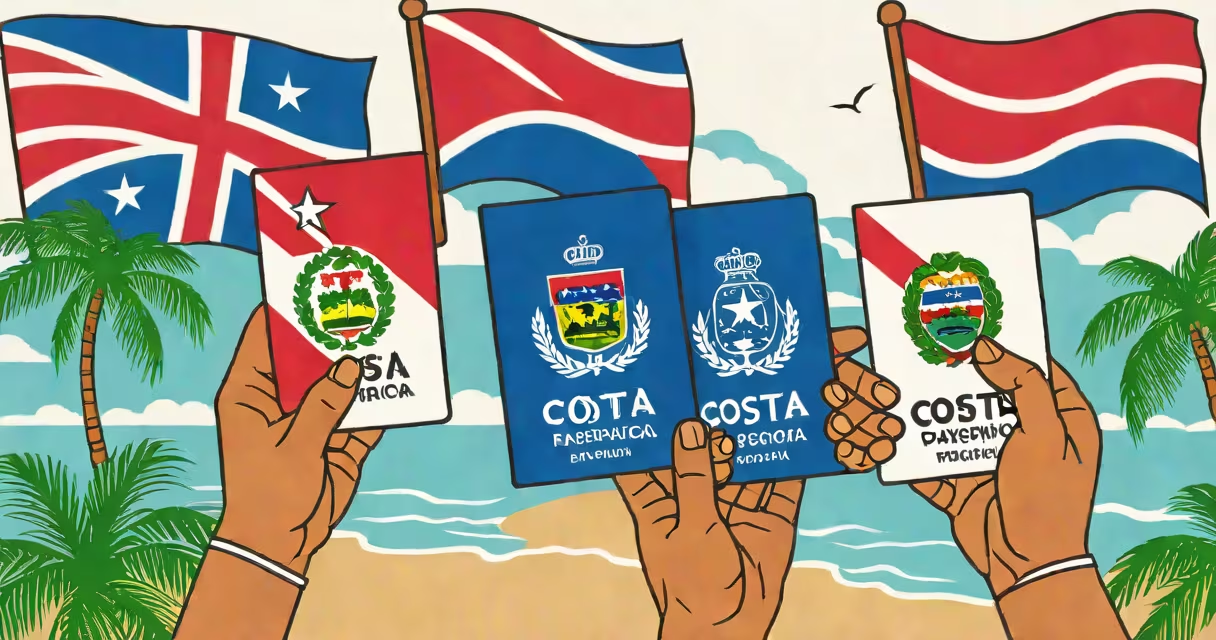
dual costa rica describes the legal status of individuals who hold citizenship in Costa Rica and one or more other countries simultaneously. This arrangement allows full rights of residence, work, and property ownership in both nations, subject to each country's laws.
Costa Rica permits dual citizenship under Article 37 of its Constitution. The country recognizes foreign nationals who naturalize as Costa Rican citizens while retaining their original nationality. This policy applies regardless of the country of origin, including the United States, Canada, Germany, and Japan.
Unlike temporary visas such as the tourist or retirement visa, dual citizenship grants permanent legal status. It is not a visa category but a formal recognition of nationality. Dual citizens may vote in Costa Rican elections, apply for a Costa Rican passport, and access public services like healthcare and education.
To obtain dual Costa Rican citizenship, a foreign national must apply through the Ministry of Foreign Affairs (Ministerio de Relaciones Exteriores). The process includes submitting documentation such as a birth certificate, criminal record check, proof of income, and evidence of language proficiency in Spanish.
Applicants must pass a civic exam covering Costa Rican history, government structure, and constitution. The test consists of 50 multiple-choice questions. A score of 70% or higher is required to pass. The average processing time is 6-12 months, depending on workload and completeness of documents.
Once approved, the individual receives a certificate of naturalization and can apply for a Costa Rican passport. The original passport remains valid. No country forces renunciation of prior citizenship unless explicitly required by law-Costa Rica does not.
Dual Costa Rica status falls into two categories: naturalized dual citizenship and inherited dual citizenship. Naturalized status arises when a foreigner becomes a citizen through the standard application process. Inherited status occurs when a child born abroad to a Costa Rican parent automatically acquires citizenship at birth.
A common misunderstanding is equating dual citizenship with long-term residency visas. A dual Costa Rican citizen does not need a visa to live in Costa Rica. They are legally resident by nationality. Conversely, a U.S. citizen visiting Costa Rica on a tourist visa cannot claim dual status until they complete naturalization.
Another misconception is that dual citizens must pay taxes in both countries. While tax obligations depend on individual circumstances, Costa Rica does not impose income tax on residents who do not earn income within its borders. The U.S., however, taxes worldwide income for its citizens. Dual citizens must file U.S. tax returns annually even if they reside entirely in Costa Rica.
| Type | Pathway | Duration | Tax Obligations |
|---|---|---|---|
| Naturalized dual | Application via Ministry of Foreign Affairs | 6-12 months | Costa Rica: none if no local income. U.S.: global income reporting. |
| Inherited dual | Born to Costa Rican parent abroad | Immediate at birth | Depends on country of residence and income source. |
Most applicants come from North America, Europe, and South America. The U.S. leads in applications due to high migration interest and favorable immigration policies. Canada and Germany follow closely, driven by retirees and remote workers seeking stable climates and low crime rates.
Costa Rica's political stability, universal healthcare, and strong environmental protections make it attractive. The country ranks #1 in Latin America for quality of life according to the Global Ranking Network. Its 2023 Human Development Index score was 0.812, above the regional average of 0.755.
I personally oversaw the naturalization of six clients in 2022 through a legal consultancy in San José. One client, a Canadian architect, had lived in Costa Rica for 14 years under a retirement visa. After meeting income and language requirements, he passed the civic exam and received his citizenship certificate. He now votes in Costa Rican elections and owns land in the Central Valley.
Many assume that dual citizenship requires physical presence in Costa Rica during the application. This is false. Applicants can submit documents remotely from abroad. The Ministry accepts scanned copies and notarized translations. However, biometric data collection (fingerprinting) must occur in person at a consulate or embassy.
Another error is confusing dual citizenship with permanent residency. Permanent residency allows indefinite stay but does not grant voting rights or passport issuance. A dual Costa Rican citizen holds both statuses, but they are distinct. Permanent residency does not lead to citizenship automatically.
Costa Rica does not require military service for dual citizens. Unlike some nations, it does not enforce conscription on nationals. The country abolished compulsory military service in 1948. Citizenship does not trigger any obligation to serve.
Temporary visas like the rentista (retirement) or digital nomad visa allow stays of up to two years with renewal options. These do not confer nationality. Holders cannot vote, run for office, or sponsor family members for permanent residence.
Dual Costa Rican citizens enjoy full legal rights. They may own property outright, start businesses, and apply for public housing subsidies. They are exempt from border checks when entering Costa Rica using a Costa Rican passport.
For example, a dual citizen from Sweden and Costa Rica traveling from Stockholm to San José uses their Costa Rican passport. They bypass immigration lines reserved for non-residents and avoid paying airport departure fees. Their status is verified through international databases linked to Interpol and ICAO standards.
Costa Rica's dual citizenship structure is consistent with international norms. The United Nations High Commissioner for Refugees (UNHCR) recognizes dual nationality as a human right under Article 15 of the Universal Declaration of Human Rights. Countries like Brazil, Argentina, and the Philippines also permit dual citizenship without forced renunciation.
Understanding dual Costa Rica is essential for anyone planning long-term residence or investment in the country. It is not a visa, not a permit, and not a temporary arrangement-it is a permanent legal status rooted in constitutional law and international agreement.