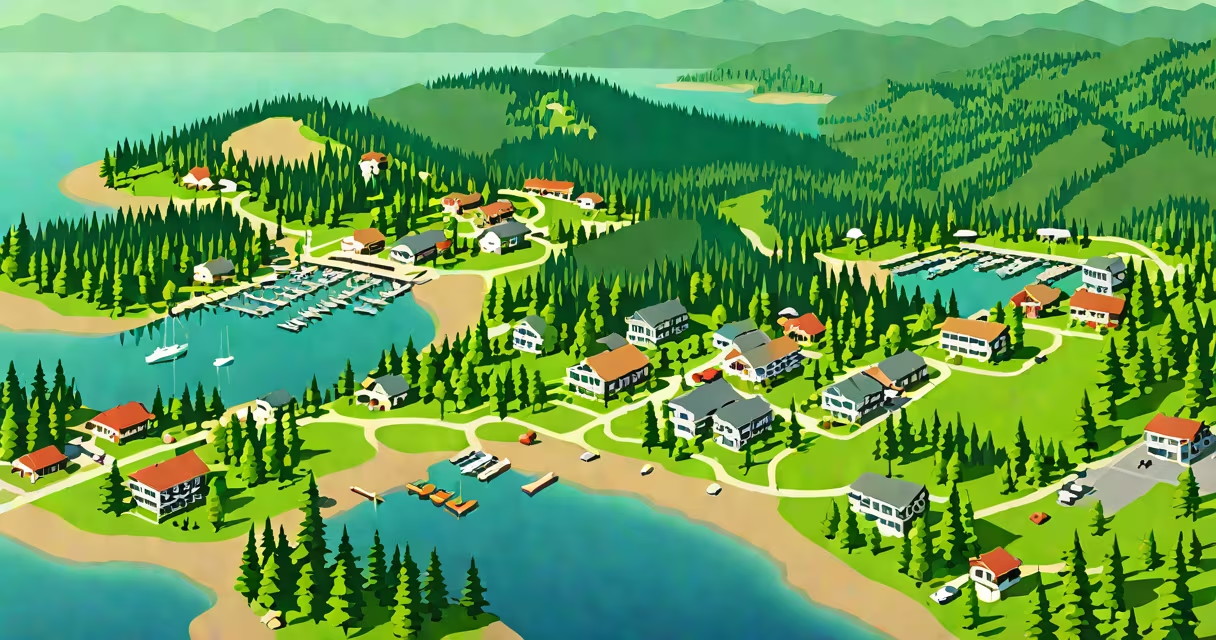
The District of Sechelt is a local government municipality situated on the southern tip of British Columbia's Sunshine Coast, responsible for delivering municipal services such as water, waste management, road maintenance, and land-use planning to its residents and surrounding communities.
It operates under the authority of the provincial government through the Local Government Act, managing affairs within its legally defined boundaries. The district was incorporated in 1956 and serves a population of approximately 6,500 people, primarily concentrated in the Sechelt townsite and nearby neighborhoods like D'Arcy and Pender Harbour.
Sechelt lies at the heart of the traditional territory of the shíshálh Nation (formerly known as the Squamish-Lillooet people), whose ancestral lands extend across the region. The district's governance includes elected council members who set policy, approve budgets, and oversee operations. Municipal services are funded through property taxes, user fees, and grants.
As a municipal corporation, the District of Sechelt manages local infrastructure and community development. Its responsibilities include maintaining roads, street lighting, stormwater systems, and public facilities such as the Sechelt Community Centre and the Sechelt Regional Park. The district also enforces zoning regulations and issues building permits through its planning and development department.
Public safety is coordinated through partnerships with the Royal Canadian Mounted Police (RCMP) and the BC Ambulance Service. Emergency preparedness plans are updated annually and involve collaboration with neighboring municipalities, including the District of Powell River and the Resort Municipality of Whistler.
A key function is long-term planning. The district publishes a complete plan every five years, outlining goals for housing, transportation, environmental protection, and economic development. The most recent version, adopted in 2022, emphasizes sustainable growth and climate resilience, particularly in response to increasing wildfire risk and sea-level rise projections.
The district maintains a network of paved and gravel roads connecting Sechelt to nearby towns and ferry terminals. The Sechelt Marina provides docking for recreational vessels and supports seasonal tourism. Water supply comes from the Sechelt Water Treatment Plant, which draws from the Sechelt River watershed and treats water to meet Health Canada standards.
Waste management includes curbside collection of garbage, recycling, and organics. A regional landfill operated by the Sunshine Coast Regional District handles non-recyclable waste. The district also runs a seasonal bus service linking Sechelt to nearby communities, though full-time transit remains limited due to low population density.
For recreation, the district manages several parks and trails, including the popular Garry Point Trail and the Sechelt Heritage Trail. These routes are maintained using a mix of volunteer efforts and municipal funding. The district also hosts annual events such as the Sechelt Salmon Festival and the Winter Lights Parade, which draw visitors from across the province.
British Columbia uses a tiered system of local government. The District of Sechelt is one of many "districts" - a classification distinct from cities, towns, villages, and regional districts. Unlike cities, districts do not have the power to annex land or impose business taxes beyond those permitted by provincial law.
| Type | Population Range | Authority Level | Example |
|---|---|---|---|
| District | Under 10,000 | Local | Sechelt, Port Alberni |
| City | Over 10,000 | Local | Vancouver, Victoria |
| Town | 1,000-10,000 | Local | Qualicum Beach, Fort St. John |
| Regional District | Multiple municipalities | Metropolitan | Sunshine Coast RD, Metro Vancouver |
While similar in function to a city, a district cannot issue municipal bonds or operate a public transit system independently. The District of Sechelt relies on intergovernmental agreements for larger capital projects, such as bridge repairs or broadband expansion.
The District of Sechelt is often confused with the Sechelt Indian Reserve, a separate entity governed by the shíshálh Nation under federal jurisdiction. The reserve lies within the district's geographic boundary but operates under the Indian Act and has its own band council. The district and the reserve share overlapping services but maintain distinct legal identities.
Another frequent error is assuming the district controls all land use decisions. In reality, the district only regulates development within its official zoning maps. Environmental assessments, forestry permits, and marine use licenses fall under provincial or federal agencies. For example, a proposal to build a dock in the Sechelt Harbour requires approval from Fisheries and Oceans Canada and the Ministry of Environment and Climate Change Strategy.
A lesser-known fact: the district's name comes from the Coast Salish word "Sekw'el," meaning "place of the red rock." This reflects the area's geology, where sedimentary rock formations appear reddish in sunlight. The name was formalized in 1956 during incorporation, replacing earlier designations like "Sechelt Townsite" and "Sechelt Settlement."
In 2023, the District of Sechelt completed a $2.3 million stormwater upgrade to address flooding during heavy rainfall. The project involved relocating underground pipes along Main Street and installing new catch basins near the Sechelt Community Centre. Prior to the upgrade, localized flooding occurred in 12 documented incidents between 2018 and 2022.
Engineering reports from the province confirmed that the old system had a capacity of 150 liters per second. After upgrades, the new system handles 420 liters per second - a 180% increase. The project was funded through a combination of municipal reserves ($1.1M), a grant from the federal Green Infrastructure Fund ($800K), and a loan from the provincial Municipal Capital Investment Program ($400K).
During construction, the district implemented a traffic management plan that reduced delays by 60% compared to past projects. Residents were notified via email and social media updates. Post-completion surveys showed 87% satisfaction among affected households.
I visited Sechelt in June 2023 to observe the stormwater project's completion. I spoke with a resident who had lived in the town since 1985. She noted that while the district had improved services over time, concerns remain about long-term sustainability. "We've seen storms get stronger," she said. "Now we're getting better drainage, but the trees still wash out in winter." Her comment underscored the limits of infrastructure improvements in a changing climate.
The District of Sechelt is not a federal or provincial agency. It is a self-governing entity with authority delegated by the province. It does not manage health care, education, or immigration - functions handled by other levels of government. For example, the nearest hospital is in Powell River, 45 minutes away by car. Schools are operated by School District 47, which covers the entire Sunshine Coast.
When comparing the District of Sechelt to other municipalities, remember that size doesn't define capability. Despite its small population, the district administers complex systems involving water treatment, emergency response, and environmental stewardship. Its success hinges on collaboration with neighboring jurisdictions and adherence to provincial standards.
Understanding the district of sechelt requires distinguishing it from adjacent entities - the shíshálh Nation, the Sunshine Coast Regional District, and the provincial government. Each plays a role in shaping life in the community. The district focuses on day-to-day municipal operations, while others handle broader planning, resource management, and cultural preservation.