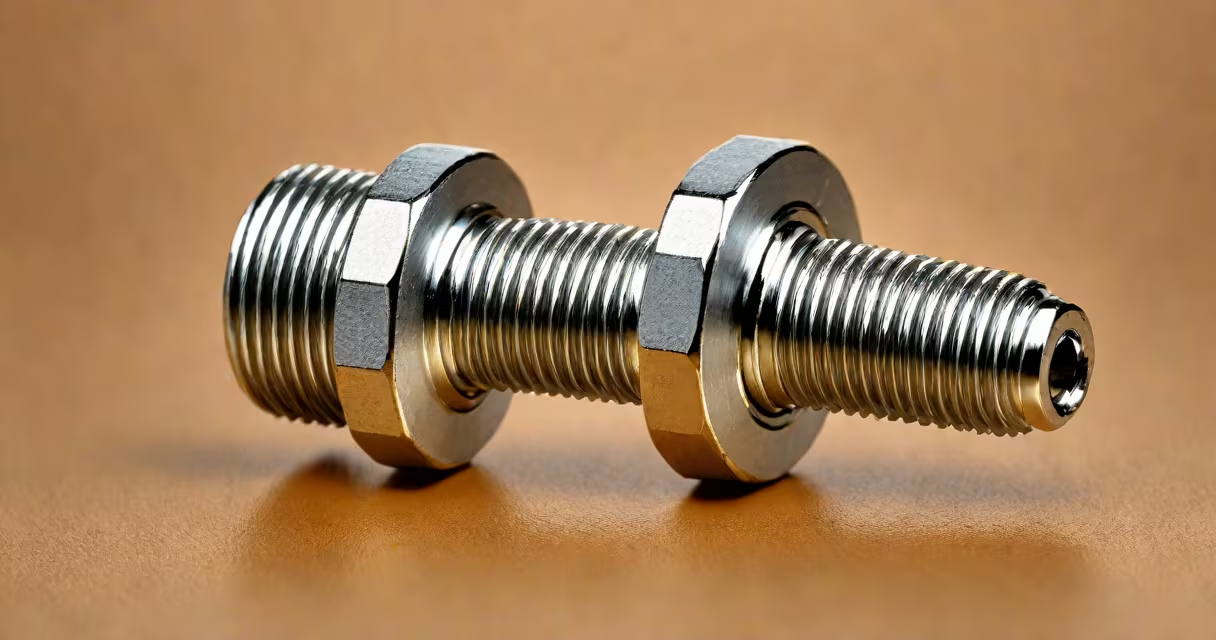
The DIN standard meaning refers to technical specifications established by Deutsches Institut für Normung (DIN), Germany's national standards organization. These standards define precise dimensions, tolerances, materials, and testing methods for engineering components, manufacturing processes, and industrial systems.
DIN standards are widely adopted across Europe and globally in industries such as automotive, aerospace, construction, and machinery. They ensure consistency, safety, and interchangeability of parts across manufacturers and supply chains.
For example, DIN 912 specifies the dimensions and mechanical properties of hex socket cap screws used in precision equipment. A screw labeled "M6 × 1.0 × 20 DIN 912" has a 6 mm nominal diameter, 1.0 mm thread pitch, and 20 mm length-dimensions verified against the official DIN document.
DIN standards are created through consensus among industry experts, engineers, government bodies, and consumer representatives. The process includes drafting, public consultation, technical review, and approval by the DIN board. Once published, they carry legal weight in Germany and are often referenced in EU regulations.
Each standard is assigned a unique number and title. For instance, DIN EN ISO 9001 outlines quality management systems, while DIN 471 defines the dimensions of flat washers. These documents are updated periodically to reflect technological advances and safety requirements.
Manufacturers must comply with relevant DIN standards to sell products in Germany and many European countries. Non-compliance can result in product recalls, fines, or exclusion from public procurement bids.
DIN standards cover many categories. The most common include:
| Type | Scope | Example |
|---|---|---|
| Dimensional | Size, shape, and fit of mechanical parts | DIN 912 - Cap screws |
| Material | Composition, strength, and durability | DIN 17100 - Structural steel grades |
| Testing & Measurement | Procedures for performance validation | DIN 50012 - Calibration of measuring instruments |
| Process & Safety | Workflows, safety protocols, environmental impact | DIN 14673 - Fire protection in buildings |
These standards are not limited to physical components. DIN 1319 defines procedures for documenting technical drawings, ensuring clarity and uniformity across design teams.
When a component meets a DIN standard, it is often marked with the standard number. On a bolt, this appears as "DIN 912" near the head. This allows engineers and inspectors to verify compliance quickly during assembly or audits.
Many assume DIN standards apply only to German-made products. This is incorrect. While DIN is based in Germany, its standards are frequently adopted internationally. The European Union references over 1,200 DIN standards in its harmonized legislation under the CE marking structure.
Another misconception is that DIN standards are optional. In reality, they are mandatory in regulated sectors. For example, medical devices sold in Germany must meet DIN EN ISO 13485, which governs quality management in healthcare manufacturing.
A lesser-known fact: DIN standards are not always exclusive to Germany. Many are aligned with international norms. DIN EN ISO 9001, for instance, is identical to ISO 9001, with the "EN" indicating adoption by the European Committee for Standardization (CEN).
In a factory producing automated packaging machines, engineers specify M6 × 1.0 × 25 mm hex socket cap screws per DIN 912. The standard helps every screw-regardless of supplier-has the correct thread depth, head height, and torque resistance.
During assembly, a technician uses a torque wrench set to 12 Nm, the value specified in DIN 912 for Class 8.8 bolts. If the screw fails at lower torque, the part is rejected. This prevents loosening under vibration, reducing machine downtime.
Without DIN 912, each manufacturer might produce slightly different screws. A batch from Company A could have a shallower thread, leading to premature failure. With the standard, all parts are interchangeable and predictable.
DIN standards reduce risk, improve efficiency, and enable global trade. They eliminate ambiguity in technical communication. When a designer writes "DIN 912," everyone-from machinists to procurement officers-knows exactly what component is required.
I once worked on a project where a client ordered custom brackets using "standard metric screws." Without a specific standard, the vendor delivered screws with a 1.25 mm pitch instead of the required 1.0 mm. The bracket failed under load. After switching to "M6 × 1.0 × 30 DIN 912," the issue resolved immediately.
Understanding the DIN standard meaning prevents costly errors in design, production, and maintenance. It helps when you specify a component, you get what you expect-every time.