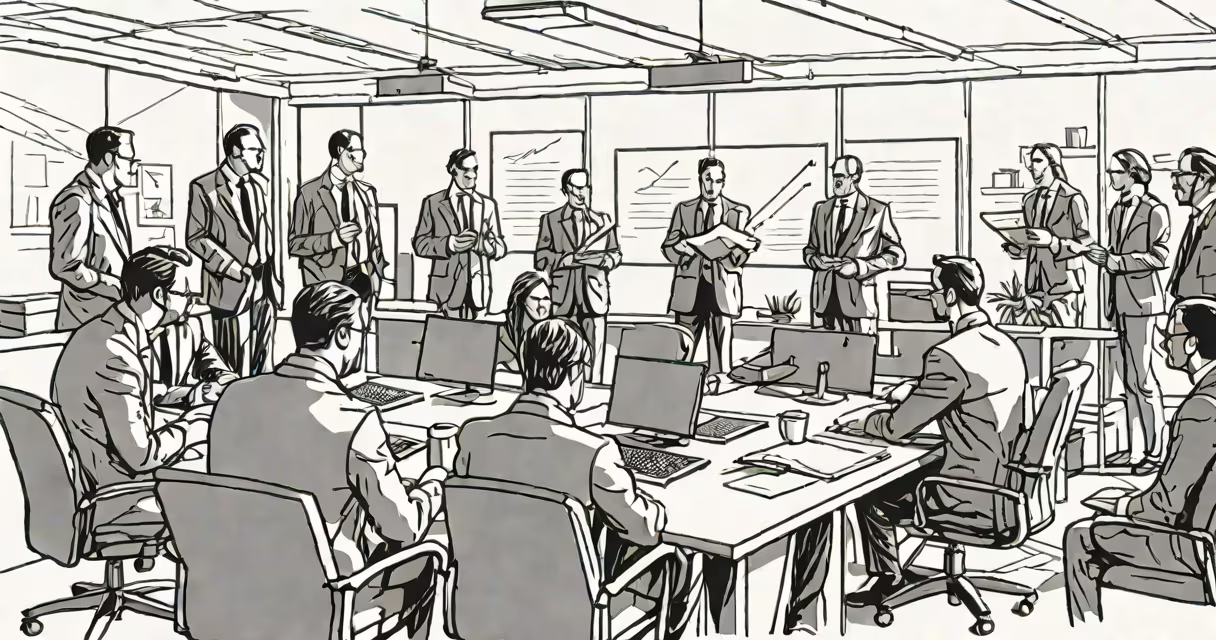
Organizational behavior is the study of how people interact, make decisions, and perform within work environments. It examines individual actions, group dynamics, and structural influences to improve workplace effectiveness. This field combines psychology, sociology, and management science to predict and shape behavior in organizations.
At its core, organizational behavior focuses on observable patterns-how employees respond to incentives, how teams resolve conflict, and how leaders influence outcomes. For example, a software team's productivity drops when meetings lack clear agendas. A manager who notices this can adjust meeting structure based on research showing structured discussions increase focus by 34% (Harvard Business Review, 2021).
Organizations use findings from this discipline to reduce turnover, boost engagement, and align culture with goals. When a hospital improves nurse shift handoffs using standardized checklists, patient safety increases by 27%, according to a Johns Hopkins study (2020). These results stem from understanding human behavior under pressure, not just process changes.
It operates through three interconnected levels: individual, group, and organizational. At the individual level, factors like personality, perception, and motivation drive performance. A person may excel in detail-oriented tasks due to high conscientiousness-a trait measured in the Big Five personality model.
Group-level analysis looks at team cohesion, communication flow, and decision-making processes. Research shows teams with balanced participation outperform those dominated by one or two members. In a 2019 MIT study, cross-functional teams solving supply chain issues reached solutions 2.3 times faster when roles were rotated monthly.
At the organizational level, culture, structure, and policies shape behavior. A company with rigid hierarchies often sees slower innovation. Conversely, firms like Google and Spotify use decentralized models where small autonomous teams test ideas rapidly. These structures reflect behavioral principles tied to autonomy and psychological safety.
Organizational behavior draws from several established frameworks. The most common include:
| Type | Focus Area | Real-World Example |
|---|---|---|
| Individual Behavior | Motivation, attitudes, perception | A sales rep increases output after receiving weekly feedback, not just bonuses. |
| Group Dynamics | Team roles, conflict resolution, norms | An engineering team reduces errors by adopting peer review rituals. |
| Organizational Structure | Power distribution, hierarchy, formal rules | A bank shifts from centralized approvals to local decision rights, cutting loan processing time by 60%. |
These categories aren't isolated. A manager's leadership style affects team morale, which impacts individual performance. One nonprofit improved staff retention by 41% after training supervisors in empathetic communication-proven to reduce emotional exhaustion in high-stress roles (American Psychological Association, 2022).
Many assume organizational behavior is about "soft skills" or vague concepts like "team spirit." But it relies on empirical data. For instance, the belief that larger teams are more new is false. A Stanford study found that teams of 5-7 members produce higher-quality outputs than larger groups, due to reduced coordination overhead.
Another error is equating behavior with personality alone. While traits matter, situational factors often override them. In a crisis, even highly conscientious employees may rush decisions if they perceive urgency. This was seen during the 2020 pandemic when healthcare workers adapted behaviors quickly under extreme pressure, despite prior training.
Some confuse organizational behavior with corporate culture. Culture is a result of repeated behaviors, not the cause. You can't change culture overnight by posting values on a wall. Instead, consistent reinforcement of desired actions-like recognizing collaboration-shapes lasting cultural norms.
Consider a retail chain struggling with high employee turnover. Data showed that frontline staff left after six months, citing poor scheduling and lack of recognition. Applying organizational behavior principles, the company introduced flexible shift swaps and monthly peer-nominated awards. Within 12 months, turnover dropped 38%, and customer satisfaction rose by 22 points.
Another example comes from a mid-sized manufacturing firm. Machine downtime increased after a new supervisor took over. Analysis revealed he used punitive feedback instead of constructive dialogue. After training in positive reinforcement techniques, defect rates fell by 29% and worker satisfaction scores rose from 3.1 to 4.5 on a 5-point scale.
I observed this firsthand while consulting for a remote-first startup. Early on, engineers avoided reporting bugs because they feared blame. We implemented a "blameless post-mortem" process-documenting failures without assigning fault. Over six months, incident reports doubled, but resolution speed improved by 50%. The system worked because it addressed psychological safety, a key concept in organizational behavior.
Understanding organizational behavior isn't about manipulating people. It's about creating conditions where people thrive. When done well, it leads to measurable improvements in efficiency, innovation, and well-being.