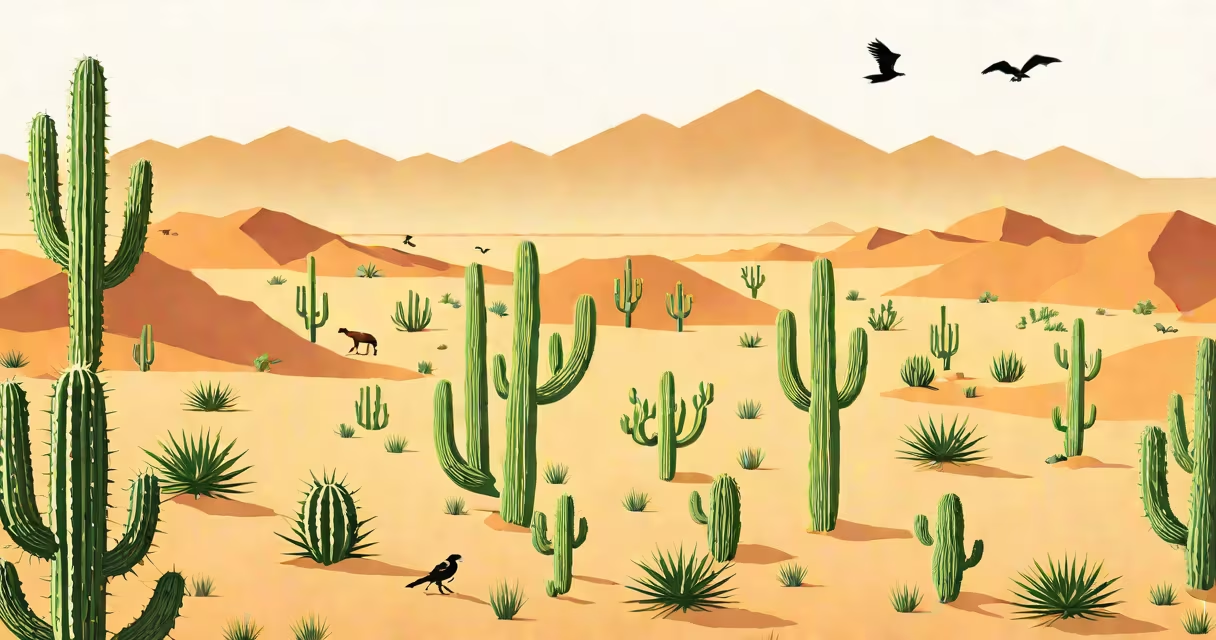
A desert food chain is a sequence of organisms through which energy and nutrients move, starting with primary producers like cacti and grasses, then passing to herbivores such as kangaroo rats, and finally to carnivores like coyotes and hawks. This system reflects how life sustains itself in extreme heat and low water conditions.
Energy enters the desert food chain through photosynthesis. Plants such as saguaro cacti, creosote bushes, and brittlebush convert sunlight into chemical energy stored in their tissues. These plants form the base of the food chain. They grow slowly due to limited rainfall and high temperatures, but they support a surprising variety of life.
Herbivores consume these plants. The kangaroo rat, for example, eats seeds and plant material. It survives with minimal water by extracting moisture from its food and excreting highly concentrated urine. A single adult rat can live for years without drinking water. Its survival depends entirely on the energy captured by desert plants.
| Level | Organism | Role | Energy Source |
|---|---|---|---|
| Primary producer | Cactus, creosote bush | Converts solar energy to biomass | Sunlight |
| Primary consumer | Kangaroo rat, desert tortoise | Eats plants | Plant matter |
| Secondary consumer | Desert fox, Gila monster | Eats herbivores | Herbivore tissue |
| Tertiary consumer | Coyote, red-tailed hawk | Predators at top of chain | Smaller carnivores |
Secondary consumers eat primary consumers. The Gila monster, a venomous lizard, feeds on eggs and young rodents. It stores fat in its tail and can survive months without eating. Its metabolism slows dramatically during dry periods, reducing energy needs. This adaptation allows it to thrive in environments where prey is scarce.
Tertiary consumers occupy the highest trophic level. Coyotes hunt small mammals and birds. Red-tailed hawks soar above desert plains, spotting prey from great heights. Their sharp eyesight detects movement from over 100 meters away. They rely on consistent prey populations to maintain energy levels.
Decomposers complete the cycle. Scavengers like the sidewinder rattlesnake and insects such as darkling beetles break down dead organisms. Beetles collect dew on their backs and channel water to their mouths-a behavior known as fog basking. This adaptation allows them to extract moisture from the air, supporting decomposition even in dry conditions.
One non-obvious fact: Energy transfer between trophic levels is inefficient. Only about 10% of energy from one level reaches the next. A plant captures 1,000 units of solar energy. A herbivore consuming it gains roughly 100 units. The carnivore that eats the herbivore receives only 10 units. This limits the number of top predators in any desert system.
For example, in the Sonoran Desert, a single coyote may require 200 grams of meat daily. To sustain this, it must kill or scavenge multiple small animals each week. This demand shapes population sizes and distribution patterns. Studies show that coyote densities drop sharply in areas with less prey availability, even when water is present.
Desert food chains differ from those in forests or oceans. Water scarcity reduces plant growth, limiting biomass. As a result, food chains are shorter and have fewer links. Most desert ecosystems contain only four trophic levels, compared to five or six in temperate forests. This makes them more vulnerable to disruption.
Common confusion: People often assume that deserts lack biodiversity. In reality, desert food chains are complex and tightly interconnected. The presence of keystone species-such as the kit fox, which controls rodent populations-can stabilize entire systems. Removing one species can cause cascading effects. For instance, eliminating coyotes leads to rodent overpopulation, which depletes vegetation and increases soil erosion.
Another misconception: All desert animals are nocturnal. While many are, not all are. The roadrunner, for example, is diurnal and hunts during daylight hours. It relies on speed and agility rather than stealth. Its diet includes lizards, insects, and small birds. It can run up to 20 mph in short bursts, making it one of the fastest birds in North America.
I once observed a desert food chain unfold during a field study in Arizona. I watched a coyote catch a jackrabbit near a wash. Minutes later, a red-tailed hawk circled overhead. The coyote dropped the carcass and fled. The hawk landed and began feeding. Later, beetles appeared and consumed the remains. Within 36 hours, the rabbit's body was nearly gone. This cycle demonstrated how quickly energy moves through a desert system.
Understanding the desert food chain helps explain conservation priorities. Protecting habitat for one species affects others. For example, preserving mesquite trees supports ants, which feed birds, which in turn control insect pests. This interdependence means that restoring a single plant species can trigger recovery across multiple levels.
Research from the U.S. Geological Survey confirms that desert food webs are sensitive to climate shifts. Warmer temperatures increase evaporation, reducing plant growth. Lower plant productivity reduces herbivore numbers, which then impacts carnivores. A 2°C rise in average temperature can reduce desert mammal abundance by up to 30% over 20 years.