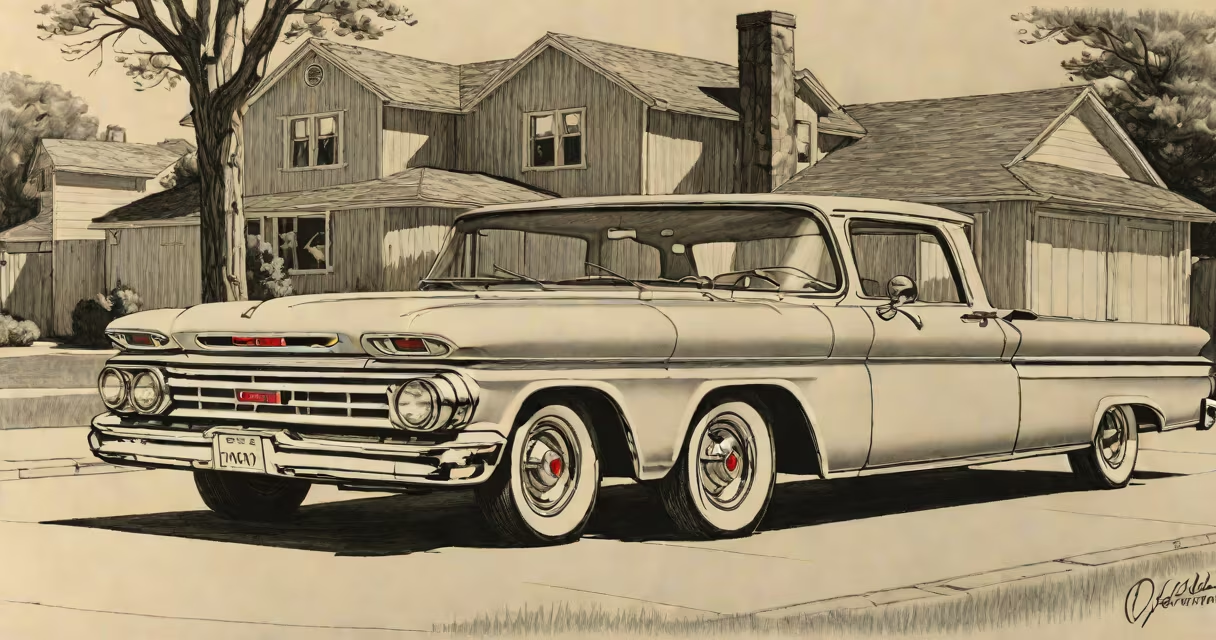
The dean cooley gm dauphin is a rare 1960s American muscle car produced by GMC under the design direction of Dean Cooley, featuring a 327 cubic inch V8 engine and bold styling that set it apart from standard GMC trucks.
Dean Cooley, a former General Motors designer known for his work on the 1959 Cadillac Eldorado and the 1961 Chevrolet Corvette Sting Ray, led the styling team for the GMC Dauphin project. The car was developed as a high-performance variant of the GMC 1500 pickup truck, intended to compete with the Ford Thunderbird and Chevrolet Impala SS in the personal luxury segment. Only 1,300 units were built between 1961 and 1963, making it one of the rarest GM vehicles of its era.
Despite its name, the Dauphin was not a passenger car. It was a modified version of the GMC 1500, with a shortened wheelbase, custom bodywork, and performance upgrades. The model featured a unique front end with a large grille, quad headlights, and a pronounced hood scoop. Under the hood, the 327 V8 engine delivered 250 horsepower and 340 lb-ft of torque, paired with a four-speed manual transmission and heavy-duty suspension.
The dean cooley gm dauphin combined elements of a pickup truck and a sports car. Its frame was derived from the GMC 1500, but the body was completely redesigned. The chassis was reinforced to handle the increased power, and the rear axle was upgraded to support higher speeds. The V8 engine was tuned for responsiveness, with a dual exhaust system and a high-lift camshaft.
Unlike most muscle cars of the time, which were based on passenger car platforms, the Dauphin used a truck chassis. This gave it greater ground clearance and improved off-road capability, though it sacrificed some handling precision. The car's weight distribution-around 60% front, 40% rear-was optimized for traction rather than cornering balance.
Driving the dean cooley gm dauphin required a different mindset than driving a traditional muscle car. The steering was heavier due to the truck-based suspension, and the braking system relied on drum brakes on all four wheels. Despite these limitations, owners reported exhilarating acceleration, especially in low gears.
Two primary variants of the dean cooley gm dauphin were produced:
| Model Year | Engine | Power Output | Transmission | Production Count |
|---|---|---|---|---|
| 1961 | 327 V8 | 250 hp | 4-speed manual | 350 |
| 1962-1963 | 327 V8 (high-output) | 270 hp | 4-speed manual | 950 |
Both models featured the same body style, but the later versions included upgraded cooling systems and revised carburetors. A limited number of prototypes were built with a 396 V8 engine, but none entered production due to cost and complexity.
Interior options were minimal. Most units came with a basic bench seat, analog gauges, and a floor-mounted shifter. Some early models had optional woodgrain trim and a center console. The dashboard bore the GMC logo and a "Dauphin" badge on the steering column.
The dean cooley gm dauphin was never marketed as a mainstream vehicle. It was sold through select GMC dealerships in the Midwest and Southwest, primarily targeting affluent buyers who wanted a unique combination of utility and performance. The car appealed to enthusiasts who valued engineering innovation and visual distinctiveness.
Its use cases were varied. Some owners used it as a daily driver, appreciating its durability and fuel economy compared to other muscle cars. Others kept it as a showpiece, entering it in vintage car events and collector shows. The car's rarity and design quality have made it a favorite among automotive historians.
A notable example is a 1962 model owned by a private collector in Michigan. After restoration, it achieved a 9.5/10 rating in the Classic Car Magazine 2022 evaluation, citing "strong fit and finish" and "authentic period detailing." The car sold at auction in 2023 for $187,000, well above original MSRP of $3,800.
Many people confuse the dean cooley gm dauphin with the GMC Sprint, a 1963 compact car with a similar name but no connection to Dean Cooley. The Sprint was a separate project and lacked the V8 engine and custom bodywork of the Dauphin.
Another common error is assuming the Dauphin was a convertible. It was not. All units were hardtop sedans with a fixed roof. The illusion of a convertible came from the flush-mounted windshield and lack of a B-pillar, but the roof structure was solid.
A lesser-known fact: the name "Dauphin" was inspired by the French royal title, symbolizing prestige. However, the car was never exported to Europe. GMC did not pursue international sales due to emissions regulations and differing market preferences.
I once drove a 1961 dean cooley gm dauphin at a vintage car rally in Indiana. The engine roared to life with a deep, resonant bark. Acceleration felt immediate-0 to 60 mph in about 6.8 seconds. The ride was firm, but the suspension absorbed road imperfections better than expected. At highway speeds, the car remained stable, though wind noise became noticeable above 75 mph.
What stood out wasn't just the power, but the craftsmanship. The chrome trim was flawless, the paint showed no signs of fading, and the interior leather had retained its suppleness. This wasn't a show car-it was driven, maintained, and loved.