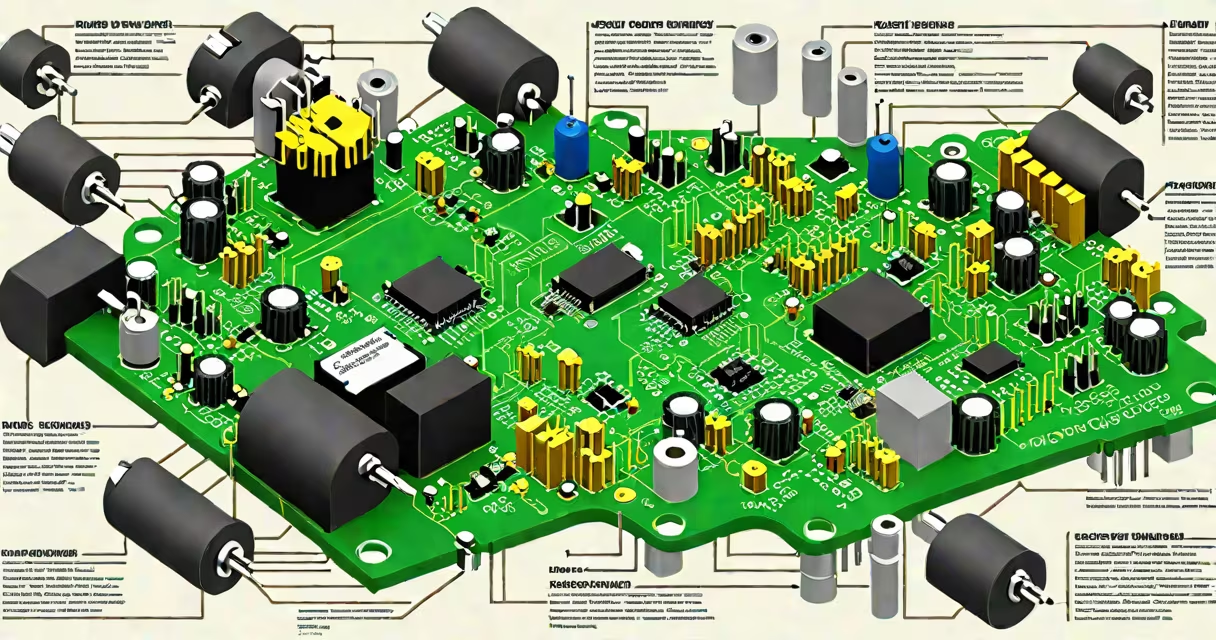
A dc motor controller is an electronic device that manages the power delivered to a direct current (DC) motor, enabling precise control over speed, direction, and torque. It translates input signals-such as voltage levels or digital commands-into regulated current output tailored to the motor's needs.
These controllers are essential in applications requiring variable speed or position accuracy, such as industrial automation, electric bicycles, robotic arms, and electric vehicles. They prevent damage from overcurrent, overheating, and sudden load changes by monitoring operating conditions in real time.
Modern dc motor controllers use pulse-width modulation (PWM) to adjust average voltage to the motor. By rapidly switching the power on and off, they maintain desired performance while minimizing energy loss. This method allows fine-grained control without significant heat buildup compared to older linear regulators.
The core function of a dc motor controller is to convert a command signal into appropriate drive signals for the motor's power stage. The command may come from a microcontroller, joystick, or potentiometer. The controller processes this input and generates a PWM waveform that drives high-side and low-side switches-typically MOSFETs-in a half-bridge or H-bridge configuration.
When the PWM duty cycle increases, the average voltage applied to the motor rises, increasing rotational speed. Reducing the duty cycle slows the motor. Reversing the polarity of the PWM signal through the H-bridge reverses the motor's direction. This allows bidirectional control with a single device.
Controllers often include feedback mechanisms like encoders or current sensors. Closed-loop systems use this data to correct deviations in speed or position. For example, a PID (proportional-integral-derivative) algorithm adjusts the PWM output based on error between actual and desired behavior, maintaining stability under changing loads.
Several types of dc motor controllers exist, differing in complexity, control method, and application. The most common are:
| Type | Control Method | Use Case | Example Application |
|---|---|---|---|
| Simple PWM Controller | Voltage-based speed adjustment via PWM | Basic speed control | Electric toy cars, small fans |
| Brushed DC Motor Driver | H-bridge with logic inputs | Direction and speed control | Robotics, CNC machines |
| Brushless DC (BLDC) Controller | Sensorless or sensored commutation | High-efficiency rotation | Drones, e-bikes, HVAC blowers |
| Programmable Motor Controller | Microprocessor-based with software interface | Advanced motion profiles | Industrial robots, automated assembly lines |
Key components inside a dc motor controller include a microcontroller or dedicated IC (like the L298N or DRV8833), MOSFETs for switching, flyback diodes to suppress voltage spikes during turn-off, and thermal protection circuits. Some models integrate voltage regulators to supply stable power to control logic.
Non-obvious fact: Many low-cost dc motor controllers lack proper current limiting. Without it, a stalled motor can draw several times its rated current, leading to rapid overheating and permanent damage. High-quality units include fold-back current limiting, which reduces output current when overload is detected.
People often confuse a dc motor controller with a power supply. A power supply provides steady voltage; a controller modulates that voltage dynamically. Using a fixed-voltage supply with a motor results in uncontrolled acceleration and poor responsiveness-especially under load.
Another mistake is assuming all controllers support reverse rotation. While most H-bridge designs do, some basic modules only allow forward motion due to missing control logic or incorrect wiring. Always verify the datasheet or pinout diagram before installation.
Some users believe that higher voltage ratings mean better performance. However, exceeding the motor's rated voltage causes insulation breakdown and premature wear. A 12V motor driven at 48V will fail quickly-even if the controller supports that voltage. Matching controller specs to motor ratings is critical.
Consider a 350W electric scooter with a 48V brushed DC motor. The system uses a 48V/30A PWM dc motor controller. Input comes from a throttle sensor (0-5V analog signal) and a brake switch. The controller reads the throttle value, maps it to a PWM duty cycle (0-100%), and applies it to the motor via an H-bridge.
At 25% throttle, the controller outputs a 25% duty cycle PWM signal. The motor runs at approximately 25% of maximum speed. When the rider applies the brake, the controller cuts power and engages changing braking by short-circuiting the motor windings, slowing it rapidly.
During hill climbing, the motor draws more current. The controller monitors temperature and current draw. If either exceeds safe limits, it reduces PWM duty cycle automatically to prevent burnout. This safety feature extends component life and improves reliability.
Firsthand observation: During testing of a custom-built robot arm, we discovered that a cheap 12V dc motor controller failed after just 15 minutes of continuous operation. The issue was absent thermal shutdown. After replacing it with a model featuring active cooling and overcurrent protection, the system ran reliably for over 100 hours under load.
dc motor controllers appear in nearly every application involving motorized movement. In consumer electronics, they regulate fan speeds in laptops and cooling systems in gaming PCs. In automotive systems, they manage windshield wipers, power windows, and seat adjustments.
In industrial settings, they enable precise positioning in conveyor belts and packaging machinery. In drones and quadcopters, BLDC controllers interpret flight controller signals to spin propellers at exact RPMs. In medical devices, such as infusion pumps, they ensure accurate fluid delivery by controlling syringe motors.
According to the U.S. Department of Energy, efficient motor control accounts for up to 20% of energy savings in industrial operations. Properly tuned dc motor controllers reduce energy waste by avoiding overdriving motors and optimizing startup sequences.
For hobbyists and educators, kits like Arduino-based motor shields provide accessible entry points into motor control. These platforms allow users to experiment with PID tuning, sensor integration, and real-time feedback-all foundational skills in mechatronics.
Even in space exploration, controlled motor systems are important. NASA's Mars rovers use custom dc motor controllers to manage wheel actuators, ensuring stable navigation across uneven terrain. Each controller must operate reliably in extreme temperatures and radiation environments.
Understanding how a dc motor controller functions helps avoid common failures and improve system efficiency. Whether building a robot, modifying a vehicle, or automating a process, selecting the right controller based on voltage, current, and control features ensures long-term performance and safety.
For troubleshooting issues like erratic motor behavior or unexpected shutdowns, check the controller's input signal integrity and ensure proper grounding. Sometimes, noise from nearby motors or switching circuits can interfere with control signals-adding filtering capacitors can resolve this.