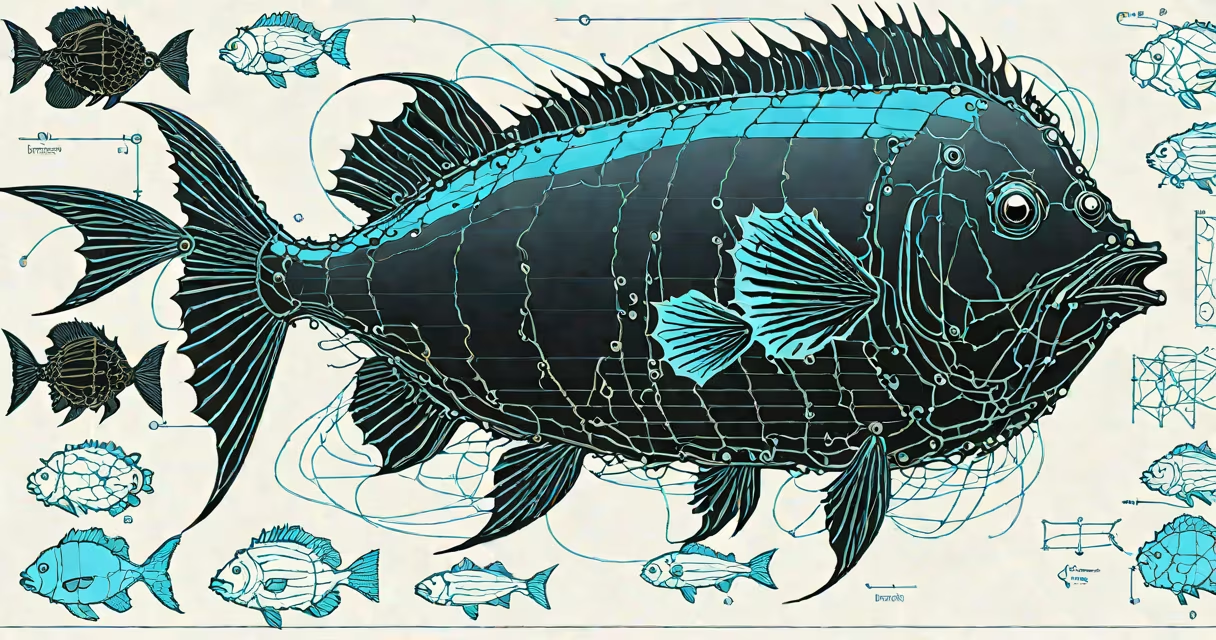
Creature oceaniche biolum refers to deep-sea organisms that generate their own light via biochemical reactions. These animals live in the aphotic zone-where sunlight never reaches-and use bioluminescence for hunting, communication, and camouflage.
Bioluminescence occurs when luciferin, a light-emitting molecule, reacts with oxygen in the presence of an enzyme called luciferase. The reaction produces visible light, typically blue or green, which travels farther in water than other wavelengths. This process requires no external light source and operates efficiently in cold, high-pressure environments.
Marine biologists classify these organisms under the broader term "bioluminescent fauna." They include species such as the anglerfish, certain jellyfish, squid, and small crustaceans. Most live between 200 and 4,000 meters below the surface, where temperatures hover near freezing and pressure exceeds 100 atmospheres.
Light production begins inside specialized cells called photocytes. In many deep-sea fish, these cells cluster in organs known as photophores. When triggered by neural signals, calcium ions release stored luciferin and luciferase into a reaction chamber. Oxygen enters, and within milliseconds, a flash of light appears.
The emitted light is nearly 100% efficient-almost no heat is produced. This contrasts sharply with artificial lighting, where most energy becomes waste heat. In nature, this efficiency conserves important energy in nutrient-poor environments.
A single flash from a deep-sea ostracod (a tiny crustacean) lasts less than 100 milliseconds. Yet, it can attract mates or startle predators. Some species modulate light intensity and color by altering the structure of luciferase enzymes, allowing subtle signaling.
Not all bioluminescence serves the same purpose. Different species evolved distinct strategies based on ecological niche and evolutionary pressures.
| Type | Examples | Primary Function | Light Color |
|---|---|---|---|
| Hunting Lure | Anglerfish, deep-sea eel | Attract prey with dangling bioluminescent appendages | Blue-green |
| Defense Flash | Ostracods, certain squid | Startle predators with sudden bursts | Green-blue |
| Camouflage | Midwater squid, hatchetfish | Match ambient light from above to hide silhouette | Blue |
| Communication | Firefly squid, some shrimp | Signal mates during mating season | Variable (blue, green) |
One non-obvious fact: some bioluminescent organisms host symbiotic bacteria. The Hawaiian bobtail squid (Euprymna scolopes) houses Vibrio fischeri bacteria in its light organ. The bacteria produce light that matches moonlight, making the squid invisible from below-a form of counter-illumination.
Another misconception is that all deep-sea creatures glow. Only about 75% of deep-sea species exhibit bioluminescence. Many remain dark, relying on stealth or sound-based navigation instead.
"Bioluminescence" is often confused with "phosphorescence," but they are different. Phosphorescence involves absorbing light and slowly releasing it-like glow-in-the-dark paint. Bioluminescence is chemical, not light-dependent. A creature can glow in complete darkness.
Some assume bioluminescent animals are rare. In reality, they are widespread. Over 75% of deep-sea species in the Atlantic and Pacific show some form of light emission. The Census of Marine Life estimated that more than 1,000 new bioluminescent species were discovered between 2000 and 2010.
There's also confusion around the origin of the light. It's not caused by electricity or friction. The energy comes entirely from metabolic reactions-specifically, the oxidation of luciferin. No external power source is needed.
Consider the anglerfish (Melanocetus johnsonii). It lives at depths of 600-2,000 meters. Its most distinctive feature is a modified dorsal fin ray that dangles above its mouth, tipped with a bioluminescent lure.
The lure contains photophores filled with bacteria that produce light. The fish moves slowly, swaying the lure to mimic small prey. When a curious fish approaches, the anglerfish snaps shut with a jaw that opens wide enough to swallow prey larger than its own head.
Research from the Monterey Bay Aquarium Research Institute (MBARI) shows that the anglerfish uses low-frequency flashes-about one every 30 seconds-to avoid attracting unwanted attention. This pacing conserves energy and reduces detection risk.
I once observed a video feed from a remotely operated vehicle (ROV) during a deep-sea expedition off the coast of California. A lone anglerfish appeared in the frame, its lure pulsing faintly. The light was barely visible, yet it drew in a small fish that darted toward it. The capture happened in under two seconds. The entire sequence lasted less than ten minutes, but it illustrated how precise and effective bioluminescence can be.
Creature oceaniche biolum describes deep-sea life forms that produce their own light through internal chemical processes. These organisms rely on bioluminescence for survival in environments devoid of sunlight. From lures to camouflage, their glowing adaptations serve specific ecological roles.
Understanding creature oceaniche biolum reveals how life thrives in Earth's most extreme habitats. The phenomenon is not magic-it's chemistry, evolution, and adaptation working together in silence, far beneath the waves.