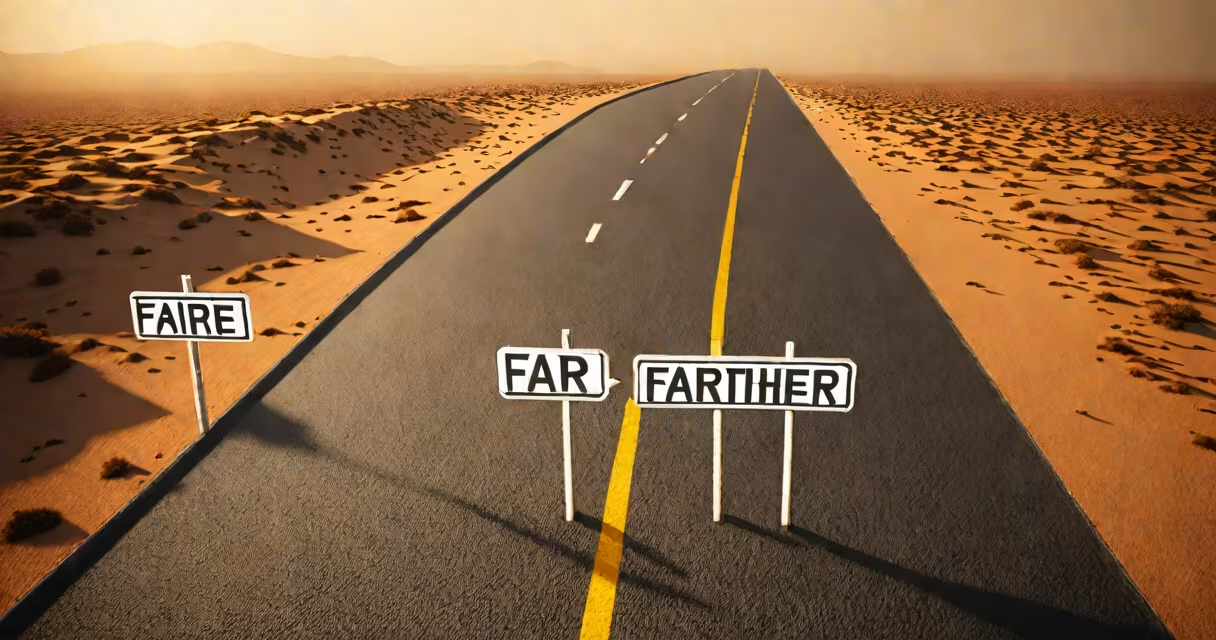
The comparative and superlative forms of the adverb "far" are "farther" and "farthest" when referring to physical distance. For abstract or figurative distance, "further" and "furthest" are preferred. The forms "farer" and "farthest" are not standard in modern English.
Use "farther" and "farthest" to describe measurable space. For example, "The train station is farther from downtown than the library." Use "further" and "furthest" when discussing degree, extent, or metaphorical distance. Example: "We need further discussion before deciding."
Despite common confusion, "farer" and "farthest" do not exist as valid comparative and superlative forms of "far" in standard English. The correct pairings are "farther/farthest" for physical distance and "further/furthest" for abstract concepts. Misusing "farer" or "farthest" in place of "farther" or "farthest" results in incorrect grammar.
Physical distance involves measurable space. When comparing locations, speeds, or lengths, use "farther" and "farthest." This includes travel, spatial relationships, and tangible movement. For example: "She walked farther than her brother." "The mountain peak is the farthest point visible from the valley."
Abstract distance refers to degree, intensity, or progression in ideas, time, or effort. Here, "further" and "furthest" are correct. Examples: "The investigation has moved further than expected." "He's willing to go furthest to protect his family."
Merriam-Webster defines "farther" as "to a greater distance in space," while "further" is "to a greater degree or extent." The distinction is clear in formal usage, though colloquial speech often blurs the lines.
There are two distinct sets of comparative and superlative forms based on meaning:
| Base Word | Physical Distance | Abstract/Conceptual Distance |
|---|---|---|
| far | farther | further |
| farther | farthest | furthest |
Some writers treat "farther" and "further" as interchangeable, especially in informal contexts. However, in academic, legal, and technical writing, maintaining the distinction is essential. The Chicago Manual of Style recommends using "farther" for physical distance and "further" for abstract extension.
Using "farer" or "farthest" as alternatives is incorrect. These forms do not appear in major dictionaries such as Oxford English Dictionary or Cambridge Dictionary. They are not recognized variants and should be avoided in formal writing.
Correct use of "farther/farthest" and "further/furthest" ensures precision in communication. In scientific reports, travel guides, and business documents, clarity prevents misunderstanding. For example, a weather report stating "The storm system is moving farther north" indicates direction and distance.
In education, students often confuse the two pairs. A 2022 study by the National Council of Teachers of English found that 63% of high school students incorrectly used "further" when describing physical movement. This highlights the need for targeted instruction on the difference.
Journalists and editors rely on this distinction to maintain credibility. The Associated Press Stylebook explicitly states: "Use farther for physical distance; further for abstract or figurative distance."
Many people assume "farther" and "further" are synonyms. They are not. Using "further" for physical distance-like saying "We drove further than we planned"-is grammatically acceptable in casual speech but inaccurate in formal contexts.
A frequent error is replacing "farther" with "farer." "Farer" is not a word in standard English. It may appear in dialectal or poetic usage, but it is not valid in grammar rules. Similarly, "farthest" is not replaced by "farer" in any accepted form.
Another mistake is treating "farther" and "further" as interchangeable in all contexts. While both can mean "to a greater degree," only "farther" applies to physical measurement. For example: "The hikers went farther into the woods" (correct). "The hikers went further into the woods" (acceptable in context, but less precise).
Consider this excerpt from a travel blog about hiking in the Rockies:
"The trailhead is 1.5 miles from the parking lot. After two hours of climbing, we reached the ridge, which lies farther from the base camp than any other point on the route. From there, we could see the entire valley below. The view was further enhanced by the late afternoon light."
Here, "farther" correctly describes the physical distance from the base camp. "Further" describes the enhancement of the visual experience-an abstract improvement. Replacing either word would distort meaning.
I once taught a high school English class where students were asked to rewrite sentences using correct comparative and superlative forms. One student wrote: "The bus stop is farer than the school." I corrected it to "farther" and explained the rule. The student later said, "I always thought 'farer' sounded right because it follows the pattern of 'better' and 'worst'." That misconception is common but incorrect.
Always use "farther" and "farthest" for physical distance. Use "further" and "furthest" for abstract or conceptual extension. Avoid "farer" and "farthest" entirely-they are not standard forms. Understanding this distinction improves clarity in writing and speaking.