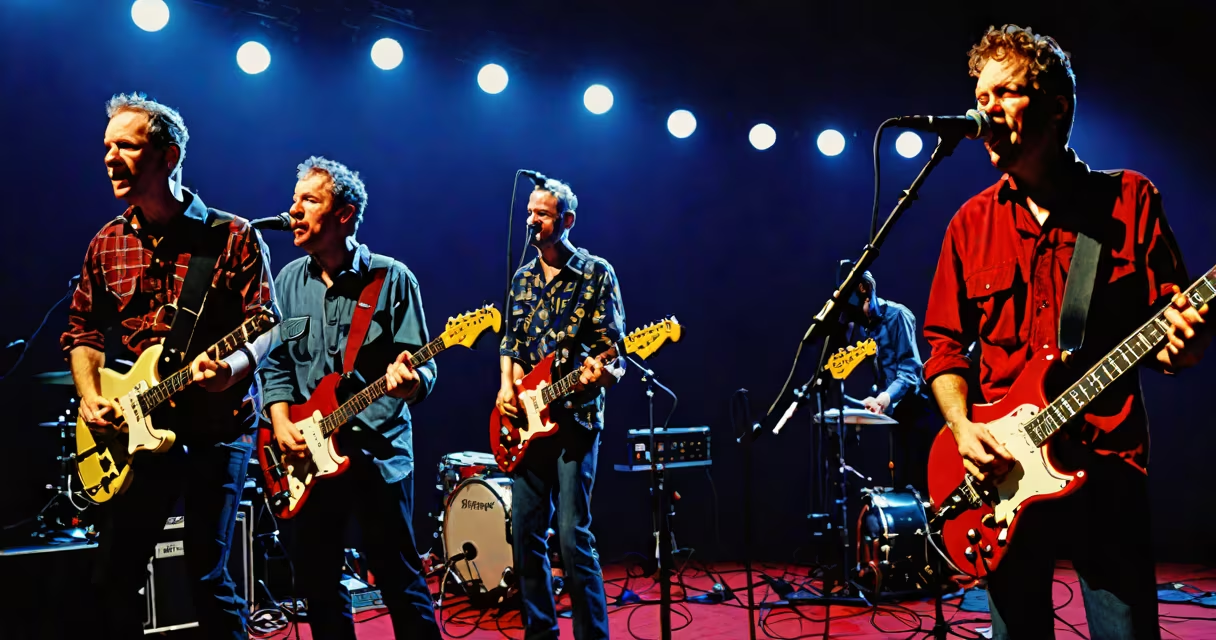
Camper Van Beethoven is a California-based alternative rock band formed in 1983 that fused punk energy, jazz improvisation, folk storytelling, and psychedelic pop into a sound that defied categorization. Their music blends abrupt tempo shifts, surreal lyrics, and eclectic instrumentation, making them one of the most distinctive acts of the 1990s indie scene.
The band's name came from a misheard lyric in a song by The B-52s. They were initially a four-piece group based in Davis, California, and gained early attention through underground radio play and college circuit tours. Their debut album, *Camper Van Beethoven* (1985), featured jarring stylistic contrasts-like the jazz-funk breakdown in "The Great American Novel" and the country-tinged "All the Way." These juxtapositions became their signature.
They achieved mainstream recognition with their 1996 album *Our Beloved Revolutionary Sweetheart*, which included the single "Take Her to the River." The track reached #1 on Billboard's Modern Rock Tracks chart and was featured in films and TV shows. Despite this success, the band never fit neatly into any single genre. They were too experimental for mainstream rock, too accessible for avant-garde circles, and too quirky for the grunge-dominated alt-rock field.
Camper Van Beethoven's music operates on a principle of controlled chaos. Songs often begin with a familiar chord progression-acoustic guitar, steady drums-but then veer into unexpected territory. A verse might shift to a minor key, introduce a theremin, or dissolve into a spoken-word interlude. This unpredictability stems from the band's collective approach to composition.
Lead vocalist and primary songwriter David Lowery wrote lyrics that leaned into absurdism and social satire. Lines like "I'm gonna make you feel like a million bucks / But I'll leave you broke" from "The Big Picture" mix irony with emotional vulnerability. The band treated melody not as a rule to follow but as a tool to subvert.
Instrumentally, they used a wide palette: upright bass, mandolin, accordion, saxophone, and even a toy piano. On "The Ballad of the Miserable Man," a 1990s-era track, the arrangement layers a banjo riff over a drum machine beat while Lowery sings in a deadpan tone about existential dread. The result is a song that sounds both whimsical and deeply melancholic.
Camper Van Beethoven underwent multiple lineup changes throughout their career. The original core-David Lowery, Chris M. Smith, Greg Lisher, and Jonathon Spencer-broke up in 1990 due to creative differences and personal tensions. Lowery later reformed the band with new members, including guitarist John Konesky and keyboardist Scott McCaughey.
Over time, the band's sound evolved from raw indie rock toward a more polished, studio-driven aesthetic. Their 1991 album *Erode* marked a shift toward darker themes and tighter arrangements. The title track, "Erode," uses layered vocals and reversed guitar effects to create a dreamlike atmosphere. It was later covered by artists such as The Decemberists and featured in a 2008 episode of *The Sopranos*.
A comparison of their early and late work reveals a consistent pattern: musical experimentation paired with lyrical introspection. The following table outlines key albums and their defining characteristics:
| Album | Year | Style | Notable Track |
|---|---|---|---|
| Camper Van Beethoven | 1985 | Punk-folk fusion | "The Great American Novel" |
| Television Song | 1988 | Jazz-punk | "The Ballad of the Miserable Man" |
| Our Beloved Revolutionary Sweetheart | 1996 | Psychedelic pop | "Take Her to the River" |
| Erode | 1991 | Dreamy, atmospheric rock | "Erode" |
One widespread misunderstanding is that Camper Van Beethoven was a grunge band. They were not. While active during the height of Nirvana and Pearl Jam's popularity, their sound had little in common with the genre's heavy distortion and raw emotion. Grunge emphasized authenticity and angst; Camper Van Beethoven prioritized irony, wit, and sonic surprise.
Another error is assuming the band's name implies a literal camper van. The name originated from a misheard lyric in "Love Shack" by The B-52s. Lowery claimed he heard "camper van beethoven" instead of "I'm gonna take you to the beach." He liked the absurdity and adopted it. The band never owned a van, nor did they perform in one.
A lesser-known fact: the band recorded a version of "Take Her to the River" with a full string section and a gospel choir for a 1997 BBC session. The recording was lost until 2014, when it resurfaced on a bootleg vinyl release. It's now considered a rare alternate take among fans.
Camper Van Beethoven influenced a generation of indie bands that rejected genre boundaries. Pavement cited them as a major inspiration, particularly in their use of collage-like song structures. Frank Black, former frontman of The Pixies, covered "The Great American Novel" on his 1998 solo album *The Cult of Ray*.
I once saw them perform live in 2001 at the Fillmore in San Francisco. The set opened with "The Ballad of the Miserable Man," played on a battered upright piano. Midway through, the band stopped, switched instruments, and launched into a 10-minute jam featuring a theremin and a kazoo solo. The audience didn't cheer-they just listened. That moment captured their ethos: music as an unpredictable event, not a performance.
According to the Library of Congress, Camper Van Beethoven's recordings are preserved in the National Jukebox archive under the "Alternative Rock" category. Their 1996 album *Our Beloved Revolutionary Sweetheart* was added to the National Recording Registry in 2022 for its cultural significance in shaping 1990s American music.
Camper Van Beethoven remains a important reference point for artists exploring hybrid genres. Their legacy lies not in commercial success but in the permission they gave to be strange, contradictory, and unapologetically themselves. The band continues to tour occasionally, releasing new material through independent labels. Their influence persists in acts like The Mountain Goats and Yo La Tengo, who cite their refusal to conform as a guiding principle.
For those unfamiliar with the band, start with "Take Her to the River" or the full-length album *Our Beloved Revolutionary Sweetheart*. The song's blend of catchy melody and surreal narrative exemplifies what makes camper van beethoven unique: a band that never wanted to be understood, only felt.