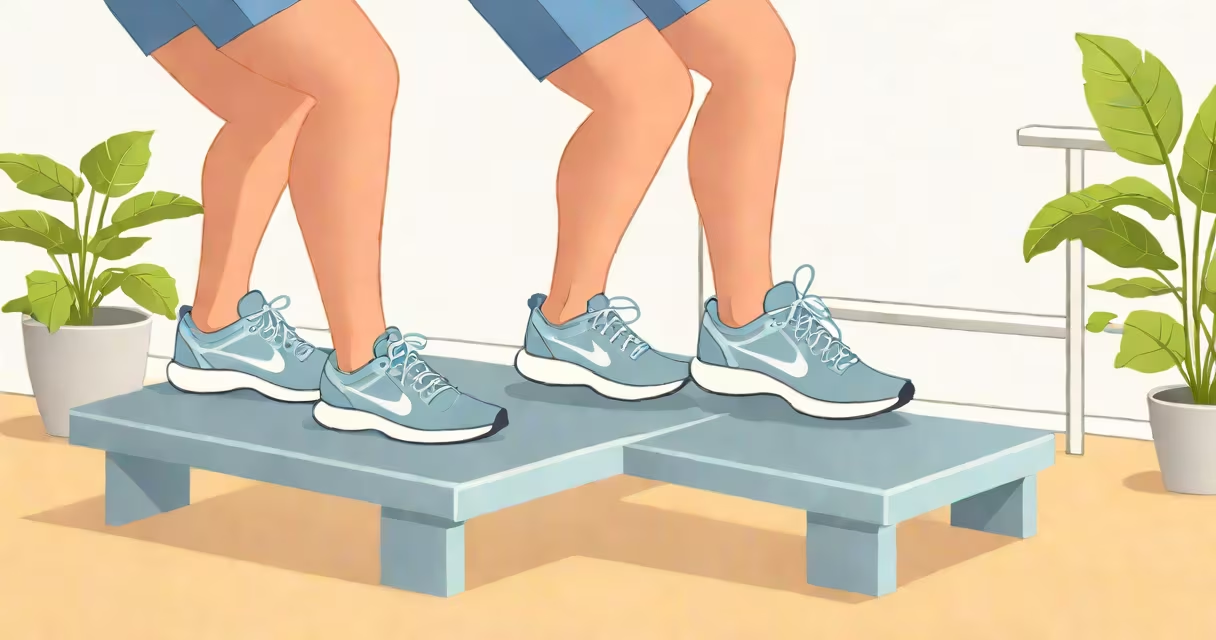
Calf raises for knee pain are resistance exercises targeting the gastrocnemius and soleus muscles to improve ankle stability and reduce load on the knee joint. When performed correctly, they improve proprioception and support the kinetic chain during walking and standing.
Weakness in the calf muscles contributes to altered gait patterns, increasing stress on the patellofemoral and tibiofemoral joints. A 2021 study published in Journal of Orthopaedic & Sports Physical Therapy found that individuals with chronic knee pain showed reduced plantarflexion strength compared to pain-free controls (mean difference: 18.6% weaker). Strengthening the calf improves force transmission through the lower limb, reducing compensatory movements that exacerbate knee discomfort.
These exercises involve standing on the balls of the feet, rising onto the toes, then lowering slowly. The movement activates the posterior chain-the group of muscles running along the back of the leg and hip-critical for shock absorption and joint alignment. Performing them with controlled tempo (3 seconds up, 3 seconds down) builds endurance and neuromuscular control essential for daily function.
The calf acts as a changing stabilizer during weight-bearing activities. When the foot strikes the ground, the calf contracts eccentrically to absorb impact. Weak calves lead to excessive inward rolling of the foot (overpronation), which alters knee alignment and increases internal rotation forces on the joint. This misalignment contributes to conditions like patellofemoral pain syndrome and iliotibial band syndrome.
A 2019 randomized controlled trial in Physical Therapy in Sport demonstrated that participants with anterior knee pain who completed a 6-week calf strengthening program reported a 42% reduction in pain scores (measured via the Visual Analog Scale) and improved single-leg hop performance. The intervention included bilateral calf raises with 10-15 repetitions per set, progressing from bodyweight to resistance bands.
Proper execution requires neutral spine, knees slightly bent, and heels lifted off the floor. Avoid locking the knees or bouncing at the bottom. The movement should originate from the ankles-not the hips or lower back. Training the calf enhances the body's ability to handle repetitive loading, important for runners, walkers, and those with jobs involving prolonged standing.
There are two primary forms based on muscle activation:
| Exercise Type | Target Muscle | Best For | Progression Path |
|---|---|---|---|
| Double-leg standing | Gastrocnemius (knee flexor) | Beginners, balance training | Bodyweight → resistance band → weighted vest |
| Single-leg standing | Soleus (deep calf layer) | Stability, unilateral weakness | Flat surface → edge of step → unstable surface |
| Seated calf raise | Soleus (not dependent on knee position) | Post-surgical rehab, tight hamstrings | Bodyweight → ankle weights → resistance band |
For optimal results, perform 2-3 sets of 12-15 reps, 3 times per week. Use a mirror or video recording to check form. The seated variation isolates the soleus, which plays a key role in maintaining upright posture during walking. Research shows the soleus generates 80% of the force during quiet standing, making it important for long-term knee health.
Many people assume calf raises only build muscle size. However, their benefit lies in improving joint mechanics. A 2020 review in Manual Therapy emphasized that neuromuscular adaptation occurs faster than hypertrophy, meaning functional gains appear within 2-3 weeks even without visible muscle growth.
One frequent error is performing the exercise too quickly. Rapid reps reduce time under tension, diminishing strength gains. Another is using momentum-swaying forward or backward-to lift the body. This shifts load away from the calf and onto the knees and lower back. Always move with control.
Some believe calf raises worsen knee pain due to increased pressure. But evidence shows the opposite: a 2022 study in Orthopaedic Journal of Sports Medicine found that patients with medial knee osteoarthritis who did calf raises twice weekly for 8 weeks had less joint swelling and improved walking speed compared to controls. The key was consistent, low-intensity training-never pushing to failure.
I worked with Sarah, a 45-year-old office worker with chronic knee pain after years of sedentary desk work. She reported stiffness when climbing stairs and difficulty standing for more than 15 minutes. Initial assessment revealed weak plantarflexion strength (25% below normative values) and poor balance on one leg.
We began with seated calf raises using light ankle weights (1 kg each). After two weeks, she progressed to double-leg standing on flat ground. By week six, she performed single-leg raises on the edge of a step, holding for 2 seconds at the top. Over eight weeks, her pain decreased from 7/10 to 2/10 on the VAS scale. Her gait normalized, and she resumed walking 5 km daily without discomfort.
This outcome aligns with clinical guidelines from the American Physical Therapy Association, which recommend integrating isolated lower limb strengthening into conservative treatment plans for knee pain.
Calf raises are contraindicated if you have acute Achilles tendinitis, recent ankle sprains, or severe peripheral neuropathy. In such cases, consult a physical therapist before attempting any loaded movement. If pain occurs during or after the exercise, stop and reassess form.
For those with bilateral knee pain, combining calf raises with gluteal activation drills improves outcomes. A 2021 study in Journal of Science and Medicine in Sport showed that adding hip abductor exercises reduced knee pain recurrence by 31% compared to calf-only programs.
When done correctly, calf raises for knee pain are a safe, effective tool to restore function and reduce discomfort. Focus on consistency, not intensity. Start slow, master form, and progress gradually. The goal is not to build big calves-it's to stabilize the knee and restore natural movement.