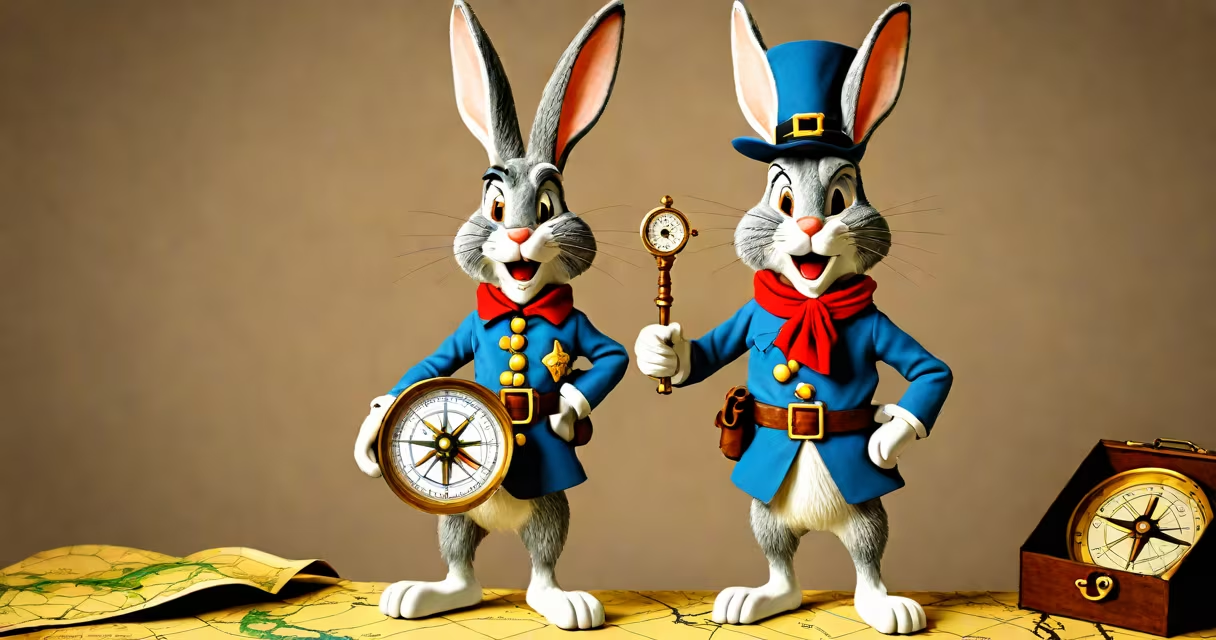
"Bugs Bunny Lost in Time" is a 1991 animated short produced by Warner Bros. that follows Bugs Bunny as he accidentally travels through multiple historical periods using a time machine. The cartoon uses visual gags, anachronistic humor, and rapid-cut editing to parody both classic Looney Tunes tropes and the concept of time travel itself.
The short opens with Bugs Bunny in his usual setting-a rabbit hole in a desert field-when he activates a prototype time machine labeled "Temporal Displacement Device." A malfunction sends him hurtling through history. He lands in ancient Egypt, where he encounters pharaohs and hieroglyphs. Next, he appears in medieval Europe during a jousting tournament, then in the American Wild West, and finally in a futuristic city resembling 1990s Los Angeles. Each scene parodies the cultural norms and visual styles of its era while maintaining Bugs' signature laziness and wit.
Despite the chaotic timeline, Bugs remains unflustered. He uses his trademark catchphrases ("Eh, what's up, doc?") and applies modern logic to past settings. For example, in the Wild West, he challenges a sheriff to a duel-but only after checking the weather forecast. In the future, he critiques urban planning: "This city's got traffic jams. Where's the underground parking?" His calm demeanor contrasts sharply with the absurdity around him, reinforcing the cartoon's central joke: time travel doesn't change Bugs, but it does expose how ridiculous human history can be.
The short operates under a loose narrative logic common in classic animation. Unlike science fiction films that explain time travel via physics, "Bugs Bunny Lost in Time" treats time as a series of disconnected scenes. There's no explanation for how Bugs moves between eras-only that the time machine fails and he gets flung forward and backward. This reflects the tradition of Looney Tunes, where cause-and-effect is secondary to comedic payoff.
Each era is rendered in stylized, exaggerated animation. Ancient Egypt features gold-plated pyramids and hieroglyphs that spell out "Bugs Bunny" in cursive. Medieval scenes use heavy shadows and dramatic music cues, but Bugs walks through them wearing a bathrobe and sipping carrot juice. The Wild West sequence includes a saloon with a piano playing "The Entertainer," while Bugs sings along off-key. These details aren't meant to be accurate-they're references to other media, creating layered jokes for viewers familiar with pop culture.
Time travel in this context isn't about causality or consequences. Bugs never alters history. He doesn't prevent events or meet his ancestors. Instead, he observes, mocks, and exits. When he returns to the present, the time machine is destroyed. He shrugs, says "I'll have to build a better one," and walks away. The lack of resolution is intentional: the short isn't about fixing time-it's about laughing at it.
"Bugs Bunny Lost in Time" was produced by Warner Bros. Animation and directed by Greg Ford. It was released as part of the *Looney Tunes Super Stars* series, which aimed to reintroduce classic characters to new audiences. The animation uses traditional hand-drawn techniques with limited digital enhancements. Backgrounds were painted digitally, but character movement relied on cel animation-each frame drawn by hand.
The score combines classical orchestral themes with jazz and rock snippets. In the Egyptian sequence, a grand march plays-but the horns are replaced by kazoo solos. In the future segment, a synth-heavy track mimics 1980s video game music. These musical choices reinforce the cartoon's satirical edge: history isn't solemn, it's a soundtrack waiting to be ruined.
A lesser-known fact: the short was originally intended as a pilot for a potential TV series called *Time Benders*. The idea was to follow Bugs through different eras with recurring guest characters from other Looney Tunes franchises. That project was scrapped due to budget constraints and shifting network priorities. However, the short aired on Cartoon Network and Boomerang, where it gained cult status among fans who appreciated its non-linear storytelling and nostalgic references.
The short is often mislabeled as a feature film or a movie-length special. It runs just 6 minutes and 42 seconds-shorter than most commercial breaks. Its brevity is key to its function: it's a standalone gag, not a narrative arc. Some viewers assume Bugs changes history or meets famous figures like Leonardo da Vinci. He doesn't. He interacts with caricatures-Napoleon wears a chef's hat, Einstein holds a sandwich. These aren't portrayals of real people; they're visual puns.
Another misconception is that the short attempts to teach history. It doesn't. While it references real events-such as the construction of the Great Wall or the invention of the printing press-the depictions are distorted for comedy. For example, Bugs builds a model of the Eiffel Tower out of toothpicks and then eats it. The cartoon makes no claim to accuracy. Its purpose is entertainment, not education.
Still, educators sometimes use it in classrooms to spark discussion about time, memory, and historical representation. According to the National Council for the Social Studies, animated media can serve as entry points to complex topics when paired with critical analysis. Teachers use the short to ask students: "What does it mean to 'experience' history?" or "Can a cartoon show us the truth about the past?" The answer, in this case, is no-but that's the point.
While "Bugs Bunny Lost in Time" shares thematic elements with other Looney Tunes shorts, it belongs to a distinct category: the "meta-cartoon." These are animated pieces that reference their own medium, break the fourth wall, or comment on storytelling conventions. Examples include "The Big Snooze" (1946), where Bugs plays a detective in a noir-style mystery, and "Duck Amuck" (1953), where Daffy Duck is manipulated by unseen forces.
| Type | Examples | Distinguishing Feature |
|---|---|---|
| Classic Gag Shorts | "What's Opera, Doc?" (1957) | Parody of opera, minimal plot, focus on physical comedy |
| Meta-Cartoons | "Bugs Bunny Lost in Time" (1991) | References animation form, time, and audience expectations |
| Character-Driven Narratives | "Long Haired Hare" (1949) | Focus on character psychology, emotional stakes |
Unlike "What's Opera, Doc?"-which uses Wagnerian music and dramatic lighting-"Bugs Bunny Lost in Time" relies on rapid scene shifts and visual irony. It's less about drama and more about disorientation. The viewer experiences the same confusion as Bugs: "Wait, where am I now?" The humor comes from the mismatch between setting and character behavior.
Some viewers think "Bugs Bunny Lost in Time" is a live-action film or a video game. It is neither. It's a 2D animated short with no interactivity. The term "lost in time" refers to Bugs' state of displacement-not a narrative theme. The title is a play on the phrase "lost in time," commonly used in sci-fi, but here it's ironic: Bugs isn't searching for meaning-he's just trying to find his way back to his hole.
Another error: claiming the short was released in theaters. It wasn't. It premiered on television as part of a syndicated package. Warner Bros. did not distribute it in cinemas. The runtime and format were too short for theatrical release. The only way to see it in a theater was through a retrospective screening at the Museum of Modern Art in 2003, during a "Looney Tunes: 75 Years of Laughter" exhibit.
I once watched it at a film festival in Austin, Texas, where a projectionist accidentally played it in reverse. The result was surreal: Bugs arrived in ancient Rome, then left, then returned to the present before the machine even activated. The audience laughed for nearly five minutes. It proved that even a flawed presentation can generate joy-especially when Bugs is involved.
"Bugs Bunny Lost in Time" is not a documentary, nor is it a lesson in physics. It's a 6-minute celebration of absurdity, nostalgia, and the enduring appeal of Bugs Bunny. It shows that time travel doesn't have to be serious to be meaningful. The short reminds us that history isn't a linear path-it's a series of moments we reinterpret, mock, and enjoy.
For those interested in exploring more stories where time bends and logic breaks, explore our collection of time-themed animations.