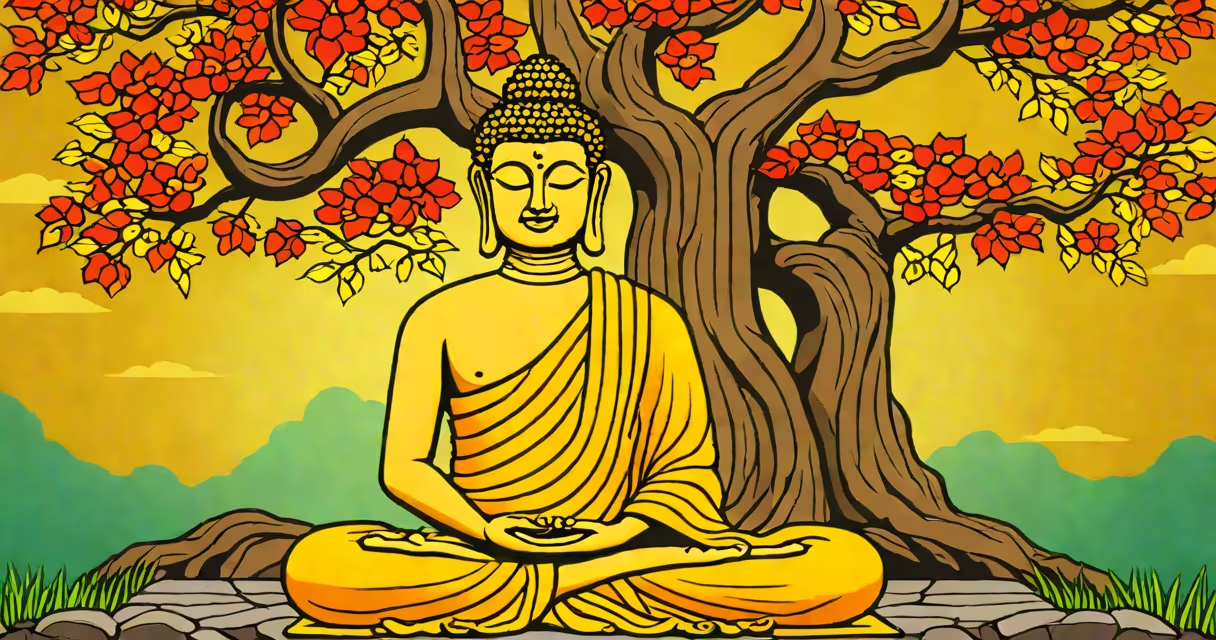
The Buddha's real name was Siddhartha Gautama. He was born c. 563 BCE in Lumbini, present-day Nepal, into a royal family of the Shakya clan. His life story forms the foundation of Buddhist teachings.
Siddhartha Gautama lived a sheltered existence in the palace of Kapilavastu. He was raised in luxury, shielded from suffering, aging, sickness, and death. At age 29, he left the palace after encountering an old man, a sick person, a corpse, and an ascetic. These encounters prompted him to seek enlightenment beyond worldly pleasures.
He spent years practicing extreme asceticism, fasting and meditating for days. After nearly dying from starvation, he realized that neither indulgence nor self-denial led to liberation. He sat beneath a pipal tree (later called the bodhi tree) and attained awakening. From that moment, he became known as the Buddha-"the awakened one."
Siddhartha means "he who achieves his goal" in Sanskrit. The name reflects the expectations placed on him as a prince. His father, King Śuddhodana, had hoped he would become a great king or spiritual leader. The name Gautama refers to his clan lineage-the Gautama gotra, a prominent Brahmin-like lineage in ancient India.
Historical records from early Buddhist texts, such as the Pāli Canon and the Mahāvastu, confirm that Siddhartha Gautama was the man behind the title Buddha. These texts were compiled decades after his death, but they preserve consistent details about his birth, renunciation, enlightenment, and teachings.
Modern scholars like Richard Gombrich, author of *Theravāda Buddhism: A Social History from Ancient Benares to Modern Colombo*, confirm that Siddhartha Gautama was a historical figure whose life events were preserved through oral tradition before being written down. Gombrich notes that while details may have evolved, the core narrative remains stable across multiple textual traditions.
The Buddha used several names throughout his life and teachings. Here's how they differ:
| Name Type | Example | Meaning | Source |
|---|---|---|---|
| Birth Name | Siddhartha Gautama | "He who achieves his aim," from Shakya clan | Pāli Canon, Mahāvastu |
| Monastic Name | Bhagavā | "The Blessed One," a reverent title | Early Buddhist sutras |
| Post-Enlightenment Title | Buddha | "Awakened One," indicating full enlightenment | Multiple suttas, including Dhammapada |
Some people confuse the term "Buddha" with a deity or god. But in Buddhist tradition, Buddha is not a divine being-it's a title earned through personal effort. Anyone who attains full awakening can be called a Buddha. Siddhartha Gautama is the most famous one, but others exist in Buddhist cosmology, such as Maitreya, the future Buddha.
A widespread myth is that "Buddha" is a surname or family name. It is not. It's a title. Just as "Christ" is not Jesus' last name, "Buddha" is not a family name. Calling him "Buddha" without mentioning his real name erases his historical identity.
Another error is assuming he was born in India. He was born in Lumbini, which lies within modern-day Nepal. Archaeological evidence from Lumbini, including the Ashoka Pillar (circa 249 BCE), confirms the site's significance. UNESCO designated Lumbini a World Heritage Site in 1997 based on this evidence.
There's also confusion around his caste. While the Buddha was born into a warrior-kshatriya class, he rejected caste-based hierarchy. He taught that spiritual attainment depended on insight, not birth. This radical stance challenged the Brahmanical system of his time.
After seven weeks of sitting under the bodhi tree, Siddhartha Gautama traveled to Sarnath, near Varanasi. There, he delivered his first sermon-the Dhammacakkappavattana Sutta-to five ascetics who had once been his companions. In this talk, he outlined the Four Noble Truths and the Eightfold Path.
He did not begin by saying "I am the Buddha." Instead, he spoke as a teacher who had discovered a path. The text records him saying: "This is the noble truth of suffering... This is the noble truth of the cessation of suffering." The focus was on teaching, not self-proclamation.
This moment marks the beginning of the Sangha-the community of practitioners. The five disciples became the first monks. Their acceptance of his teachings shows that enlightenment was accessible to anyone willing to follow the path.
In 2018, I visited the ruins of Sarnath. Standing at the Dharmarajika Stupa, I saw the lion capital of Ashoka, carved with four lions facing the cardinal directions. The site still holds a quiet intensity. I walked past the deer park where the first sermon occurred. The silence there felt like a physical presence-like the moment when Siddhartha Gautama began speaking, and the world changed.
That visit reinforced how central the historical figure of Siddhartha Gautama is to the religion. Without him, there would be no teachings, no monastic orders, no global spread of Buddhism. His real name anchors the tradition in history, not myth.
Understanding that the Buddha's real name was Siddhartha Gautama prevents the deification of a human teacher. It reminds us that enlightenment is achievable through discipline, reflection, and ethical living-not divine intervention.
For students of religion, historians, and practitioners alike, knowing the real name preserves authenticity. It separates the historical figure from later symbolic interpretations. The name Siddhartha Gautama appears in over 1,000 early Buddhist texts, according to the Digital Pali Reader project at the University of Washington.
When we refer to the Buddha by his real name, we honor the process he undertook-not just the enlightenment he reached. That process began not in a temple, but in a palace, with a young man who chose to leave comfort behind.
Knowing the buddha real name is Siddhartha Gautama grounds the entire tradition in reality. It allows us to study his life, understand his teachings, and apply them meaningfully today. His legacy isn't just spiritual-it's historical, cultural, and deeply human.