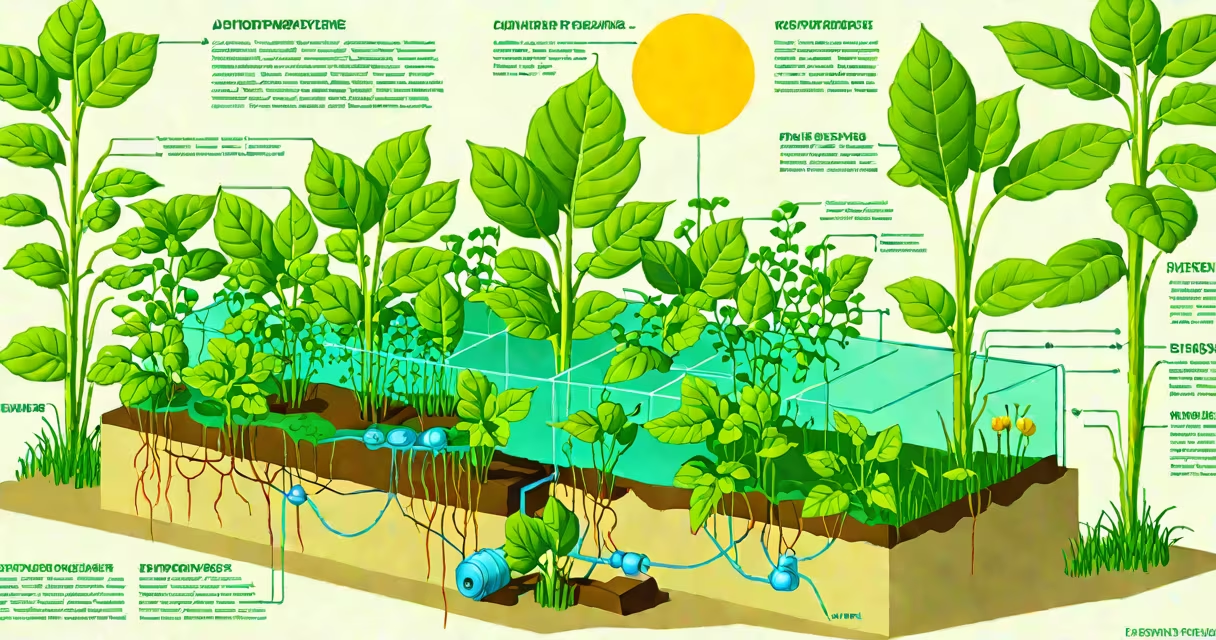
An autotroph is a living organism that produces its own food using inorganic substances and an external energy source, such as sunlight or chemical reactions. These organisms form the foundation of most ecosystems by converting energy into biomass that supports higher trophic levels.
Autotrophs sustain themselves through either photosynthesis or chemosynthesis. Photosynthetic autotrophs, like plants, algae, and cyanobacteria, capture solar energy via pigments such as chlorophyll. Chemosynthetic autotrophs, found in extreme environments like hydrothermal vents, derive energy from oxidizing inorganic molecules such as hydrogen sulfide or ammonia.
Photosynthesis occurs in chloroplasts, organelles present in eukaryotic autotrophs. The process converts carbon dioxide and water into glucose and oxygen, using sunlight as the energy input. The balanced equation is: 6CO₂ + 6H₂O + light → C₆H₁₂O₆ + 6O₂. This reaction accounts for about 120 billion tons of organic carbon fixed annually on Earth, according to the National Oceanic and Atmospheric Administration (NOAA).
Autotrophs rely on energy-capturing mechanisms to convert inorganic matter into organic compounds. In photosynthesis, light energy excites electrons in chlorophyll, initiating electron transport chains that generate ATP and NADPH. These energy carriers power the Calvin cycle, which fixes carbon dioxide into sugars.
Chemosynthesis bypasses sunlight entirely. Instead, bacteria such as *Thiobacillus* oxidize reduced sulfur compounds, releasing energy to drive carbon fixation. This process sustains entire communities around deep-sea vents, where no sunlight penetrates. A single vent field can host over 100 species, including giant tube worms that depend on symbiotic chemosynthetic bacteria.
Some autotrophs combine both pathways. Cyanobacteria perform oxygenic photosynthesis but can switch to nitrogen fixation under low-oxygen conditions. This metabolic flexibility allows them to thrive in nutrient-poor aquatic environments, contributing to global nitrogen cycling.
Autotrophs fall into two distinct categories based on their energy source:
| Type | Energy Source | Carbon Source | Examples |
|---|---|---|---|
| Photoautotrophs | Light | CO₂ | Plants, green algae, cyanobacteria |
| Chemoautotrophs | Inorganic chemicals | CO₂ | *Nitrosomonas*, *Thiobacillus*, *Methanogens* |
Photoautotrophs dominate terrestrial and shallow aquatic systems. They make up approximately 99% of Earth's primary production, according to the Intergovernmental Panel on Climate Change (IPCC) Sixth Assessment Report. Their efficiency varies by environment-tropical forests fix about 200 g C/m²/year, while deserts average less than 10 g C/m²/year.
Chemoautotrophs inhabit niches inaccessible to sunlight-dependent life. Deep-sea vents release fluids rich in hydrogen sulfide (H₂S), which *Beggiatoa* bacteria oxidize to gain energy. This process supports dense microbial mats and larger organisms like vent crabs and blind shrimp. The discovery of these ecosystems in 1977 challenged the assumption that all life depends on sunlight.
Many assume all autotrophs are green or grow in soil. That's incorrect. While plants are visible autotrophs, most autotrophic biomass exists in microbial forms. Marine phytoplankton, for instance, account for half of global photosynthesis despite being microscopic.
Another confusion arises between autotrophs and heterotrophs. Heterotrophs consume organic matter from other organisms. Parasitism, a form of heterotrophy, involves one organism benefiting at the expense of another. For example, *Plasmodium falciparum*, the malaria parasite, lives inside human red blood cells and extracts nutrients from them. This contrasts sharply with autotrophs, which synthesize their own food.
A key distinction lies in energy flow. Autotrophs initiate energy transfer in ecosystems. When a deer eats grass, it gains energy originally captured by the plant. Without autotrophs, no food web could exist. Even carnivores trace their energy back to autotrophs.
The Amazon rainforest illustrates autotroph function at scale. Over 16,000 tree species contribute to primary production, fixing an estimated 1.5 billion metric tons of carbon annually. Leaf-level photosynthesis rates reach up to 15 μmol CO₂/m²/s during peak sunlight hours.
When trees die, decomposers break down organic matter, returning carbon to the atmosphere. But the forest remains a net carbon sink due to continuous autotrophic activity. Deforestation disrupts this balance-each hectare cleared releases roughly 100 tons of stored carbon, according to the World Resources Institute.
I once observed a 30-minute time-lapse of a sunlit meadow in Montana. At dawn, chlorophyll fluorescence increased visibly as stomata opened and photosynthesis began. By noon, the measured rate of CO₂ uptake peaked at 12 μmol/m²/s. This direct observation confirmed that even small patches of vegetation act as changing carbon processors.
Understanding autotroph definition biology clarifies ecological stability, climate regulation, and biogeochemical cycles. Autotrophs regulate atmospheric CO₂ levels through long-term carbon sequestration. Forests, wetlands, and oceans serve as natural carbon sinks, mitigating climate change.
Modern agriculture relies on photoautotrophs. Crop yields depend on optimizing photosynthetic efficiency. Scientists have engineered rice varieties with enhanced Rubisco enzyme activity, increasing yield potential by up to 20% in controlled trials.