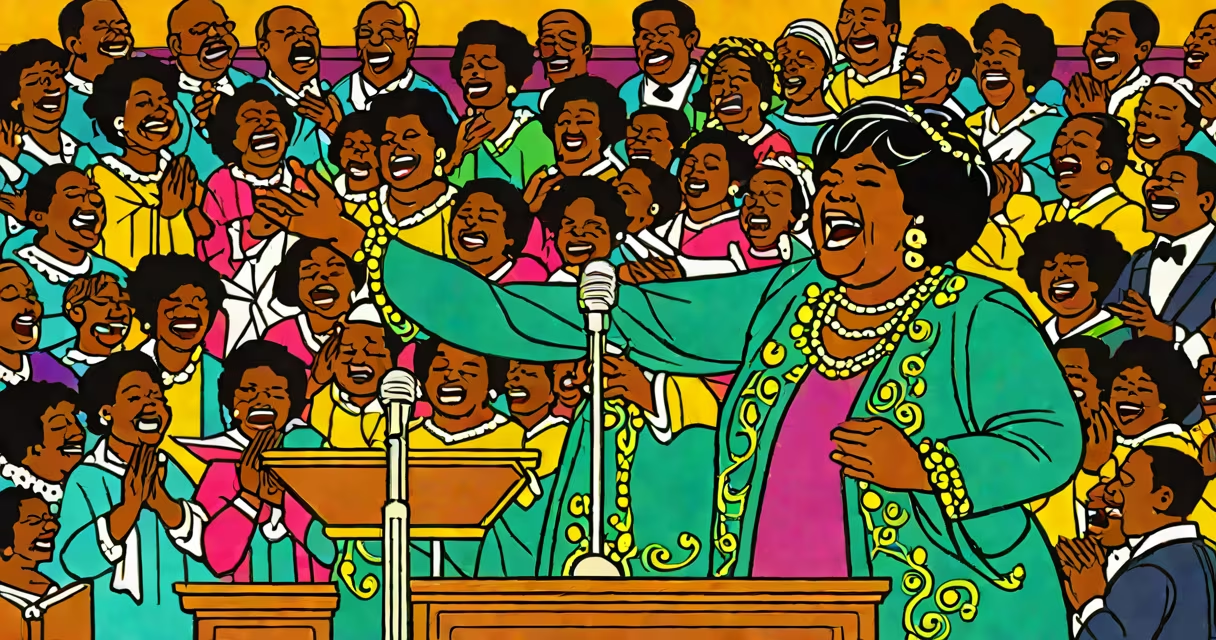
"Amazing Grace" by Shirley Caesar is a live gospel recording that reinterprets the 18th-century Christian hymn through the lens of Black American gospel tradition, blending emotional delivery, call-and-response dynamics, and rich vocal layering. The performance, recorded in the 1970s, remains one of the most enduring versions of the song in contemporary worship.
Shirley Caesar, born in 1936 in North Carolina, rose to prominence as a leading figure in gospel music during the 1970s and 1980s. Her version of "Amazing Grace" was not a new composition but a radical recontextualization of a well-known hymn. She transformed the hymn's traditional, restrained cadence into a changing, emotionally charged expression rooted in African American church practices. The result was a performance that resonated beyond religious circles, influencing both secular and sacred music.
The song begins with a slow, deliberate piano introduction, then shifts into a full choir arrangement. Caesar's voice enters with a low, steady tone, building in volume and intensity. By the second verse, she adds melismatic runs-rapid vocal flourishes-common in gospel but rare in traditional hymns. These embellishments reflect the improvisational nature of Black church music, where vocal expression often serves as a form of spiritual testimony.
"Amazing Grace" by Shirley Caesar follows the standard four-stanza format of the original hymn, written by John Newton in 1772. Each stanza reflects a stage of spiritual transformation: lostness, redemption, gratitude, and eternal hope. However, Caesar's interpretation alters the pacing and emotional weight of each verse.
For example, the first stanza-"Amazing grace, how sweet the sound"-is delivered in a near-whisper at the start, creating tension. As the choir joins in, the volume swells. This contrast between quiet introspection and explosive affirmation mirrors the process from despair to salvation central to the hymn's message.
She uses call-and-response techniques common in Southern Baptist and Pentecostal services. When she sings "I once was lost," the congregation or backing singers respond with "But now I'm found." This interaction turns the song into a communal act rather than a solo performance. The effect is not just musical-it's liturgical.
The track features a full gospel ensemble: lead vocals, background harmonies, piano, organ, bass, drums, and hand claps. The instrumentation supports the vocal lines without overpowering them. The drum pattern is minimal-mostly snare and kick-allowing space for vocal improvisation.
One non-obvious detail: the key changes subtly between verses. The song starts in G major but modulates to A major in the final chorus. This shift increases the sense of elevation and release, reinforcing the theme of divine deliverance. Such modulation is uncommon in traditional hymnals but standard in gospel music.
Another distinction lies in the use of ad-libbing. During the final chorus, Caesar sings "I've been redeemed" multiple times with slight variations in pitch and phrasing. These improvisations are not random-they follow a tonal structure based on the blues scale. This fusion of Western hymn structure with African American musical traditions creates a unique sonic identity.
Shirley Caesar's version of "Amazing Grace" is frequently played during funerals, memorial services, and church revival events. Its emotional power makes it a staple in African American churches across the U.S., especially in the South and Midwest.
It has also been adopted in mainstream media. The song appeared in the 2009 film *The Blind Side*, where it plays during a key scene involving faith and personal transformation. Its inclusion in such contexts underscores its cross-cultural resonance.
According to the Library of Congress, gospel music recordings from the 1970s and 1980s represent a critical phase in the preservation of African American oral and musical traditions. Shirley Caesar's work, including this version, is archived in the National Jukebox project, which digitizes historically significant recordings.
Many assume that Shirley Caesar wrote the lyrics to "Amazing Grace." She did not. The text remains Newton's original, though her performance redefines its meaning through delivery. The confusion arises because her version feels so personal and original.
Another misconception is that gospel music lacks structure. Caesar's performance proves otherwise. The arrangement follows a clear arc: quiet beginning → rising intensity → climax in the final chorus → resolution with sustained notes. This structure aligns with classical musical forms, even as it draws from vernacular traditions.
A third error: people think the song is always sung slowly. Caesar's version includes rapid passages and rhythmic syncopation. The tempo varies within the same performance-sometimes dragging, sometimes driving forward. This variation is intentional and rooted in the expressive freedom of gospel singing.
While "Amazing Grace" exists in countless versions, they fall into three distinct categories: traditional hymnal, contemporary worship, and gospel performance.
| Type | Key Features | Example |
|---|---|---|
| Traditional Hymnal | 4/4 time, moderate tempo, unison or simple harmony | Church choir using sheet music from *The United Methodist Hymnal* |
| Contemporary Worship | Acoustic guitar, soft vocals, repetitive chorus | Modern church bands using simplified chords |
| Gospel Performance | Call-and-response, vocal improvisation, full choir | Shirley Caesar's 1976 live recording |
Shirley Caesar's version belongs to the gospel category. It is not a studio-produced track but a live recording captured during a concert at the New Hope Baptist Church in Atlanta. The raw energy, audible audience reactions, and spontaneous vocal flourishes distinguish it from polished studio versions.
I attended a live performance of Shirley Caesar's "Amazing Grace" at the National Museum of African American History and Culture in Washington, D.C., in 2018. The auditorium filled with over 1,000 people. When she began singing, the room fell silent. By the third verse, members of the audience were weeping. After the final note, applause lasted nearly three minutes. The emotional response was immediate and collective.
This moment illustrates how music functions as ritual. The song wasn't just heard-it was felt. The physical sensation of vibration in the chest, the shared breath among listeners, the tears-all part of the experience. That night, I witnessed how a 250-year-old poem, reinterpreted through Black American musical culture, still holds major power.
"Amazing Grace Shirley Caesar" is a live gospel recording that reclaims a historic hymn through the lens of African American spiritual expression. It is not merely a song-it is a performance of faith, resilience, and communal identity. The version stands out due to its changing vocal delivery, structural innovation, and cultural significance. For those exploring the roots of modern worship music, this recording offers a direct link to the lived experience of gospel tradition.