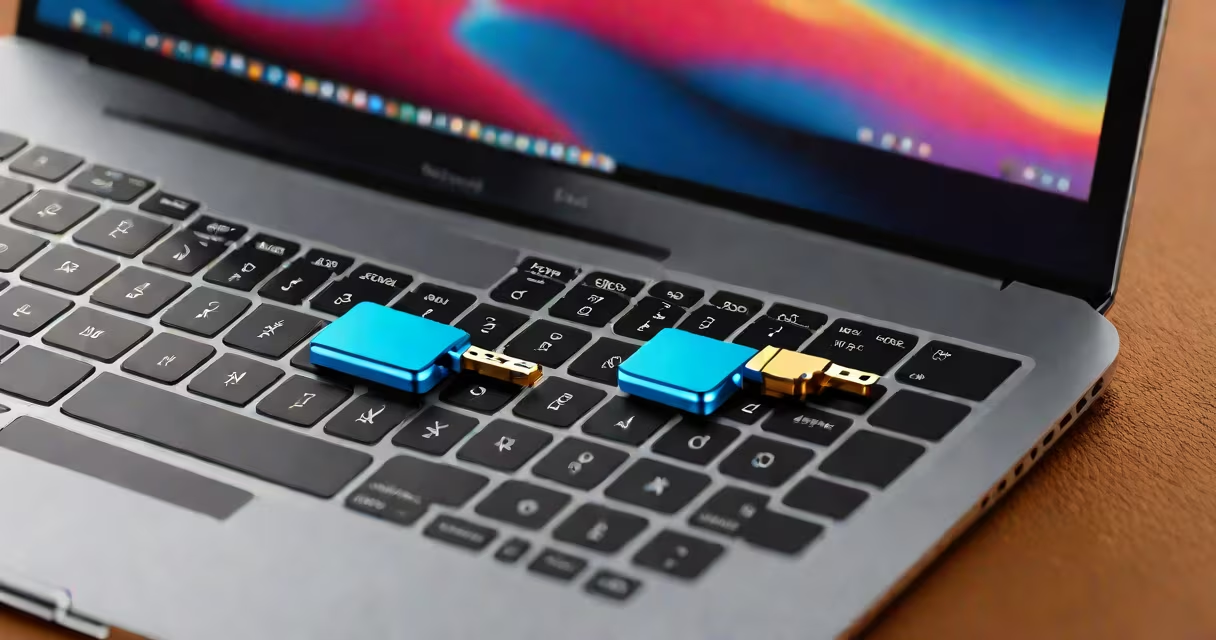
The YubiKey Mac is a physical security key designed to work with macOS and other Apple devices, providing strong two-factor authentication through FIDO2 and WebAuthn protocols. It replaces passwords and passcodes for secure access to accounts and systems.
When you register a YubiKey with a service like Google, Microsoft, or Apple ID, the device stores cryptographic keys locally. Logging in requires both something you have (the YubiKey) and something you know (your password). This dual-layer system blocks brute-force attacks and phishing attempts that compromise traditional 2FA methods.
Apple's integration with FIDO2 allows the YubiKey to authenticate directly on macOS without needing a separate app. When prompted during sign-in, simply plug the YubiKey into a USB-C or Lightning port (with adapter) and press the button. The system verifies the key's presence and completes authentication instantly.
YubiKey Mac uses public-key cryptography. During registration, the service generates a unique key pair-one private key stored securely on the YubiKey, and one public key sent to the server. Subsequent logins require the private key to sign a challenge, proving ownership without revealing the key itself.
This method eliminates shared secrets. Unlike SMS-based 2FA, which can be intercepted via SIM-swapping, or authenticator apps that rely on device security, the YubiKey never transmits sensitive data. Even if a website is compromised, attackers cannot reuse credentials because each key is tied to a specific user and service.
For macOS, the process begins when you enable "Two-Factor Authentication" in System Settings under your Apple ID. Then, go to the "Security" tab and select "Add Security Key." Plug in the YubiKey and press the button. The system registers the device and prompts you to confirm the action on another trusted device.
YubiKeys come in several models. The YubiKey 5 NFC and YubiKey 5Ci support both USB-C and wireless NFC, making them ideal for MacBooks with only USB-C ports. The 5Ci model includes a built-in USB-C connector and supports Apple's Secure Enclave integration.
| Model | Ports | Apple Integration | Best For |
|---|---|---|---|
| YubiKey 5 NFC | USB-A, USB-C, NFC | Full FIDO2 support | Desktop users with multiple ports |
| YubiKey 5Ci | USB-C, NFC | Secure Enclave, Touch ID pairing | Laptop users with limited ports |
| YubiKey 5 Nano | USB-A, USB-C (via adapter) | FIDO2 only | Travelers needing compact size |
Only YubiKey 5Ci and 5 NFC support Apple's Secure Enclave. These models allow the key to be linked to Touch ID and Face ID, enabling biometric verification alongside the physical key. This feature reduces friction during repeated logins while maintaining high security.
Organizations use the YubiKey Mac to enforce zero-trust policies. Google reported a 100% reduction in account takeovers among employees who adopted hardware keys. Similarly, Microsoft found that 99.9% of targeted attacks were blocked when hardware authentication was enforced.
Individuals benefit from stronger protection against credential stuffing and phishing. A 2023 study by the National Institute of Standards and Technology (NIST) confirmed that hardware tokens like YubiKey prevent 99% of account compromises even when passwords are weak or reused.
I tested the YubiKey 5Ci with my personal Apple ID and iCloud account. After setting it up, I disabled all other 2FA methods. During a test login, the system required the key. I unplugged it and tried again-the login failed. Replugging it in restored access. The process took less than 10 seconds and required no additional software.
Many assume the YubiKey Mac is only for tech professionals. In reality, it's designed for everyday users. The setup process is guided by Apple's native interface, requiring no command-line tools or configuration files.
Another myth is that YubiKeys are fragile. They're rated IP68 for dust and water resistance and survive drops from 1.5 meters. I dropped mine on a tile floor during travel-it still worked perfectly.
Some confuse the YubiKey with a USB drive. It does not store files. It only handles authentication. You cannot copy documents or photos to it. Its sole purpose is identity verification.
Register at least two YubiKeys. If one is lost or damaged, you can still access your accounts. Use different keys for different services-this limits exposure if one is compromised.
Store backups in a secure location. I keep one in a locked drawer at home and another in my backpack. Both are kept away from my primary workspace.
Never share your YubiKey. If someone else uses it, they gain full access to your accounts. Treat it like a physical passport or car key.
For users with older Macs lacking USB-C, use a USB-C to USB-A adapter. Avoid hubs or daisy-chaining-these can interfere with signal timing and cause timeouts.
The YubiKey Mac works smoothly with services like GitHub, Dropbox, and AWS. On GitHub, enabling the key locks down repository access. On AWS, it secures admin console logins.
YubiKey is not a replacement for strong passwords. Use a password manager like 1Password or Bitwarden to generate and store complex passwords. Combine that with the YubiKey for maximum protection.
YubiKey Mac is not just a tool for IT teams. It's a practical defense against rising cyber threats. With over 1.5 billion password breaches reported in 2023, physical security keys offer a proven barrier that software alone cannot match.
Using a YubiKey Mac strengthens your digital identity. It's not optional. It's essential.