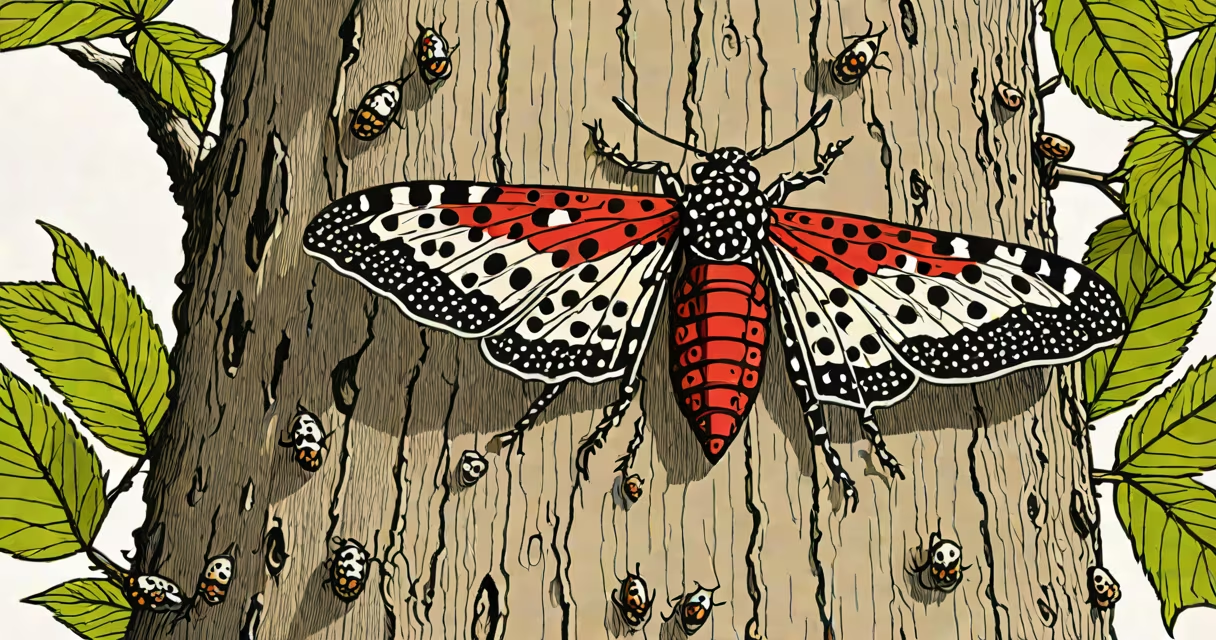
The spotted lanternfly (Lycorma delicatula) is an invasive insect native to parts of Asia that damages crops, kills trees, and disrupts ecosystems. It feeds on sap from over 70 plant species, including grapevines, fruit trees, and hardwoods, weakening them until they die. Its presence triggers economic losses and ecological harm across regions where it's established.
Native to China, Japan, and Vietnam, the spotted lanternfly was first detected in the United States in 2014 in Berks County, Pennsylvania. Since then, it has spread to at least 16 states, including New Jersey, Delaware, Maryland, and Ohio. The U.S. Department of Agriculture classifies it as a high-priority pest due to its rapid expansion and destructive feeding habits.
Adults are about 1 inch long, with gray forewings marked by black spots and red underwings. Nymphs, which hatch in spring, are black with white spots and grow through four stages before becoming adults. They lay eggs in late summer on tree trunks, rocks, vehicles, and outdoor equipment. These egg masses resemble mud splatters and can survive winter, hatching the following spring.
Lanternflies feed by piercing plant tissue and sucking sap using their needle-like mouthparts. This weakens the host plant, reduces growth, and causes dieback. Their feeding also leads to the excretion of honeydew-a sticky, sugary substance that attracts ants and promotes mold growth. Mold can block sunlight from reaching leaves, reducing photosynthesis and further stressing the plant.
For grape growers, the impact is severe. A 2022 study by Penn State Extension found that vineyards infested with lanternflies saw yield declines of up to 40% compared to uninfested sites. Honeydew buildup on grape clusters increases the risk of botrytis bunch rot, a fungal disease that ruins wine quality. In response, many vineyards have adopted costly monitoring and treatment programs.
Hardwood trees such as black walnut, maple, and birch are also vulnerable. A single adult lanternfly can consume up to 10 times its body weight in sap daily. Over time, this constant drain depletes nutrients and water transport systems, leading to branch dieback and eventual death. In areas like southeastern Pennsylvania, researchers have documented tree mortality rates exceeding 30% in heavily infested zones.
The economic toll of lanternfly infestations is substantial. The USDA estimates that if left unchecked, the pest could cost the U.S. economy $380 million annually in agricultural and forestry losses. This includes direct crop damage, increased pesticide use, and costs related to containment and eradication efforts.
Transportation infrastructure is also affected. The insects hitch rides on vehicles, trailers, and shipping containers. State agencies enforce quarantines in infested counties, restricting movement of wood, firewood, and outdoor furniture. Violators face fines up to $1,000 per violation. These restrictions disrupt local businesses and increase compliance costs for farmers and loggers.
| Impact Area | Specific Damage | Estimated Cost (Annual) |
|---|---|---|
| Agriculture | Reduced yields in grapes, apples, peaches | $120 million |
| Forestry | Tree mortality in hardwood stands | $80 million |
| Quarantine Enforcement | Inspections, permits, transportation limits | $60 million |
| Public Awareness & Education | Outreach, signage, training | $20 million |
One non-obvious fact: lanternflies do not attack plants directly through chewing or burrowing. Instead, their damage is cumulative and indirect-sap depletion and secondary infections cause most harm. This makes early detection difficult because symptoms appear slowly, often after significant internal damage has occurred.
Many people mistake lanternflies for other similar-looking insects. The name "spotted lanternfly" can lead to confusion with true fireflies (lightning bugs), which are harmless and even beneficial. Fireflies are beetles that produce bioluminescence; lanternflies are planthoppers that do not glow and are destructive.
Another misconception is that lanternflies only affect ornamental trees. In reality, they threaten commercial agriculture. Vineyards in New York and Michigan have reported infestations that led to early harvests and lower-quality wine. Some wineries now require staff to inspect equipment for egg masses before moving between sites.
I once observed a lanternfly infestation during a field visit to a Pennsylvania orchard in June 2023. The trees were covered in honeydew, which had turned black with sooty mold. Ants swarmed the trunks, and several branches showed signs of wilting. The farmer said he'd lost 25% of his apple crop over two seasons. He'd tried multiple sprays, but the insects kept returning.
Early detection is critical. The USDA recommends checking trees for egg masses from September to May. If found, scraping them off and submerging them in alcohol destroys the eggs. Public reporting via state extension services helps track spread patterns.
Biological control methods are being tested. Researchers at the University of Maryland have studied parasitic wasps that target lanternfly eggs. While still in trials, these natural predators show promise for reducing populations without chemical pesticides.
Chemical treatments are used in high-risk zones. Systemic insecticides applied to tree trunks can prevent nymphs from feeding. However, these pose risks to pollinators and aquatic life. The Environmental Protection Agency warns against broad-spectrum applications near waterways.
Residents in infested areas are advised to clean vehicles and outdoor gear before moving between counties. The Pennsylvania Department of Agriculture runs a public campaign called "Stop the Spread" with signage at rest stops and truck stops. These efforts aim to reduce accidental transport.
Understanding why lanternflies are bad requires seeing them not as isolated pests but as part of a larger system of invasive species threats. Their ability to thrive in diverse environments and reproduce rapidly makes them hard to control. Unlike native insects, they lack natural predators in North America, allowing populations to explode unchecked.
Preventing further spread demands coordinated action across state lines. The U.S. Department of Agriculture's Animal and Plant Health Inspection Service (APHIS) maintains a national surveillance network. As of 2024, over 12,000 reports of lanternfly sightings have been logged through this system.
Why are lanternflies bad? Because they disrupt food systems, degrade forests, and cost billions. Their invasive nature, combined with limited natural controls, makes them one of the most damaging pests in the U.S. today.