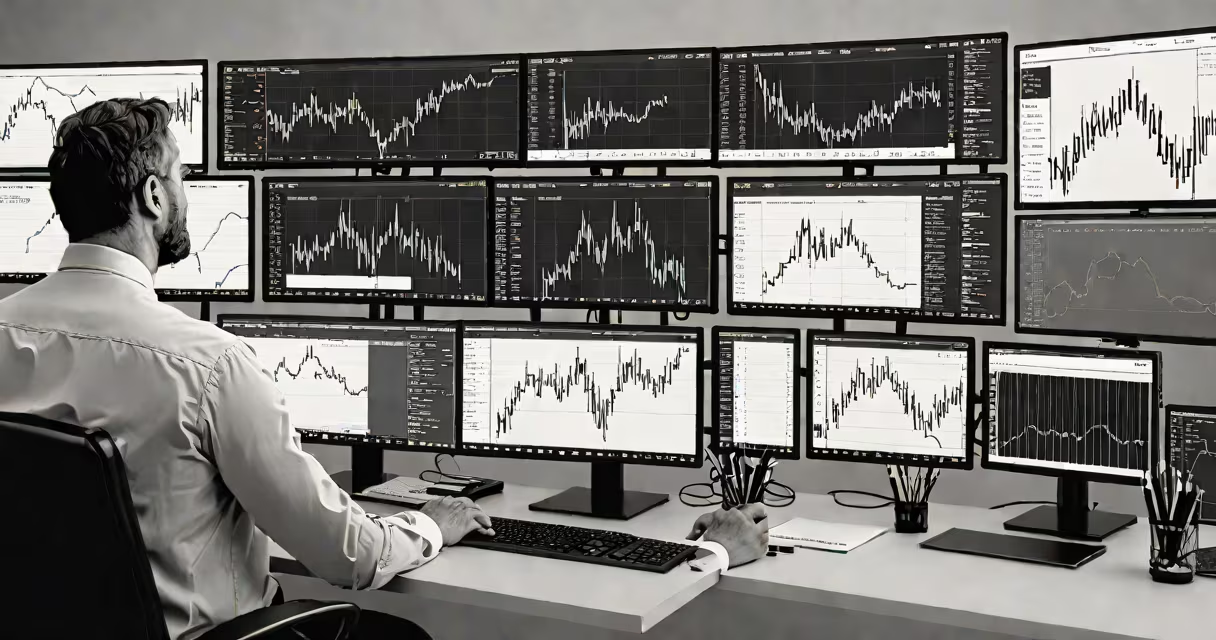
Day trading stocks means buying and selling shares within the same trading day, typically on regulated U.S. exchanges like the New York Stock Exchange (NYSE) and NASDAQ. Traders execute trades during regular market hours (9:30 a.m. to 4:00 p.m. Eastern Time) using brokerage accounts with real-time data and low-latency execution.
Successful day trading requires access to liquid markets, fast order execution, and tools that support rapid decision-making. The most common venues are major U.S. exchanges and electronic communication networks (ECNs), which route orders directly to market makers. These systems process trades in milliseconds, essential for strategies like scalping and momentum trading.
Traders often use platforms such as Interactive Brokers, TD Ameritrade's thinkorswim, or Fidelity's Active Trader Pro. These offer advanced charting, level 2 data, and direct market access (DMA), enabling precise entry and exit points. Without proper infrastructure, even well-researched trades can fail due to slippage or delayed fills.
Day trading relies on short-term price movements driven by news, earnings reports, volume spikes, or technical patterns. Traders enter positions based on analysis of price action, volume, and order flow, then close them before the market closes to avoid overnight risk.
Each trade must be executed within the same session. Holding a position past 4:00 p.m. Eastern Time classifies it as a swing trade or long-term holding, which changes margin requirements and risk exposure. The SEC defines a pattern day trader as someone who executes four or more day trades in five business days, requiring a minimum account balance of $25,000 under Regulation T.
For example, a trader identifies a breakout in Apple (AAPL) stock at 10:15 a.m. based on a 5-minute chart showing increasing volume. They buy 100 shares at $175.20, then sell at $175.80 just after 11:00 a.m., capturing a $60 profit before the close. This entire sequence happens within one trading day and uses real-time data to confirm execution.
The primary venues for day trading are regulated U.S. exchanges and electronic trading networks. Key platforms include:
| Platform/Exchange | Trading Hours | Best For | Key Feature |
|---|---|---|---|
| NYSE | 9:30 a.m.-4:00 p.m. ET | Larger-cap stocks, blue chips | High liquidity, official listing authority |
| NASDAQ | 9:30 a.m.-4:00 p.m. ET | Technology and growth stocks | Electronic marketplace with high-speed routing |
| FINRA's TRACE System | Real-time data available during market hours | Fixed-income and large-cap equity trades | Tracks actual transaction prices for transparency |
| Alternative Trading Systems (ATS) | 9:30 a.m.-4:00 p.m. ET | High-frequency traders, institutional orders | Private networks that aggregate orders away from public exchanges |
Some platforms offer dark pools-private exchanges where large orders are hidden until execution. While these reduce market impact, they're not ideal for day traders seeking immediate visibility. Transparency matters when reacting to sudden price shifts.
Day trading is not the same as investing. Investors hold stocks for months or years; day traders aim for quick profits. Confusing the two leads to poor timing, emotional decisions, and account losses. According to the Securities and Exchange Commission (SEC), 70% of day traders lose money in their first year.
A lesser-known fact: many day trades occur on the NYSE Arca exchange, not the main NYSE floor. Arca handles a significant portion of electronic orders, especially for ETFs and tech stocks. Traders who assume all NYSE trades happen on the physical floor miss this nuance and may misjudge execution speed.
I set up my own day trading station using a dual-monitor setup with a 100 Mbps fiber connection. I use Interactive Brokers' Trader Workstation (TWS), which provides direct access to NYSE, NASDAQ, and several ECNs. I configured alerts for volume spikes above 200% of average and price changes exceeding 1% in under 30 seconds.
On a typical day, I scan for stocks with high relative strength (RSI above 70) and rising volume. When I spot a candidate-say, a sudden jump in Tesla (TSLA) volume-I check the Level 2 order book. I see a large bid at $240.50 with 10,000 shares. I place a limit order at $240.45 to avoid slippage. The order fills in 0.8 seconds. I exit at $240.85 within 12 minutes, locking in a $35 profit per share.
This workflow depends on real-time data feeds, low-latency connections, and a disciplined strategy. Without these, even accurate analysis fails. I've seen traders lose 10% of their capital in a single day due to delayed execution during a flash rally.
Day trading stocks requires knowing where to trade-not just *when*. The right venue ensures speed, accuracy, and access to the best prices. Always verify your broker's connectivity to major exchanges and confirm that your platform supports direct market access if you're executing high-frequency strategies.
Understanding where to day trade stocks is foundational. It determines whether your trades execute at intended prices, whether you face excessive slippage, and whether you can respond to fast-moving opportunities. Focus on regulated exchanges, real-time data, and reliable execution-these are the pillars of consistent performance.