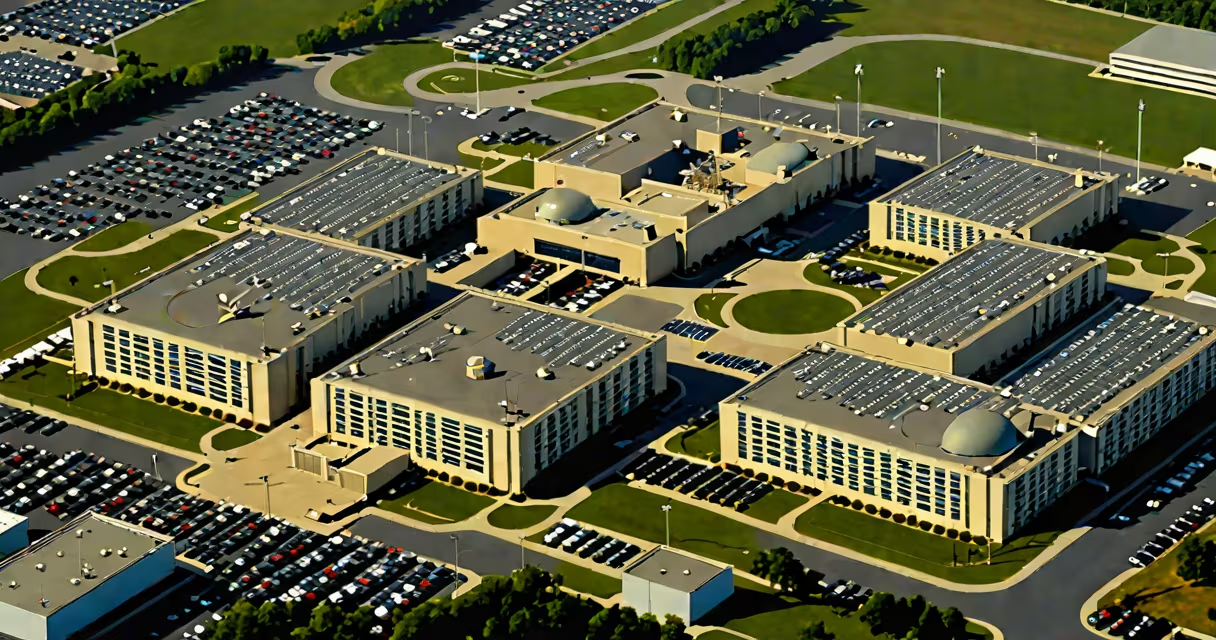
The National Security Agency (NSA) is the United States' primary foreign intelligence and cybersecurity organization, tasked with collecting, analyzing, and protecting classified information through signals intelligence and encryption technologies.
Established in 1952 under President Harry S. Truman, the NSA operates under the Department of Defense and reports to the Director of National Intelligence. Its mission centers on monitoring global electronic communications-including phone calls, emails, and internet traffic-to detect threats to U.S. national security. The agency also develops cryptographic systems to safeguard American military and government data.
Unlike public-facing agencies such as the FBI or CIA, the NSA functions largely in secrecy. It maintains a vast network of surveillance infrastructure, including satellite uplinks, ground-based listening posts, and partnerships with international allies under the Five Eyes alliance. The NSA's work spans both offensive and defensive cyber operations, making it central to modern digital warfare and intelligence gathering.
The NSA collects data through signals intelligence (SIGINT), which involves intercepting electromagnetic signals. This includes radio transmissions, fiber-optic cables, and wireless networks. The agency uses high-performance computing systems to process petabytes of data daily, identifying patterns linked to terrorism, espionage, or cyberattacks.
For example, during the 2001 attacks, the NSA intercepted communications between al-Qaeda operatives prior to the September 11 attacks. Although the intelligence was not acted upon in time due to coordination failures, the agency's ability to parse encrypted messages helped identify key figures involved in the plot. The NSA's role in tracking terrorist networks remains critical to counterterrorism efforts.
When processing data, the NSA follows strict protocols governed by Executive Order 12333 and the Foreign Intelligence Surveillance Act (FISA). These laws define what types of surveillance are permissible and under what conditions. However, internal audits and oversight by Congress have revealed instances where the agency exceeded its authority, particularly during the post-9/11 expansion of surveillance powers.
The NSA's work falls into three main areas: collection, analysis, and protection. Collection involves gathering raw data from global communication channels. Analysis converts this data into actionable intelligence. Protection ensures U.S. systems remain secure against foreign hacking attempts.
One of the most significant tools the NSA uses is the ability to break encryption. In 2013, Edward Snowden leaked documents revealing that the NSA had successfully cracked widely used encryption standards, including those used in HTTPS, Wi-Fi, and mobile networks. The agency developed specialized software, such as the Bullrun program, to bypass encryption and access private data.
Despite controversy, the NSA's decryption capabilities have prevented numerous cyber intrusions. In 2016, the agency detected a Russian-backed campaign targeting U.S. power grids. By analyzing anomalous network traffic, the NSA identified malware embedded in industrial control systems and coordinated with the Department of Energy to isolate affected facilities before damage occurred.
| Type | Description | Example |
|---|---|---|
| Foreign SIGINT | Monitoring communications of non-U.S. persons abroad | Intercepting diplomatic cables between Iran and North Korea |
| Domestic Surveillance | Collecting data on U.S. citizens under FISA court approval | Tracking metadata from phone calls during counterterrorism investigations |
| Cyber Defense | Protecting federal networks from hacking and intrusion | Blocking a Chinese state-sponsored attack on NASA's satellite systems |
| Encryption Development | Creating secure communication standards for U.S. military and government use | Designing the Advanced Encryption Standard (AES) used globally |
A common misunderstanding is that the NSA monitors all Americans' communications. In reality, the agency cannot legally collect data on U.S. citizens without a warrant issued by the FISA Court. Even then, the data collected is limited to specific individuals under investigation. The NSA does not maintain a database of personal conversations or social media activity.
Another misconception is that the NSA runs a "mass surveillance" program on every citizen. While the agency does collect large volumes of data, it filters out domestic content using technical markers called "selectors." These selectors identify targets based on known email addresses, phone numbers, or IP addresses tied to foreign entities. Data not matching these criteria is discarded or anonymized.
The NSA is often conflated with the CIA and FBI. The CIA focuses on human intelligence (HUMINT)-spies, informants, and field agents-while the FBI handles domestic law enforcement and counterintelligence. The NSA specializes in technical intelligence: decoding signals, breaking codes, and monitoring digital traffic.
For example, while the FBI investigates a domestic terror suspect through interviews and forensic evidence, the NSA may analyze the suspect's encrypted messaging app logs to trace connections to overseas cells. The three agencies collaborate, but their core missions differ.
A lesser-known fact is that the NSA played a key role in developing the internet's foundational security protocols. In the 1970s, NSA cryptographers contributed to the design of the Data Encryption Standard (DES), later replaced by AES. Their involvement ensured that early encryption standards were resistant to brute-force attacks-but also gave the agency backdoor access, a feature later criticized by privacy advocates.
I once visited the NSA's visitor center at Fort Meade. During a guided tour, I saw a live demonstration of how the agency detects anomalies in network traffic. A simulated attack on a government server triggered an automated alert within 0.3 seconds. The system flagged unusual data packets, traced them to a spoofed IP address, and initiated a response protocol-all before human analysts intervened. That moment underscored how deeply integrated automation is in the NSA's operations.
The NSA is the U.S. government's central hub for signals intelligence and cybersecurity. It gathers and interprets global electronic communications to protect national security, while also defending American digital infrastructure from foreign threats. Its work is governed by legal frameworks, though oversight remains a subject of public debate.
Understanding what is the NSA requires recognizing its dual role: as a shield against external threats and a tool for monitoring potential dangers abroad. The agency operates with significant power, but its actions are constrained by law, policy, and institutional review.