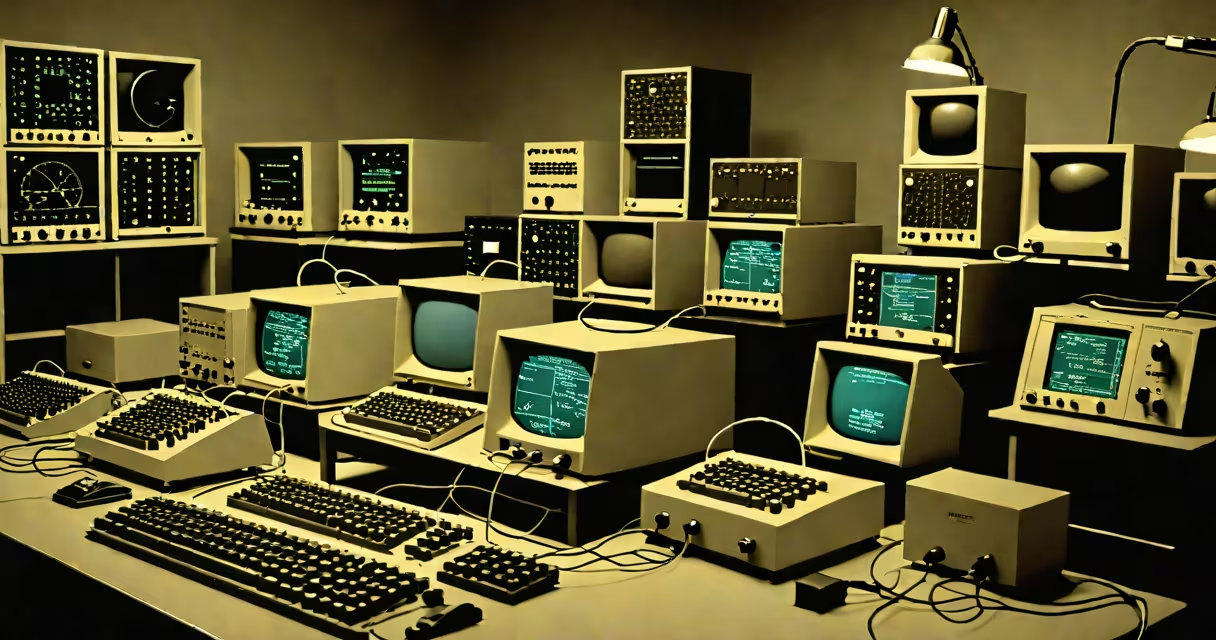
The first internet was ARPANET, a U.S. Department of Defense project launched in 1969 that connected four universities using packet-switching technology. It was the first operational network to implement the protocols later standardized as TCP/IP, forming the technical basis for the modern internet.
ARPANET began as a solution to the problem of centralized computing. Before its creation, researchers relied on isolated mainframes. The goal was to allow geographically dispersed teams to share resources and communicate reliably during emergencies, including nuclear attacks. By distributing data across multiple nodes, ARPANET reduced single points of failure.
On October 29, 1969, the first message was sent between UCLA and Stanford Research Institute. The intended message was "login," but the system crashed after transmitting "lo." This event marked the birth of networked communication on a large scale. Over the next decade, ARPANET expanded to connect over 100 institutions across North America.
ARPANET used packet switching-a method where data is broken into small packets, each routed independently through the network. Packets were reassembled at their destination. This design allowed efficient use of bandwidth and resilience against node failures.
Each host computer ran a protocol called NCP (Network Control Program), which managed connections between machines. NCP enabled basic services like remote login (Telnet), file transfer (FTP), and email. These tools became essential for academic collaboration and scientific research.
By 1983, ARPANET adopted TCP/IP as its core protocol set. This shift allowed interoperability with other networks, enabling the creation of a larger, unified system. The transition marked the beginning of what we now call the internet, though ARPANET remained the core for years.
ARPANET relied on specialized hardware and software. Host computers were typically minicomputers like the Honeywell DDP-24 or PDP-11. They connected via Interface Message Processors (IMPs)-dedicated routers that handled packet routing between sites.
Communication occurred over leased telephone lines operating at 50 kbps. For context, that's roughly 1/100th the speed of a modern mobile broadband connection. Despite this, users could send emails, transfer files, and run remote programs.
A table below outlines the major components of ARPANET:
| Component | Purpose | Example |
|---|---|---|
| IMP | Router handling packet switching | BBN Model 350 |
| NCP | Early transport protocol | Host-to-host control |
| TCP/IP | Standardized communication protocol | Adopted in 1983 |
One non-obvious fact: ARPANET did not use domain names. Users accessed systems by IP address or hostname, often requiring manual configuration. The concept of URLs and web browsers came decades later.
ARPANET served primarily academic and defense research communities. Institutions like MIT, UC Berkeley, and the University of Utah used it to exchange data, collaborate on projects, and access shared computing resources.
Its most notable application was the development of email. In 1971, Ray Tomlinson sent the first networked email between two computers on ARPANET. He chose the @ symbol to separate user and host-this convention remains in use today.
Another key use was resource sharing. Researchers could run programs on distant machines, access databases, and distribute results without physical travel. This accelerated scientific progress in fields like physics, biology, and artificial intelligence.
Many assume the internet began with the World Wide Web in 1991. That's incorrect. The web is a service layer built on top of the internet infrastructure. ARPANET predates the web by over two decades.
Another misconception is that ARPANET was publicly accessible. It wasn't. Access required affiliation with a participating institution. The network was closed to the general public until the late 1980s, when NSFNET expanded connectivity.
Some confuse ARPANET with earlier networks like SABRE (a commercial airline reservation system). While both used packet switching, SABRE was proprietary and designed for transaction processing, not open research collaboration. ARPANET was purpose-built for decentralized, peer-to-peer communication.
In 1971, Ray Tomlinson, a programmer working at BBN Technologies, modified an existing file transfer program to send messages between different hosts on ARPANET. He selected the @ symbol because it was rare in usernames and unlikely to conflict with existing naming conventions.
His test message read: "QWERTYUIOP" - a random string typed on a keyboard. Later, he sent a message to a colleague: "Hello, this is a test." The recipient confirmed receipt. This event marked the first time a person sent a message across a network that wasn't physically connected.
Tomlinson's innovation led to the widespread adoption of email. By 1980, over 100,000 email accounts existed on ARPANET. Today, over 300 billion emails are sent daily worldwide.
I once visited the Computer History Museum in Mountain View, California, where a working replica of an ARPANET IMP is on display. Watching a simulated packet transmission from UCLA to Stanford in real time gave me a visceral sense of how revolutionary the idea of networked communication felt at the time. The simplicity of the interface-just a blinking light and a few command prompts-contrasted sharply with today's complex digital ecosystems.
ARPANET officially shut down on September 27, 1990, after serving its mission. Its successor, the internet, grew rapidly after the adoption of TCP/IP. The National Science Foundation created NSFNET in 1986 to extend connectivity beyond military and academic circles.
Today's internet is a global network of interconnected systems, but its roots lie in ARPANET's design principles: decentralization, fault tolerance, and open standards. The core idea-that machines can communicate without central control-remains unchanged.
Understanding what is the first internet clarifies how today's digital world evolved. ARPANET wasn't just a precursor-it was the blueprint.