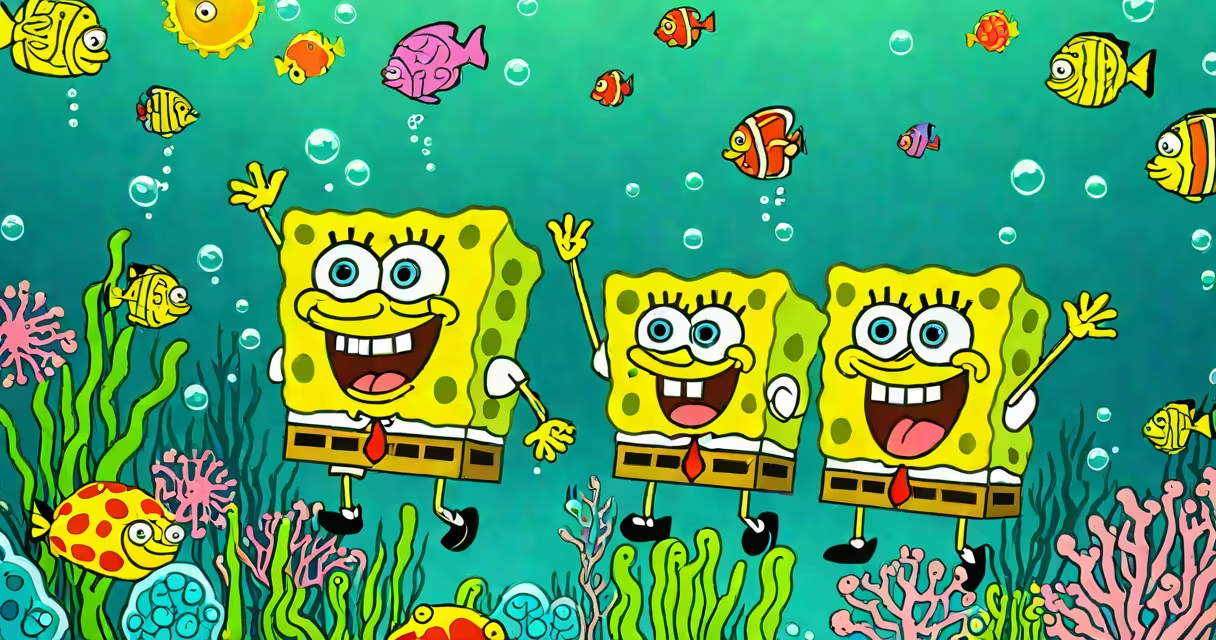
SpongeBob SquarePants is not constructed from any physical substance-he is a fictional animated character created through visual design, voice performance, and storytelling conventions. His form exists entirely within the medium of animation, shaped by artistic choices and narrative purpose.
The character's name and appearance reference a real-world organism: the sea sponge. But SpongeBob is not biologically accurate. He is a stylized, anthropomorphized version of a porous marine animal, designed for humor and visual clarity. His square shape, large eyes, and exaggerated expressions follow classic cartoon principles established in the 1930s and refined in modern animation.
Animation studios like Nickelodeon's in-house team and production partner United Plankton Pictures developed SpongeBob using traditional hand-drawn techniques early on, later transitioning to digital tools. The character's movements, facial expressions, and vocal delivery were crafted through iterative storyboarding and voice direction. His "material" is therefore a combination of pencil lines, digital paint layers, and recorded audio-none of which exist in the physical world.
SpongeBob operates under the rules of cartoon physics. He can stretch, bounce, fly, and survive underwater without breathing-features common in animated comedy but impossible in reality. These exaggerations serve narrative and comedic purposes, allowing for slapstick gags and emotional expression beyond human limits.
For example, in the episode "Band Geeks," SpongeBob runs 10 miles in under 60 seconds while wearing a heavy marching band uniform. This defies biomechanics but aligns with the expectations of animated entertainment. The audience accepts such moments because they're consistent with the genre's internal logic-not realism.
His design uses high contrast: bright yellow against blue backgrounds, black outlines, and simplified shapes. This makes him instantly recognizable even at small sizes. The simplicity of his form allows animators to focus on emotion and timing rather than anatomical detail.
SpongeBob's existence relies on five core elements:
These components combine to create a character who feels alive despite lacking biological structure. He is not made of cells, water, or protein-he is made of intention, creativity, and shared cultural memory.
Many assume SpongeBob is a real sponge or that he lives in a specific ocean zone. He does not. His home, Bikini Bottom, is a fictional underwater city located at the bottom of the Pacific Ocean-but it's not geographically accurate. The show's creators never intended it as a scientific model.
A frequent error is thinking SpongeBob's square shape is a mistake. It's not. The square is intentional. It contrasts with the fluid, organic forms of fish and jellyfish in the show, making SpongeBob stand out visually. It also simplifies animation-squares are easier to draw and animate than complex curves.
Another misunderstanding: people think SpongeBob is always happy. He isn't. Episodes like "The Sponge Who Could Fly" explore loneliness and fear. His optimism is a performance, not a permanent state. This complexity is part of why the character resonates across generations.
Consider how a video game character like Mario is "made of." He's not flesh and bone-he's polygons, textures, and code. Similarly, SpongeBob is composed of frames, voice samples, and scripts. Both exist in digital space and rely on perception to feel real.
Even real animals aren't made of "stuff" in the way we imagine. A sea sponge is mostly water and structural fibers called spongin. But SpongeBob doesn't mimic real sponges closely. He's more like a cartoon version of a mythic creature-part animal, part human, all symbol.
For comparison, look at the 2019 film SpongeBob SquarePants: Sponge on the Run. The movie uses CGI, motion capture, and voice modulation to bring the character to life. Yet the underlying structure remains unchanged: a yellow square with a pineapple house and a job at a fast-food restaurant.
| Element | Physical Reality? | Role in SpongeBob's Existence |
|---|---|---|
| Yellow color | No | Visual identifier; aids recognition in low-light scenes |
| Square shape | No | Design choice for contrast and animation ease |
| Speech and laughter | No | Performs emotional and comedic function |
| Underwater survival | No | Plot device enabling fantasy setting |
I once watched a fan-made animation where SpongeBob was rendered in 3D with realistic skin texture and muscle movement. The result felt alien. The character lost his charm. That experiment proved: SpongeBob isn't made of material-he's made of style.
SpongeBob's lack of physical substance is not a flaw-it's central to his success. He represents a category of characters known as "absurdist icons." Like Bugs Bunny or Bart Simpson, he functions as a cultural symbol, not a biological entity.
According to the NPR, "SpongeBob's enduring popularity lies in his ability to embody both childlike wonder and adult irony." His form allows viewers to project their own emotions onto him-joy, frustration, nostalgia-without needing to believe he's real.
Research from the University of Southern California's Annenberg School for Communication found that audiences form stronger attachments to characters who are fictional. As the study noted, "Audiences prefer characters whose artificiality is visible, because it allows them to engage emotionally without cognitive dissonance."
When you ask "what is SpongeBob made of," the answer isn't "plastic" or "ink." It's imagination, collaboration, and decades of shared viewing. He's made of moments: the laugh at the end of "Squidward's Song," the silence when SpongeBob says "I'm ready!" before a jump, the way he salutes the camera in the theme song.
Understanding this shifts the question from material composition to cultural impact. SpongeBob isn't made of anything tangible-he's made of attention, repetition, and joy. And that's enough.