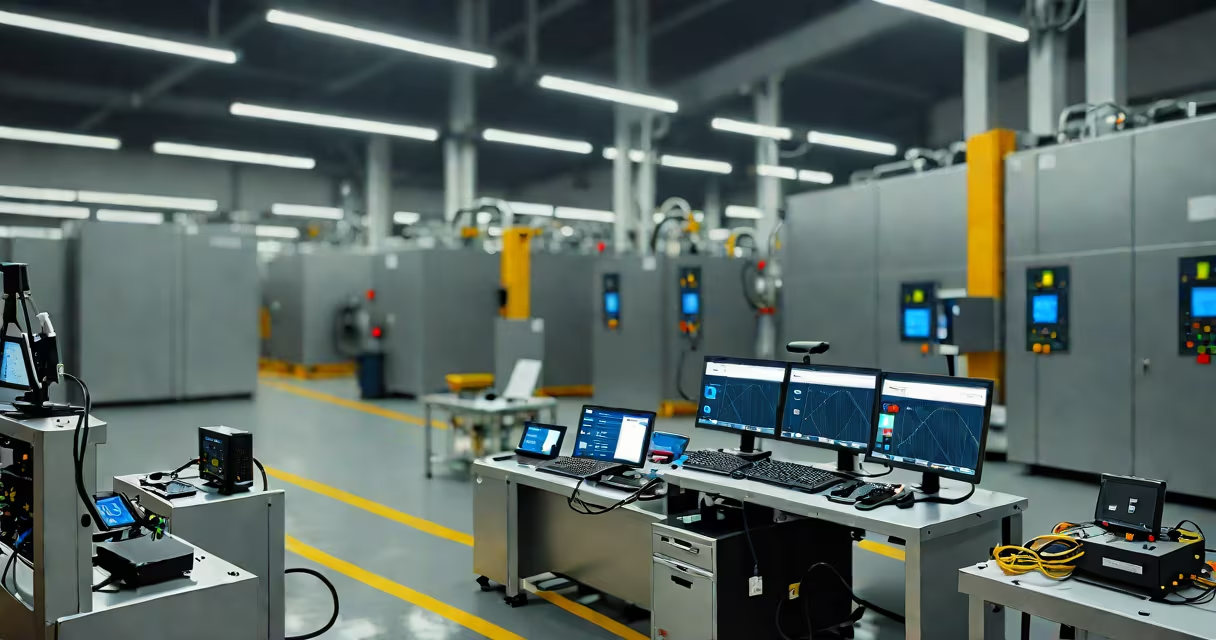
Industrial IoT services integrate sensors, software, and networked devices in manufacturing and heavy industry to collect real-time data, monitor equipment health, and automate responses. These systems enable predictive maintenance, improve production workflows, and reduce unplanned downtime.
At its core, industrial IoT services turn physical machines into data-generating assets. A conveyor belt in a packaging plant, for example, may have vibration sensors and temperature monitors wired into a central system. When the motor begins to overheat, the system detects the anomaly and alerts maintenance teams before failure occurs. This prevents costly stoppages and extends equipment life.
These services rely on edge computing, cloud platforms, and secure communication protocols. Data from field devices flows through gateways to centralized analytics engines. Algorithms process patterns in machine behavior, identifying deviations that signal wear or inefficiency. The result is a shift from reactive fixes to proactive interventions.
Industrial IoT services operate through a layered architecture. The foundation is the physical layer-sensors and actuators embedded in machinery. These capture data such as pressure, flow rate, temperature, and motion. A single CNC machine might deploy 12 sensor types across spindle, coolant, and tooling components.
Data moves to the edge layer via gateways or local controllers. Here, preprocessing happens: filtering noise, compressing streams, and triggering immediate actions. If a valve exceeds pressure thresholds, the gateway can shut off flow within 50 milliseconds-faster than human response.
The processed data then reaches the cloud or on-premise analytics platform. Machine learning models analyze historical and real-time inputs to forecast failures. For instance, a model trained on 18 months of bearing vibration data can predict a 92% likelihood of bearing seizure in 72 hours based on rising harmonic frequencies.
Services fall into four functional categories:
| Type | Function | Use Case Example | Source |
|---|---|---|---|
| Monitoring & Telemetry | Continuous data collection and visualization | Tracking energy consumption across 300 presses in a stamping facility | IBM |
| Predictive Maintenance | Forecasting component failure using AI models | Alerting operators to impending pump failure in a water treatment plant | Cisco |
| Process Optimization | Adjusting parameters in real time to improve yield | Auto-tuning furnace temperatures in a steel mill based on material feed rate | IBM |
| Remote Operations | Controlling equipment from a centralized command center | Managing crane operations in a port terminal from a remote control room | Cisco |
Each service type requires different integration complexity. Monitoring systems often use standard protocols like Modbus or MQTT. Predictive maintenance demands higher bandwidth and storage due to continuous high-frequency sampling. Remote operations require low-latency connections and fail-safe mechanisms to prevent accidents.
They are deployed in factories, oil and gas refineries, mining operations, and utility grids. A cement plant in Texas reduced kiln downtime by 37% after installing vibration and thermal sensors on critical rotating equipment. The system detected early signs of refractory lining degradation, allowing repairs during scheduled maintenance windows.
Manufacturers use industrial IoT services to meet lean production goals. A European automotive supplier cut scrap rates by 22% by analyzing welding current patterns across 14 robotic arms. Deviations below 95% of baseline indicated misalignment, triggering automatic recalibration.
A common misconception is that industrial IoT services replace human workers. In reality, they augment roles. At a semiconductor fab in South Korea, engineers use real-time defect maps generated by machine vision systems to adjust wafer processing parameters. The system flags anomalies faster than manual inspection, but humans still validate root causes and approve changes.
Many assume industrial IoT services are synonymous with automation. While both involve machines, automation focuses on executing predefined tasks. Industrial IoT adds intelligence-learning from data to adapt behavior. An automated assembly line moves parts along a track. An industrial IoT system monitors joint torque during bolt tightening and adjusts force dynamically based on material thickness.
Another error is equating industrial IoT with consumer IoT. Consumer devices prioritize convenience and low cost. Industrial systems demand durability, precision, and uptime. A smart thermostat in a home might tolerate 10-minute outages. A temperature sensor in a chemical reactor must maintain accuracy within ±0.1°C and report data every 2 seconds-even during power fluctuations.
I once observed a pilot project at a paper mill where unsecured Wi-Fi enabled direct access to PLCs controlling pulp digesters. After a security audit, we discovered that default credentials had never been changed. The system was vulnerable to remote manipulation. This highlights a key point: industrial IoT services must include embedded cybersecurity. Without it, data integrity and safety are compromised.
For example, a food processing plant in Minnesota experienced a product recall after a rogue script altered temperature settings in a pasteurization unit. The script originated from a poorly configured IIoT dashboard. The incident led to $2.3 million in losses and regulatory fines. Implementing role-based access controls and regular firmware updates prevented recurrence.
A North American tire manufacturer faced recurring failures in rubber mixing tanks. Tanks overheated during batch cycles, causing material degradation. Engineers installed thermocouples and flow meters linked to an industrial IoT platform. Data streamed to a cloud analytics engine every 15 seconds.
Over 60 days, the system identified a pattern: tank walls cooled unevenly due to worn insulation seals. The model predicted failure within 48 hours with 89% confidence. Maintenance crews replaced seals during a planned shutdown, avoiding a 12-hour production halt. The solution reduced maintenance costs by 28% and improved batch consistency.
This case shows that industrial IoT services deliver measurable ROI-not just theoretical benefits. They change operational data into actionable insights that prevent losses and improve quality.
When selecting industrial IoT services, focus on reliability, scalability, and security. Ensure the provider supports integration with existing SCADA or MES systems. Look for compliance with standards like ISA/IEC 62443 for industrial cybersecurity. Avoid vendors promising "plug-and-play" setups without assessing your infrastructure's maturity.
Industrial IoT services are not a one-size-fits-all solution. Success depends on clear objectives, proper data governance, and ongoing tuning. But when implemented correctly, they deliver tangible improvements in efficiency, safety, and asset longevity.