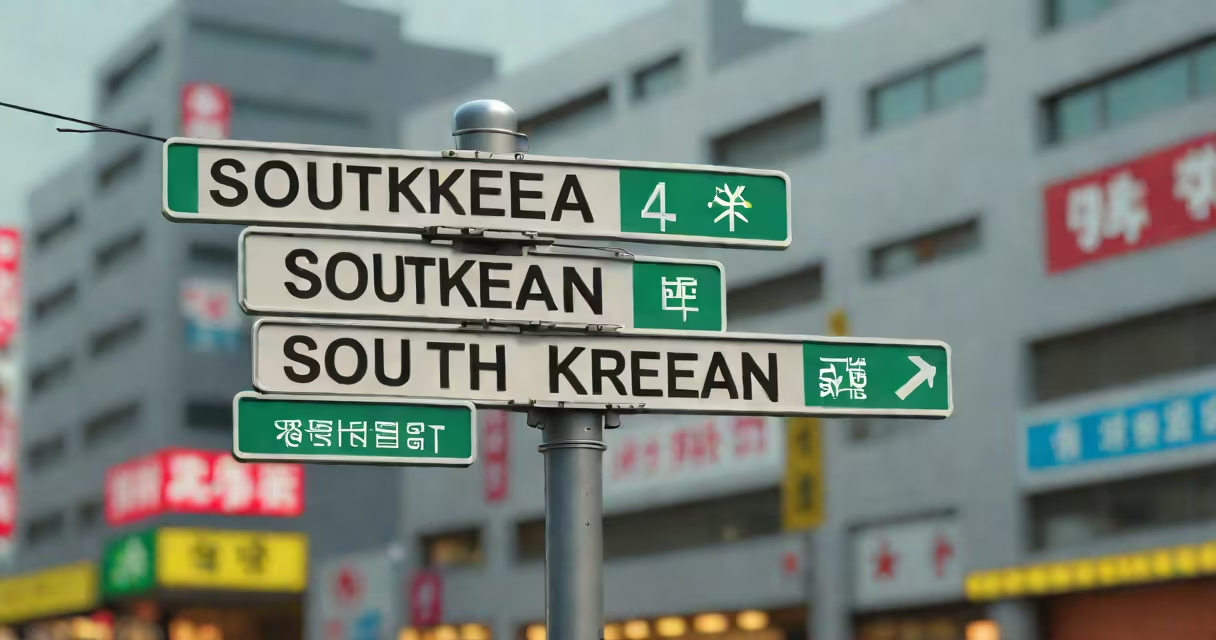
The South Korean language is a standardized form of the Korean language spoken primarily in South Korea, based on the Seoul dialect and written using Hangul, the country's native phonetic alphabet. It is mutually intelligible with North Korean speech but differs in vocabulary, pronunciation, and cultural references due to decades of political separation.
Hangul, created in 1446 under King Sejong, is the official writing system. It consists of 14 basic consonants and 10 basic vowels, arranged into syllabic blocks. Unlike Chinese characters or the Latin alphabet, Hangul aims to reflect the articulation of sounds, making it highly efficient and easy to learn. Over 95% of South Koreans are functionally literate in Hangul, according to UNESCO reports from 2021.
South Korean language features a subject-object-verb (SOV) word order, agglutinative morphology, and a complex system of honorifics that reflect social hierarchy. These honorifics are not optional-they are required in formal or respectful contexts. For example, saying "I eat" becomes "I eat respectfully" when speaking to someone older or higher in rank. This system shapes daily interactions and is deeply embedded in education and workplace culture.
South Korean language operates through a combination of phonology, syntax, and pragmatics. The phonological system includes five vowel qualities and nine primary consonant sounds, with additional aspirated and tense variants. For instance, the letter ㄱ (g/k) has different pronunciations depending on its position in a word-softened at the beginning of a syllable, harder at the end.
Syntax relies heavily on particles to mark grammatical roles. The particle -는 (neun) marks the topic, while -을 (eul) indicates direct objects. A sentence like "I am reading a book" translates to "나는 책을 읽고 있어요" (Naneun chyeogeul ikgo isseoyo), where "나는" (Naneun) = "I (topic)," "책을" (chyeogeul) = "book (object)," and "읽고 있어요" (ikgo isseoyo) = "am reading."
Pragmatically, context determines meaning. The same sentence can imply different intentions based on tone, facial expression, or prior conversation. In business settings, indirectness is common-saying "It might be difficult" often means "No, we cannot do it." This contrasts with Western directness and can confuse non-native speakers.
While the standard form is based on the Seoul dialect, regional variations exist. In Gyeongsang Province (southeastern South Korea), speech patterns differ in pitch accent and vocabulary. Words like "hello" are pronounced "annyeong" in Seoul but "annyeong" with a rising intonation in Busan. These differences are not mutually unintelligible but affect perceived authenticity and identity.
| Dialect Region | Distinct Feature | Example Word |
|---|---|---|
| Seoul (Standard) | Neutral pitch, clear consonants | 안녕하세요 (Annyeonghaseyo) |
| Busan (Gyeongsang) | Rising pitch, elongated vowels | 안녕하세여 (Annyeonghaseyo with drawl) |
| Jeju Island | Unique vocabulary, tonal inflection | 하이 (Hai) = "Hello" |
Despite regional variation, national media, education, and government communication enforce the Seoul-based standard. This standardization ensures consistency across public services, legal documents, and school curricula.
South Korean language is used in all official domains: government, education, healthcare, and commerce. It is the medium of instruction in schools from kindergarten through university. According to Statistics Korea (2022), 99.7% of students in South Korea study in Korean-medium classrooms.
Global influence has expanded its reach. K-pop, K-dramas, and streaming platforms like Netflix have made South Korean language accessible worldwide. The song "Gangnam Style" by PSY, released in 2012, introduced millions to Korean slang and pronunciation. By 2023, over 10 million people were enrolled in online Korean language courses globally, per the Korea Institute of Language and Linguistics.
Businesses increasingly require Korean proficiency. Companies like Samsung and Hyundai hire employees fluent in both Korean and English. In 2021, Samsung Electronics reported that 42% of new hires in international divisions had passed the TOPIK (Test of Proficiency in Korean) Level 4 or higher.
Many assume South Korean language is a variant of Japanese or Chinese. It is not. Korean belongs to the Koreanic language family, unrelated to Sino-Tibetan or Japonic languages. While it borrowed thousands of Chinese characters (Hanja) historically, modern Korean uses Hangul almost exclusively. Hanja appear only in academic texts, legal documents, or personal names.
Another misconception is that Korean is "hard" because of its writing system. Hangul is actually one of the most logical scripts ever devised. Its design was based on articulatory phonetics-each character represents how the mouth forms the sound. Research from the University of California, Berkeley (2019) confirmed that children learn Hangul faster than Latin-alphabet readers in equivalent grades.
A lesser-known fact: South Korean language has no gendered pronouns. There is no "he" or "she" in Korean. Instead, context and honorifics indicate gender. For example, "그는" (geuneun) means "he" or "she," depending on who is being discussed. This neutrality reduces gendered assumptions in speech and writing.
I spent six months living in Seoul during my exchange program. I initially struggled with informal speech-especially the use of honorifics in casual settings. When I greeted a shopkeeper with "안녕하세요" (Annyeonghaseyo), he responded with "안녕히 계세요" (Annyeonghi gyeseyo), which means "Stay well." I didn't realize this was a polite farewell until I accidentally used it incorrectly in a restaurant. The staff corrected me gently, and I learned that even small errors carry social weight.
Consider a job posting from a major South Korean tech firm:
"모든 지원자는 한국어 능력이 필요합니다. TOPIK 3급 이상 소지자 우선 채용됩니다."
Translation: "All applicants must have Korean language ability. Candidates with TOPIK Level 3 or above will be prioritized."
TOPIK (Test of Proficiency in Korean) is administered by the National Institute of Korean Language. It assesses listening, reading, and writing skills across six levels. Level 3 requires understanding of everyday conversations, including news summaries and workplace instructions. Passing Level 3 demonstrates functional fluency.
Understanding the South Korean language is essential for anyone engaging with South Korea's culture, economy, or society. simply watching a K-drama, knowing how the language functions beyond translation unlocks deeper connection.
Mastering the South Korean language means mastering a living system shaped by history, geography, and daily interaction. It is not a static set of rules-it evolves with each generation, each trend, each shared moment.