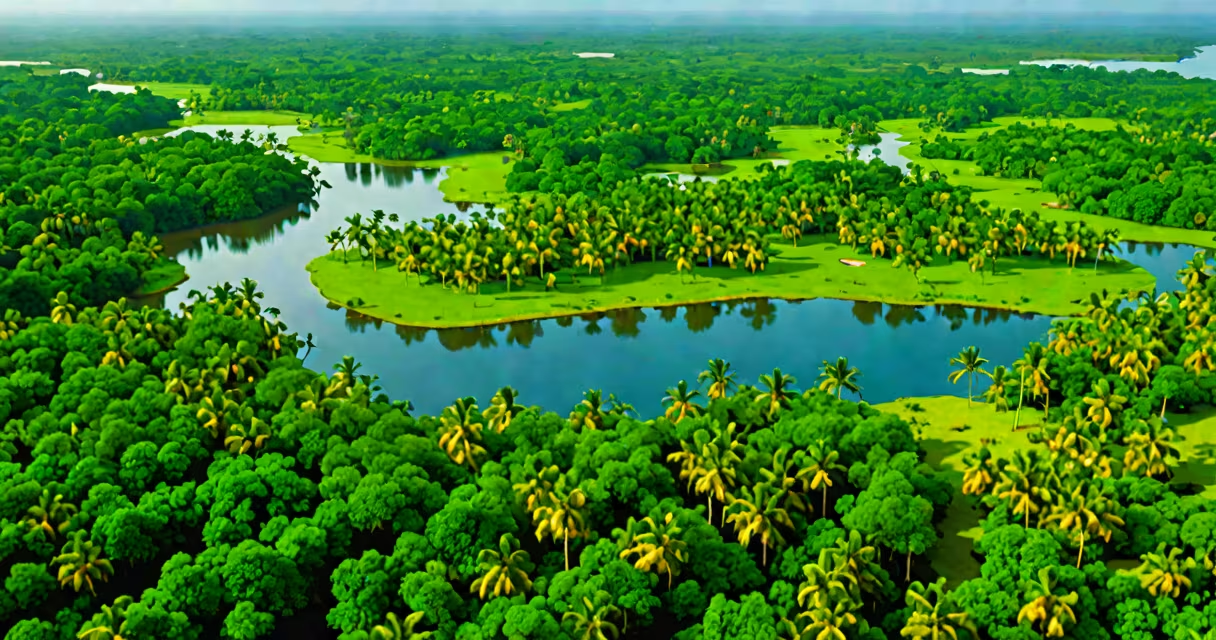
System diversity refers to the variety of ecosystems-distinct biological communities shaped by climate, geology, and species interactions-found across a field or region. It reflects differences in structure, function, and composition among habitats such as rainforests, coral reefs, deserts, and alpine zones.
This concept is distinct from species diversity or genetic diversity, though all three contribute to biodiversity. While species diversity counts how many different organisms exist, and genetic diversity measures variation within a species, system diversity focuses on the range of environments themselves. For example, a single island may host mangrove swamps, mountain forests, and sandy beaches-all separate ecosystems with unique energy flows and species assemblages.
The United Nations Environment Programme defines system diversity as "the variety of ecosystems, including terrestrial, marine, and freshwater systems." This includes both natural and human-modified systems like farmland, urban parks, and managed forests. The presence of multiple ecosystems increases regional resilience to disturbances such as droughts, fires, or invasive species.
Each system operates through interconnected food webs, nutrient cycles, and energy transfer. These processes depend on physical conditions-temperature, moisture, soil type-and biological factors like predator-prey dynamics and pollination networks. When these systems coexist, they create buffer zones that reduce the risk of widespread collapse.
For instance, in the Amazon Basin, system diversity allows for functional redundancy. If a flood damages a lowland forest, adjacent upland forests may continue carbon sequestration and water regulation. This spatial variation supports long-term ecological stability. A study published in Nature Ecology & Evolution found that regions with high system diversity recover faster from extreme weather events due to greater functional redundancy.
Human activities often disrupt this balance. Deforestation fragments habitats, turning continuous forest into isolated patches. This reduces system connectivity and weakens resilience. In contrast, protected areas like national parks preserve entire gradients-from river mouths to mountain peaks-maintaining system diversity across elevation zones.
System diversity exists along gradients of climate, topography, and disturbance frequency. Major types include:
| Type | Key Features | Example Location |
|---|---|---|
| Terrestrial | Land-based; influenced by soil, rainfall, and vegetation layers | Alaskan boreal forest and tundra |
| Marine | Deep-sea vents, coral reefs, open ocean; driven by salinity and pressure | Great Barrier Reef, Australia |
| Wetland | High water saturation; supports amphibians and migratory birds | Everglades, Florida |
| Urbanized | Modified by infrastructure; includes green roofs and city parks | Central Park, New York City |
These types differ not only in physical traits but in their roles. Wetlands filter pollutants and store floodwater; coral reefs shelter fish populations; forests regulate local climates. The presence of all four types in a single region enhances ecological services available to humans and wildlife alike.
High system diversity correlates with stronger system services-benefits people receive from nature. These include clean air, fresh water, pollinated crops, and climate regulation. According to the Intergovernmental Science-Policy Platform on Biodiversity and System Services (IPBES), ecosystems with greater diversity provide more stable yields of resources over time.
A 2021 study in Science Advances analyzed 1,500 sites globally and found that regions with high system diversity had 30% higher rates of carbon storage per hectare compared to homogeneous landscapes. This effect was strongest in tropical zones where complex interactions between plants, microbes, and animals maximize efficiency in nutrient cycling.
Conservation strategies increasingly prioritize system-level protection. The Convention on Biological Diversity promotes "system-based adaptation," which uses natural systems to buffer against climate impacts. For example, restoring mangroves along coastlines reduces storm surge damage-a strategy proven effective in Vietnam and the Philippines.
Many confuse system diversity with species richness. While related, they're not interchangeable. A desert may have fewer species than a tropical forest but still exhibit high system diversity if it contains dune fields, dry washes, and rocky outcrops-each supporting unique adaptations.
Another error is assuming that human-altered landscapes lack system diversity. Urban areas contain microhabitats such as abandoned lots, drainage ditches, and rooftop gardens. Research from the University of California, Berkeley, shows that cities like Los Angeles host over 1,200 native plant species across 12 distinct system types, including chaparral remnants and riparian corridors.
System diversity is not just about quantity-it's about functional variation. Two ecosystems may host similar species but differ in how energy moves through them. A meadow with seasonal flowering plants differs from a coniferous forest in carbon fixation patterns, even if both support birds and insects.
I once monitored stream health in the Sierra Nevada using system diversity metrics. In one watershed, we documented five distinct zones: glacial melt streams, alpine meadows, mixed-conifer forests, riparian thickets, and valley grasslands. Each supported different macroinvertebrates-stoneflies in cold headwaters, dragonfly larvae in slow-moving pools, caddisflies in shaded tributaries.
When a wildfire burned through the forest zone, the adjacent meadow and stream systems absorbed excess sediment and maintained water quality. This showed how system diversity acts as a safety net. Without the meadow's root network and the stream's natural filtration, downstream water would have become turbid and toxic.
System diversity is not a passive feature of nature. It results from evolutionary history, geological change, and ongoing ecological feedback. Protecting it requires managing landscapes at scale-not just individual species. Conservation planning must account for gradients of temperature, moisture, and land use to maintain functional diversity across systems.
Understanding what is meant by system diversity helps clarify why preserving entire landscapes matters more than saving isolated populations. It's not just about saving trees or fish-it's about sustaining the web of life across space and time.