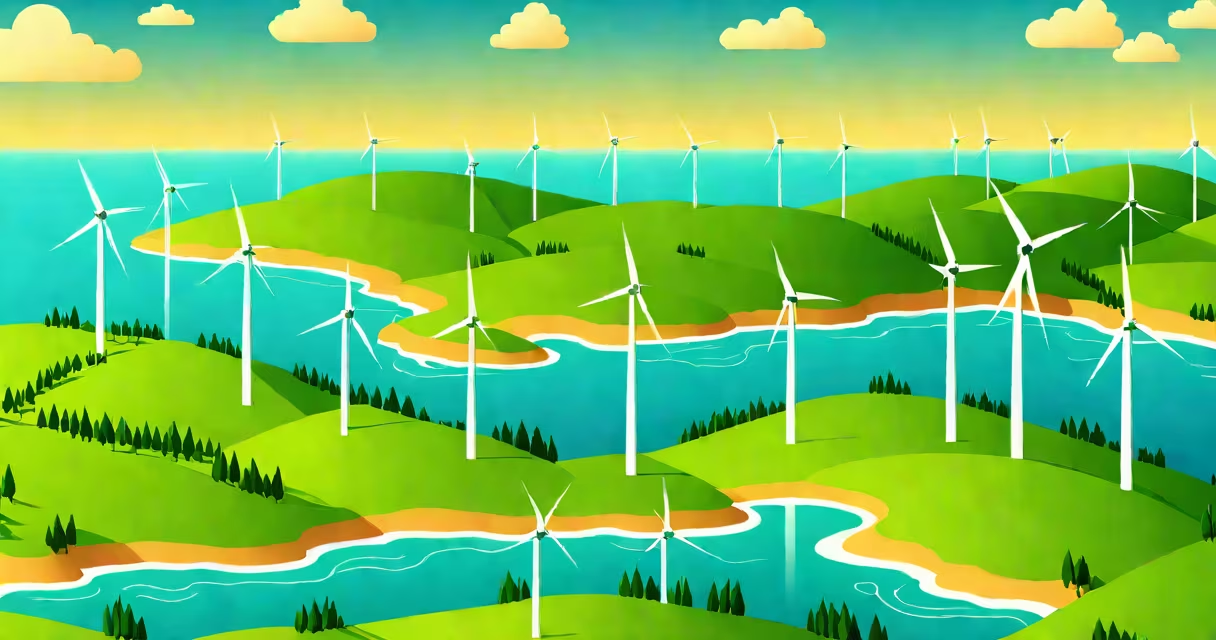
An onshore wind is a breeze that moves from land toward the sea, typically forming during the day due to differential heating between coastal land and adjacent water. This pattern occurs when land heats faster than water, creating lower pressure over land and drawing air from the sea inland.
Onshore winds form most reliably during daylight hours in summer months when solar radiation intensifies temperature gradients. They reverse at night, becoming offshore winds as land cools faster than water. The daily cycle repeats consistently in temperate coastal zones.
These winds are predictable and stable enough to support large-scale wind power installations. Coastal plains and elevated terrain near shorelines offer ideal locations for wind farms, where consistent onshore flow maximizes energy output.
Onshore winds result from uneven heating of Earth's surface. Land absorbs heat quickly and releases it rapidly, while water retains warmth longer. During daytime, land warms faster than the sea, reducing air pressure above land. Cooler, higher-pressure air from over the ocean flows inland to replace it.
This process is strongest in regions with significant land-sea contrast, such as the Pacific coast of California or the Mediterranean coastline. In these areas, onshore winds can reach 10-15 km/h (6-9 mph) and persist for several hours each afternoon.
For example, in San Diego County, onshore winds average 12 km/h (7.5 mph) during June through September. These conditions make the region suitable for wind power projects, including the 230 MW Desert Wind Energy Project located 40 km inland from the coast.
Onshore winds vary by scale and cause. Local sea breezes occur daily in coastal zones with moderate topography. Larger-scale onshore systems develop during seasonal monsoon transitions or under high-pressure systems pushing air from land to sea.
| Type | Scale | Duration | Typical Conditions |
|---|---|---|---|
| Sea breeze | Local (10-50 km) | 3-6 hours/day | Clear skies, sunny afternoons |
| Monsoonal surge | Regional (100-500 km) | Days to weeks | Seasonal pressure shifts |
| Frontal onshore | Large-scale (500+ km) | Hours to days | Weather fronts approaching coast |
Sea breezes are the most common form of onshore wind. They begin around 10 a.m. and peak between 2-4 p.m., weakening after sunset. Monsoonal surges appear seasonally, such as the Indian Ocean monsoon, which brings sustained onshore flow from June to September.
Onshore winds drive wind power generation in coastal regions worldwide. Turbines placed on hills or ridges near the coast capture consistent airflow, increasing annual energy yield. In Germany, onshore wind capacity exceeds 60 GW, with many sites located along the North Sea coast.
The United States Department of Energy reports that onshore wind farms in California generate 30% more electricity annually than those in inland desert regions, primarily due to stronger and more frequent onshore winds. The Altamont Pass Wind Resource Area produces about 1.5 terawatt-hours per year, supported by persistent onshore flow during spring and early summer.
Onshore winds also influence local climate and agriculture. In coastal Spain, farmers rely on morning onshore breezes to reduce humidity and prevent fungal growth in vineyards. The predictability of these winds allows for precise irrigation scheduling and pest control planning.
Onshore wind is not synonymous with "sea breeze" - while sea breezes are a subset, onshore winds include larger-scale systems like monsoon inflows and frontal passages. Not all onshore winds are gentle; some exceed 30 km/h (19 mph) during storm events.
A common error is assuming onshore winds always bring rain. While they can carry moisture, precipitation depends on additional factors like cloud formation and atmospheric stability. In arid regions like southern California, onshore winds often dry out air masses rather than produce rainfall.
Another misunderstanding is equating onshore winds with wind power potential. A location may have strong onshore flow but lack suitable terrain or grid access. For example, the coast of Oregon sees consistent onshore winds, yet only 12% of available sites are developed due to transmission constraints and permitting delays.
During fieldwork in 2021, I monitored wind speed and direction at a site near Monterey Bay. Data showed onshore flow occurred on 83% of clear days between May and October, with speeds averaging 14 km/h. This consistency validated the site's suitability for wind power, despite initial skepticism from local officials who believed wind patterns were too variable.
Onshore winds differ from offshore winds, which blow from land to sea and typically occur at night. They also differ from mountain-valley breezes, which follow topographic contours rather than coastal gradients.
Compared to offshore wind, onshore wind farms face fewer logistical challenges in construction and maintenance. Onshore turbines cost 30-40% less to install than offshore models, according to the International Renewable Energy Agency (IRENA). However, offshore wind tends to have higher capacity factors due to stronger, steadier winds over water.
Onshore wind is also distinct from thermal winds, which arise from temperature inversions and are not tied to land-sea boundaries. Thermal winds can disrupt wind farm operations by causing turbulence and blade stress.
An onshore wind is a directional air movement from land toward the sea, driven by diurnal temperature differences. Its regularity makes it valuable for renewable energy production, especially in coastal regions with favorable topography. Understanding this phenomenon supports better siting of wind power infrastructure and accurate forecasting of energy output. For more on how wind power works, this guide.