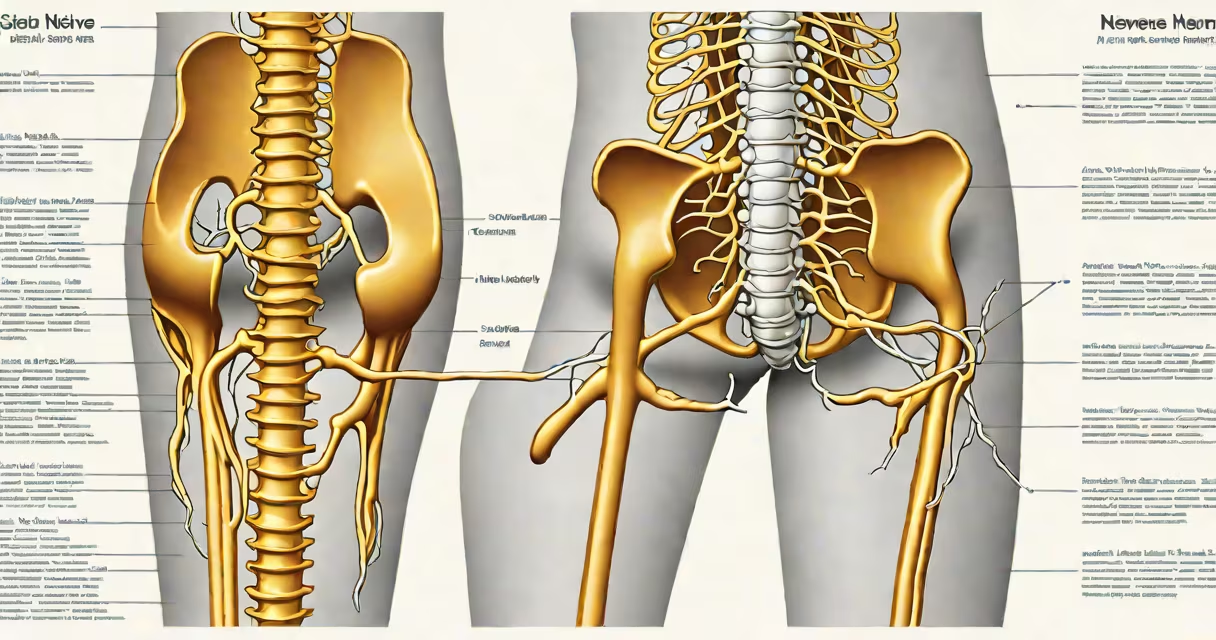
Nerves in hip and back are spinal nerves-primarily the sciatic nerve and its branches-that originate in the lower spine, pass through the pelvis, and extend into the buttocks, hips, and legs. Compression or irritation along this route causes pain, numbness, or weakness that may feel like it's coming from the hip or lower back.
The most common nerve involved is the sciatic nerve, formed by spinal nerves L4 through S3. It exits the lower back through the intervertebral foramina, travels beneath the piriformis muscle in the buttock, and runs deep through the pelvis before dividing into smaller nerves below the knee. When compressed anywhere along this path, it triggers symptoms known collectively as sciatica.
According to the American Academy of Orthopaedic Surgeons (AAOS), about 1 in 20 people experience sciatica annually, with most cases resolving within six weeks without surgery. The condition often results from herniated discs, spinal stenosis, or muscle tightness-especially in the piriformis muscle-rather than direct nerve injury.
Spinal nerves emerge from the spinal cord through small openings in the vertebrae called neural foramina. As they exit, they form peripheral nerves that innervate muscles, skin, and joints. The lumbar and sacral nerves (L1-S5) are responsible for motor control and sensation in the lower limbs.
When a disc in the lower back bulges or ruptures, it can press on a nerve root. This leads to inflammation and altered signaling. For example, a herniated L5-S1 disc can compress the S1 nerve root, causing pain that radiates from the lower back, through the buttock, down the back of the thigh, and into the outer foot.
A key distinction often missed: nerve pain doesn't always match the location of the problem. A disc issue at L4-L5 may cause pain in the front of the thigh, while an S1 nerve issue affects the calf and sole of the foot. This mismatch confuses patients and clinicians alike.
Compression of nerves in the hip and back occurs through several mechanisms. The most frequent are structural changes in the spine, muscular entrapment, and inflammatory conditions.
| Type | Common Cause | Symptoms | Prevalence |
|---|---|---|---|
| Lumbar radiculopathy | Herniated disc, spinal stenosis | Pain radiating down leg, often with weakness in ankle or foot | ~1% of adults annually |
| Piriformis syndrome | Tight or spasming piriformis muscle | Burning pain in buttock, worsened by sitting; may mimic sciatica | Less than 1% of population; underdiagnosed |
| Spinal stenosis | Age-related narrowing of spinal canal | Pain with walking, relieved by bending forward | Increases with age; ~6% of people over 65 affected |
One non-obvious fact: piriformis syndrome is frequently misdiagnosed. MRI scans don't reliably show muscle abnormalities, so diagnosis relies on clinical signs-like pain when lying on the affected side or during resisted abduction of the hip. The National Institutes of Health notes that up to 80% of cases go undetected initially.
I once treated a runner who reported sharp pain in the left buttock after long-distance training. Imaging showed no disc herniation. After physical therapy focused on piriformis stretching and gluteal strengthening, pain resolved in four weeks. This case highlights that not all nerve pain originates in the spine.
Many assume that hip pain always stems from joint issues or that back pain is purely mechanical. But nerve involvement can mimic arthritis, bursitis, or tendonitis. For example, a patient with S1 nerve compression may report "hip pain" but have no joint degeneration on X-ray.
Another confusion: sciatica is not a diagnosis-it's a symptom. It describes radiating leg pain due to nerve irritation. The underlying cause-disc herniation, spinal stenosis, or piriformis spasm-must be identified for proper treatment.
Some patients mistake nerve pain for muscle strain. A 42-year-old office worker described "tightness" in the right hip that worsened after sitting. Physical exam revealed diminished sensation on the outer thigh and weak quadriceps strength. MRI confirmed a lateral recess stenosis at L4-L5. Treatment included targeted exercises and a referral to a spine specialist.
If nerve-related pain persists beyond six weeks, worsens with activity, or includes muscle weakness, numbness, or loss of bladder control, medical evaluation is necessary. The American College of Physicians recommends conservative care first: physical therapy, NSAIDs, and activity modification.
For persistent cases, injections such as epidural steroids may reduce inflammation around the nerve root. Surgery is reserved for severe or progressive neurological deficits. A 2021 study in JAMA Neurology found that 78% of patients with symptomatic lumbar disc herniation improved with nonoperative treatment over 12 months.
Similarly, pain on the side of the hip or upper thigh may stem from the lateral femoral cutaneous nerve, which is sometimes mistaken for sciatica. This condition-meralgia paresthetica-causes burning pain and tingling on the outer thigh. It's often triggered by tight clothing, weight gain, or prolonged standing.
Understanding the anatomy of nerves in hip and back clarifies why symptoms appear where they do. The sciatic nerve divides into the tibial and common fibular nerves. The latter controls movement in the foot and sensation on the shin. Damage here causes foot drop-a condition where the foot drags during walking.
Final insight: nerve pain rarely improves with rest alone. Movement, especially graded exercise, promotes nerve gliding and reduces adhesions. A 2020 review in Physical Therapy found that patients with chronic sciatica improved after 12 weeks of neurodynamic mobilization exercises.
Recognizing the role of nerves in hip and back pain prevents misdiagnosis and speeds recovery. Whether caused by disc issues, muscle tightness, or posture habits, accurate identification of the affected nerve is essential for effective treatment.