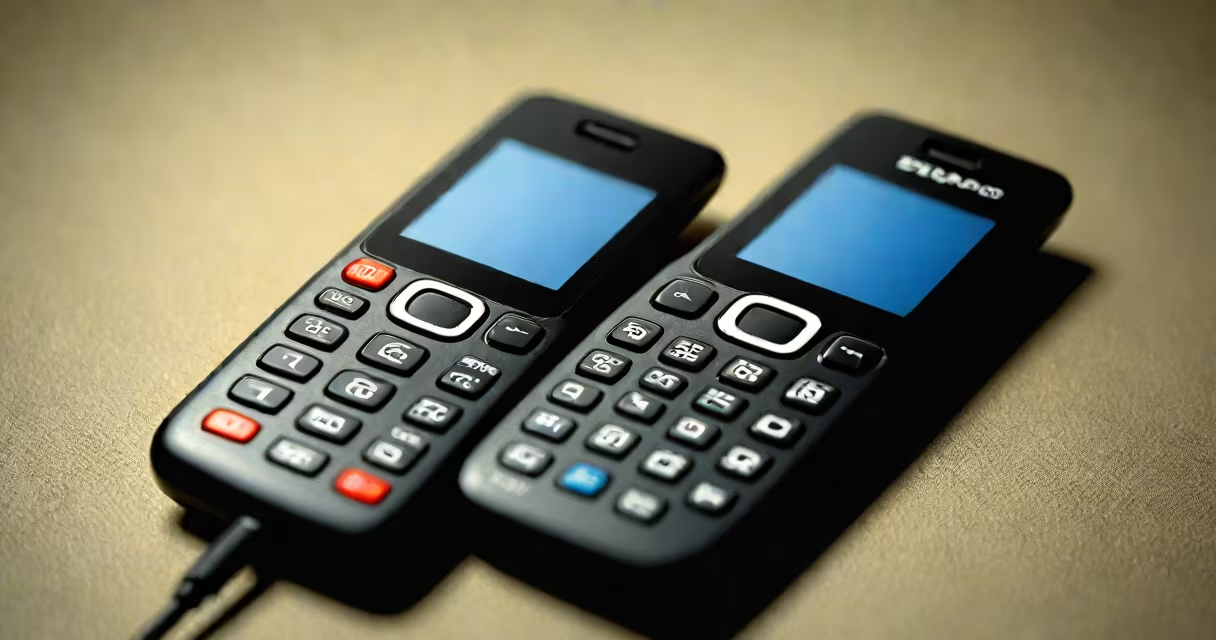
2G is the second generation of mobile network technology, launched in the early 1990s. It replaced analog voice systems with digital signaling, enabling encrypted voice calls, SMS messaging, and low-speed data transmission.
2G networks operate on digital standards such as GSM (Global System for Mobile Communications), which became the global norm. These networks use time-division multiple access (TDMA) and frequency-division multiple access (FDMA) to allocate channels among users. The core innovation was switching from analog radio waves to digital encoding, improving call quality, security, and capacity.
While 2G is now largely obsolete in developed nations, it remains in use in rural and low-income regions due to its simplicity, low infrastructure cost, and long battery life for devices. 2G enabled the first widespread mobile internet experience through GPRS and EDGE, though speeds were limited to around 50 kbps.
2G networks digitize voice signals by sampling audio at 8 kHz and compressing it using codecs like AMR (Adaptive Multi-Rate). This digital stream is then modulated onto a carrier frequency using TDMA or FDMA. In TDMA, a single frequency is divided into time slots, allowing multiple users to share the same channel sequentially.
When a call is initiated, the mobile device connects to the nearest base station, which routes the signal through a mobile switching center (MSC). The MSC manages handoffs between cells and interfaces with the public switched telephone network (PSTN) for landline connections. All communications are encrypted using A5/1 or A5/2 algorithms, though vulnerabilities have since been identified.
Data services like SMS and MMS rely on circuit-switched channels. For packet data, 2G introduced GPRS (General Packet Radio Service), which added packet-switching capabilities. GPRS improved efficiency by allowing shared bandwidth and persistent connections, enabling basic web browsing and email on devices like Nokia 3310s.
Several regional standards define 2G networks. The most widely adopted is GSM, used in Europe, Asia, Africa, and parts of South America. GSM operates on 900 MHz and 1800 MHz bands in most countries, with 1900 MHz in North America. It supports up to 8 users per 200 kHz channel via TDMA.
Other 2G standards include:
| Standard | Region | Multiple Access | Frequency Bands |
|---|---|---|---|
| GSM | Global (except U.S./Canada) | TDMA | 900/1800 MHz (Europe); 1900 MHz (North America) |
| CDMA2000 1x | North America, parts of Asia | CDMA | 800/1900 MHz |
| PDC | Scandinavia, some Asian countries | TDMA | 900 MHz |
| PHS | Japan | TDMA | 1.9 GHz |
Despite being phased out in many countries, 2G remains operational in over 100 nations. According to the GSMA, as of 2023, 2G still served 1.4 billion subscribers globally, mostly in emerging markets.
Its persistence stems from low cost and reliability. Devices like basic feature phones, IoT sensors, and emergency communication tools often run on 2G because they require minimal power and bandwidth. For example, a water level sensor in a remote village may transmit data once daily via SMS over a 2G network, consuming less than 100 mAh of battery per month.
Telecom operators in India, Nigeria, and Indonesia continue to maintain 2G networks for rural coverage. In India, Airtel and Jio still offer 2G-only plans for under $1/month, targeting users who cannot afford smartphones or 4G data.
Many assume 2G is entirely outdated. However, it still powers critical infrastructure. In 2022, the U.S. Federal Communications Commission (FCC) confirmed that 2G networks supported over 1 million emergency 911 calls annually, particularly in rural areas where LTE coverage is weak.
Another misconception is that 2G lacks security. While early encryption (A5/1) was cracked in 2010, modern implementations use stronger protocols. More, 2G's simplicity reduces attack surface compared to complex 5G architectures.
A lesser-known fact: 2G was the first mobile system to support international roaming. When GSM was standardized in 1992, it included a SIM card that stored user identity and authentication keys. This allowed a user in Germany to insert their SIM into a phone in Thailand and make calls at local rates-a capability absent in analog systems.
In 2021, a health clinic in Kitui County, Kenya, faced frequent power outages. To monitor patient important signs remotely, the team deployed a network of 2G-enabled pulse oximeters. Each device sent readings every 15 minutes via SMS to a central server.
The system used a Nokia 3310 with a local SIM card, powered by a solar panel. Data traveled over Safaricom's 2G network, which had 98% coverage in the region. Over six months, the system transmitted 14,000 messages with 99.6% delivery success. No 4G signal was available, and battery life exceeded 18 months.
This example shows how 2G enables low-bandwidth, mission-critical applications where speed and complexity are secondary to reliability and cost.
2G is not merely a relic of the past. It remains a functional, secure, and affordable foundation for communication in underserved areas. As the world moves toward 5G and beyond, 2G continues to serve billions who depend on it for connectivity, safety, and access to essential services.