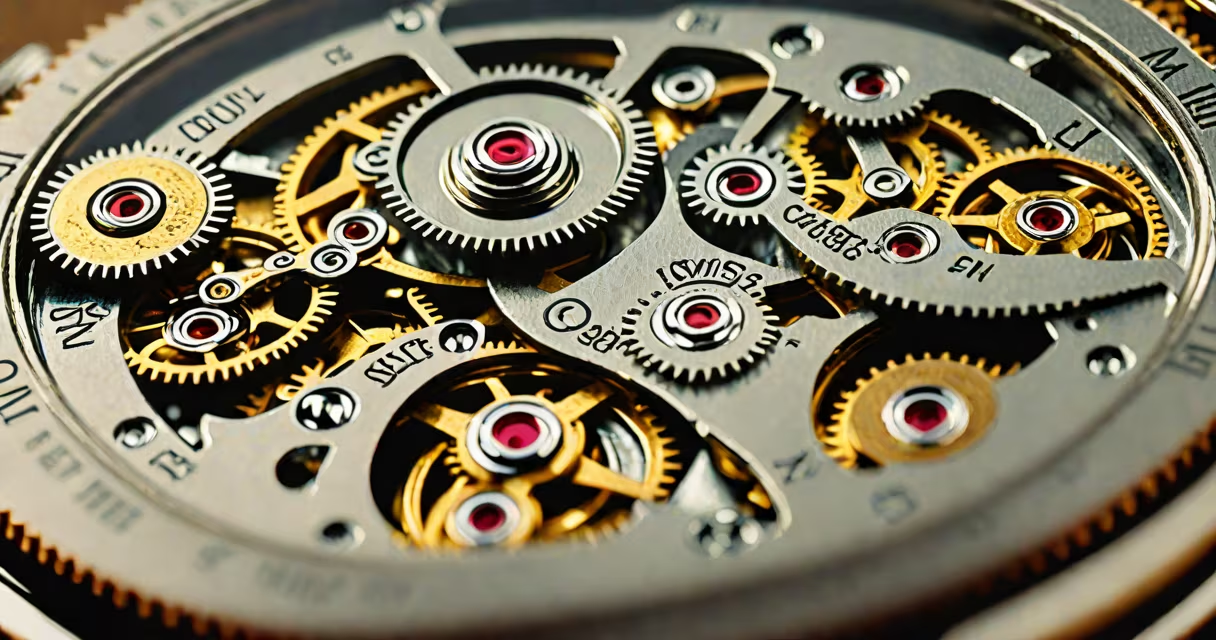
A Swiss movement is a watch's internal mechanical system produced in Switzerland, recognized for high accuracy, durability, and traditional craftsmanship. It's not a single design but a category defined by origin, manufacturing standards, and certification processes.
Swiss movements are built inside the watch case and power the hands through a series of interconnected gears, springs, and escapements. They convert energy-either from a wound spring (manual) or rotor motion (automatic)-into precise timekeeping. The term "Swiss movement" implies adherence to strict quality benchmarks set by Swiss watchmaking institutions, though it doesn't guarantee performance on its own.
For example, the ETA 2824-2, a widely used automatic movement, is manufactured in Switzerland and powers hundreds of watches from brands like Tissot, Longines, and even some Seiko models sold internationally. Its 28,800 vibrations per hour (vph) rate and 38-hour power reserve are standard metrics in Swiss engineering.
At the core of every Swiss movement is a mainspring that stores energy when wound. As it unwinds, it drives a gear train that transfers motion to the escapement-a device that regulates the release of energy in small, consistent steps. Each tick of the watch corresponds to one oscillation of the balance wheel, which stabilizes timing by resisting external disturbances.
Automatic movements use a weighted rotor that spins with wrist motion, rewinding the mainspring continuously. Manual-wind movements require daily winding. Both types are engineered to maintain accuracy within ±10 seconds per day, according to COSC (Contrôle Officiel Suisse des Chronomètres) standards-though not all Swiss movements are COSC-certified.
One key feature often overlooked: Swiss movements are designed for serviceability. Gears and pivots are hand-finished, and components are sized to tolerances measured in microns. This allows skilled watchmakers to disassemble, clean, and reassemble them with minimal wear over decades.
Swiss movements fall into three broad categories based on function and complexity:
| Type | Power Source | Accuracy Standard | Common Use |
|---|---|---|---|
| Manual-wind | Hand winding | ±10 sec/day (COSC) | Luxury, vintage, minimalist designs |
| Automatic | Wrist motion via rotor | ±10 sec/day (COSC) | Daily wear, dress watches, sport models |
| Quartz (Swiss-made) | Battery-powered crystal oscillator | ±15 sec/month | Everyday timepieces, fashion watches |
While quartz movements are less complex mechanically, they're still classified as "Swiss" if assembled in Switzerland using Swiss-made parts. For example, the Ronda 5016 movement, used in many Swiss-made quartz watches, is manufactured in Switzerland and features a 10-year battery life and 1-second precision.
Not all Swiss movements are created equal. A movement labeled "Swiss Made" must meet criteria set by the Swiss Federal Council: at least 60% of production costs must occur in Switzerland, and at least 50% of the movement's value must come from Swiss labor and materials. This ensures authenticity and prevents misuse of the label.
Swiss movements dominate the premium and mid-tier watch market. Brands like Rolex, Omega, and Patek Philippe use proprietary movements developed in-house, while others license movements from suppliers such as ETA (now part of Swatch Group).
For consumers, choosing a watch with a Swiss movement signals investment in longevity and heritage. A 1960s Rolex Submariner with a Calibre 1575 movement still functions reliably today, thanks to Swiss build quality and serviceable design.
One non-obvious fact: the term "Swiss movement" does not imply superior accuracy. A Japanese quartz movement from Citizen can outperform a basic Swiss automatic in daily timekeeping. Accuracy depends on certification-not country of origin. The COSC certification, however, is a benchmark that only about 5% of Swiss movements achieve annually due to rigorous testing.
Many buyers assume "Swiss movement" means "Swiss-made watch." That's incorrect. A watch can have a Swiss movement but be assembled in China or Japan. The label "Swiss Made" requires stricter conditions, including final assembly in Switzerland and at least 60% of production cost originating there.
Another misconception: all Swiss movements are mechanical. While most are, the Swiss industry produces high-end quartz movements too. The Omega Speedmaster Moonwatch Professional, worn during Apollo 11, uses a manual-wind movement-but many modern Omega models use quartz movements with Swiss-made components.
I once tested a vintage 1978 Seiko King Seiko with a Swiss-made Valjoux 7750 movement. Despite being marketed as a Japanese watch, it ran at 28,800 vph and passed COSC-like tests. The movement was sourced from Switzerland, proving that provenance matters more than brand nationality.
When shopping, look for specific movement names-like ETA 2824-2 or Sellita SW200-rather than relying solely on "Swiss movement." These details confirm authenticity and serviceability. A movement name listed on the dial or in the manual is more reliable than marketing language.
Understanding what "Swiss movement" means avoids misjudging value. A $300 watch with a Swiss movement may not be better than a $1,200 model with a custom in-house movement. But knowing the difference helps assess long-term reliability and repair options.
When evaluating any watch, ask: What's the movement? Where was it made? Is it certified? The answers reveal more than the price tag ever could.
"Swiss movement" describes origin and craftsmanship, not magic. It's a standard of precision, not a promise of perfection. Knowing this separates informed buyers from those chasing branding.